How to Build an AI-Powered SaaS Product: Architecture, Technology Stack & Key Decisions
Learn how to build an AI-powered SaaS product, choose the right tech stack, design scalable architecture, integrate AI, and plan for security and growth.
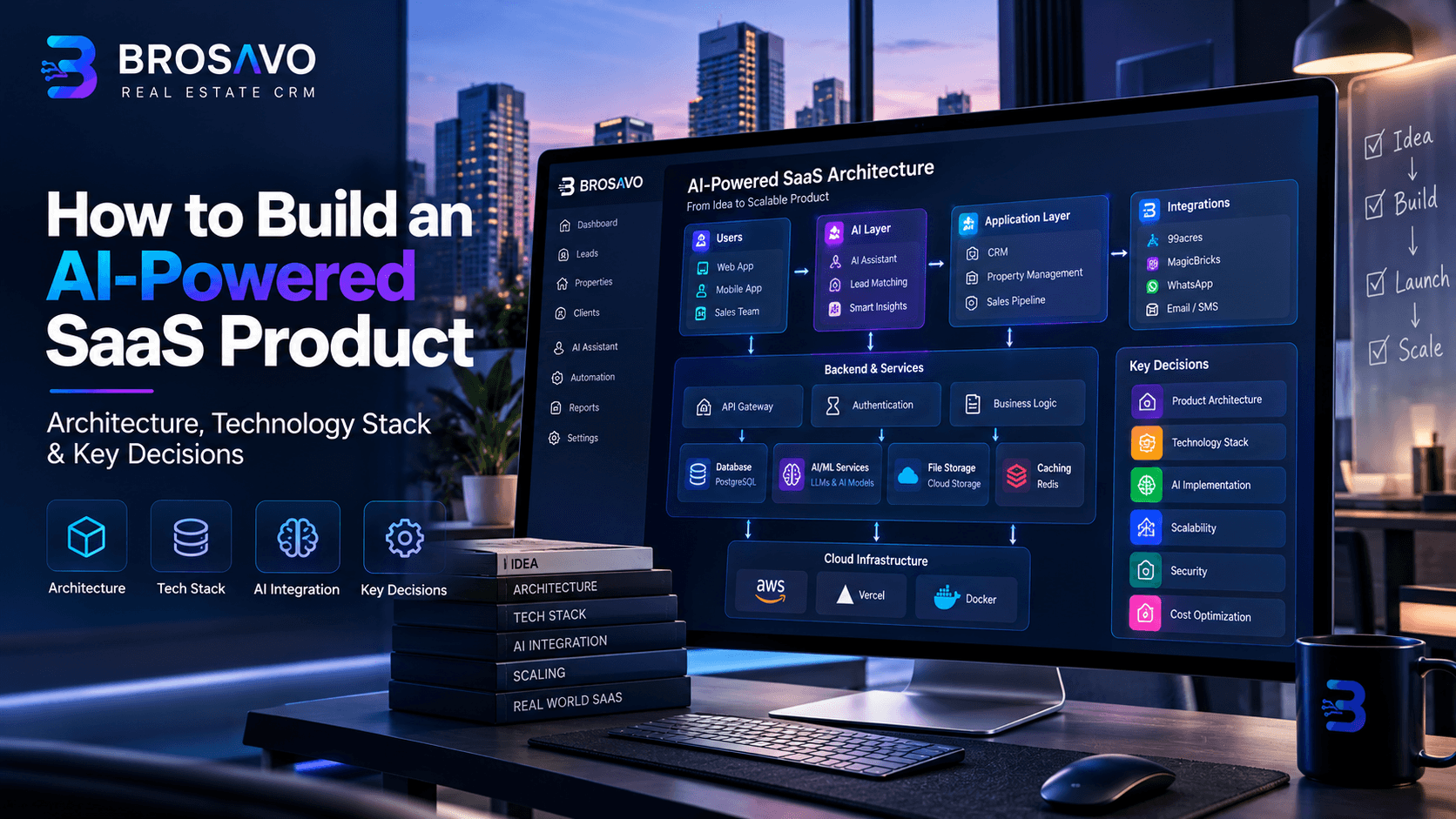
How to Build an AI-Powered SaaS Product: Architecture, Technology Stack & Key Decisions
Building a SaaS product involves much more than developing a website and deploying it to the cloud. A successful software-as-a-service platform must support multiple customers, protect sensitive data, deliver a consistent user experience, and remain reliable as usage increases.
Adding artificial intelligence introduces another layer of engineering decisions. Developers must consider model selection, inference costs, response times, data privacy, and how AI features interact with the rest of the application.
Whether you are building a business management platform, a customer relationship management system, or an AI-powered productivity application, the foundation remains the same: solve a real problem with software that can evolve alongside your customers.
In this guide, we explain the key architectural decisions, technologies, and development practices involved in building an AI-powered SaaS product.
1. Start With the Business Problem
Before choosing a programming language or AI model, identify the problem your product will solve.
A useful product concept should answer three questions:
- Who experiences the problem?
- How are they solving it today?
- What measurable improvement will your product deliver?
For example, a sales team might spend hours organising enquiries, preparing reports, and writing follow-up messages. A SaaS product could centralise customer information, automate repetitive workflows, and use AI to summarise interactions.
The goal is not to add the largest number of features. It is to create a solution that customers find valuable enough to adopt and continue using.
Start with a minimum viable product (MVP) containing the essential features needed to validate the idea. Expand functionality as you learn from actual usage.
2. Choose the Right SaaS Architecture
Architecture determines how your application handles customer data, business logic, integrations, and growing workloads.
Frontend application
The frontend provides the interface through which customers interact with your product.
Common choices include React, Next.js, Angular, and Vue.js. The right framework depends on your team's experience, rendering requirements, existing infrastructure, and product complexity.
A well-designed frontend should provide clear navigation, responsive layouts, accessible controls, and predictable application state.
Backend services
The backend handles business rules, authentication, permissions, data processing, and communication with external services.
Common technologies include Node.js with Express or NestJS, Python with FastAPI or Django, Java with Spring Boot, and C# with ASP.NET Core.
Choose a framework that fits the workload and your team's ability to maintain the application over time.
Database layer
The database stores information such as user accounts, customer records, subscriptions, transactions, and application settings.
Relational databases such as PostgreSQL and MySQL are suitable for many SaaS applications that require structured data and transactional consistency.
Document databases such as MongoDB can be useful when the data model benefits from flexible document structures.
Redis can support caching, rate limiting, and selected temporary data workloads.
The most important consideration is choosing a data model that supports the product's actual requirements rather than adopting technologies simply because they are popular.
3. Design for Multiple Customers From the Beginning
Multi-tenancy allows one SaaS application to serve multiple organisations while maintaining appropriate separation between their data and access permissions.
For example, a CRM platform might serve hundreds of businesses through the same application while ensuring each organisation can access only its own records.
Common approaches include:
Shared database and shared tables: Each tenant's records are associated with a tenant identifier. This can be cost-effective but requires strict tenant-scoped queries and access controls.
Shared database with separate schemas: Each tenant receives a separate database schema. This provides additional organisational separation but increases operational complexity.
Separate database per tenant: Each organisation has its own database. This can offer stronger isolation and customisation at the cost of additional infrastructure and maintenance.
There is no universally correct model. The decision depends on security requirements, customer expectations, operational costs, and scaling needs.
Regardless of the model, enforce tenant isolation on the server side. Never rely solely on frontend filtering to protect customer information.
4. Integrate AI Where It Creates Real Value
AI can improve a SaaS product by helping users process information, generate content, classify records, or interact with application data more efficiently.
Potential applications include:
- Summarising customer conversations.
- Classifying incoming support requests.
- Generating first drafts of emails and reports.
- Searching internal documents using natural-language queries.
- Extracting structured information from uploaded documents.
- Identifying patterns in historical business data.
The right implementation depends on the task.
Use hosted AI APIs when appropriate
Hosted model APIs can reduce the infrastructure and operational work required to introduce AI features. They may be a practical starting point for products that need to validate demand quickly.
However, consider request costs, latency, rate limits, data-handling policies, provider dependencies, and usage restrictions.
Consider self-hosted models when justified
Running models on your own infrastructure can provide greater control over deployment, model selection, and certain data-processing requirements.
However, self-hosting introduces responsibilities such as hardware provisioning, GPU memory management, model serving, monitoring, and performance optimisation.
It is not automatically cheaper or more private in every configuration.
Build AI features with appropriate safeguards
AI outputs can be incorrect, incomplete, or inconsistent. Design workflows that validate outputs, handle failures, and provide human review when necessary.
For actions involving payments, sensitive customer information, or important business decisions, use explicit permissions and deterministic business rules rather than allowing an AI model to operate without appropriate controls.
5. Select a Practical Technology Stack
A technology stack should reflect the product's requirements, team capabilities, expected traffic, and maintenance budget.
| Layer | Possible technologies | Primary purpose |
|---|---|---|
| Frontend | React, Next.js, Vue.js | User interface |
| Backend | Node.js, Python, Java, C# | Business logic and APIs |
| Database | PostgreSQL, MySQL, MongoDB | Persistent application data |
| Cache | Redis | Caching and selected temporary workloads |
| AI integration | Model APIs, self-hosted inference | AI-powered capabilities |
| Cloud infrastructure | AWS, Azure, Google Cloud | Hosting and managed services |
| Containers | Docker | Consistent application packaging |
| CI/CD | GitHub Actions, Jenkins | Automated testing and deployment |
| Monitoring | Application logs and observability tools | Reliability and troubleshooting |
You do not need every technology listed above.
For an early-stage product, a modular monolith with a well-structured backend can be easier to develop and maintain than a collection of microservices. Separate services when independent scaling, deployment, team ownership, or operational requirements justify the added complexity.
6. Build Security Into the Product
Security should be part of the initial design rather than a task left until launch.
Important considerations include:
- Secure authentication and session management.
- Role-based or permission-based access control.
- Server-side validation of user input.
- Encryption in transit and appropriate protection for stored data.
- Secure storage and rotation of API credentials.
- Rate limiting and abuse prevention.
- Tenant isolation and protection against insecure direct object references.
- Backups, recovery procedures, and audit logs where appropriate.
- Data retention policies and responsible handling of information sent to AI providers.
For AI-powered applications, also consider prompt injection, untrusted uploaded documents, accidental disclosure of confidential information, and unauthorised tool execution.
Security requirements vary by industry and jurisdiction. Products handling regulated or sensitive information may need additional technical and legal review.
7. Plan for Performance and Scalability
A SaaS platform should be designed to grow without requiring a complete rewrite every time customer usage increases.
Start by measuring actual application behaviour.
Useful metrics include API response times, database query performance, error rates, concurrent users, queue processing times, and infrastructure costs.
As demand increases, improvements might include:
- Adding database indexes and optimising expensive queries.
- Caching frequently accessed data.
- Moving long-running tasks into background queues.
- Using object storage for uploaded files.
- Scaling application instances horizontally.
- Separating workloads that have different performance requirements.
- Applying request limits to expensive AI operations.
AI workloads require additional monitoring. Track model latency, token usage, inference costs, failure rates, and the quality of generated results.
Optimise the bottlenecks that measurements reveal instead of adding infrastructure without evidence.
8. Treat Deployment and Monitoring as Core Features
Launching the application is only the beginning of operating a SaaS product.
A dependable deployment process should include automated tests, controlled releases, environment-specific configuration, database migration procedures, and a way to roll back problematic changes.
Use separate development, staging, and production environments where appropriate.
After launch, monitor application health and establish alerts for meaningful failures. Track customer-reported issues and review logs without unnecessarily exposing sensitive information.
For AI features, monitor not only technical availability but also whether the feature continues to produce useful results for customers.
Reliable operations help protect customer trust as the product grows.
9. Understand the Cost of Building an AI SaaS Product
Development cost is only one part of the total cost of ownership.
A realistic budget should account for:
- Product design and software development.
- Cloud hosting and database services.
- AI API usage or self-hosted inference infrastructure.
- Monitoring, security, and backups.
- Third-party integrations and subscriptions.
- Ongoing maintenance and customer support.
AI costs can vary substantially with model selection, input and output volume, context length, and traffic patterns.
Before building an expensive AI infrastructure, estimate usage under realistic scenarios and test the economics with a small workload.
Track the cost per customer or per completed task. This helps determine whether pricing and infrastructure remain sustainable as usage increases.
10. Measure Product Success After Launch
A technically impressive product is not necessarily a successful business.
Measure whether customers use the features, achieve the intended outcomes, and continue to find value in the platform.
Depending on the product, useful metrics include:
- Activation rate.
- Time to complete important tasks.
- Weekly or monthly active customers.
- Customer retention and churn.
- Conversion from trial to paid subscription.
- Support request volume.
- Infrastructure cost per customer.
- AI feature adoption and user satisfaction.
Use these insights to prioritise improvements. Customer feedback and actual product behaviour should guide the roadmap more than assumptions about which features sound impressive.
Conclusion
Building an AI-powered SaaS product requires a balance between product strategy, software architecture, security, AI integration, and operational discipline.
The strongest foundation is often a focused MVP, a maintainable architecture, a well-designed data model, secure multi-tenant access, and AI features that solve clearly defined problems.
As the product gains traction, monitoring, customer feedback, and measurable business outcomes should guide its evolution.
At BROSAVO Technologies, we believe technology should solve practical problems and create opportunities for sustainable growth. Whether you are planning a SaaS platform, integrating AI into an existing application, or building custom business software, thoughtful engineering decisions can help turn an idea into a product that is ready to evolve.
Planning your next software product?
Visit BROSAVO to explore our software development and technology solutions.
Frequently Asked Questions
How long does it take to build an AI-powered SaaS product?
The timeline depends on product complexity, integrations, security requirements, team size, and the AI capabilities involved. A focused MVP generally takes less time than a mature platform with extensive integrations and enterprise requirements.
Which programming language is best for AI SaaS development?
There is no single best language. TypeScript and JavaScript work well for many full-stack web applications, while Python offers a broad ecosystem for AI and machine learning. Java and C# are also strong choices for many enterprise applications.
Should an AI SaaS product use microservices?
Not necessarily. A modular monolith is often a practical starting point for a new product. Microservices may become appropriate when independent scaling, deployment, or organisational requirements justify their additional operational overhead.
Is self-hosting an AI model better than using an API?
It depends on expected usage, performance requirements, data policies, infrastructure expertise, and total cost. Hosted APIs simplify operations, while self-hosting can provide more deployment control but requires ongoing infrastructure management.
What is the most important consideration when building a multi-tenant SaaS?
Tenant isolation is fundamental. Every request, database operation, and background process must enforce the correct access boundaries so one organisation cannot access another organisation's data.
Transform Your Real Estate Business with Brosavo
Brosavo Real Estate CRM helps real estate professionals capture leads, automate follow-ups, manage properties, organize customer relationships, and streamline their daily operations from one modern platform.

Written by
Govind Dhall
Founder & Product Engineer at Brosavo
Govind Dhall is the Founder of Brosavo and a software engineer with 6+ years of experience building CRM platforms, SaaS products, and enterprise applications. He specializes in real estate technology, automation, AI-powered workflows, and scalable cloud infrastructure, helping agencies streamline operations and increase sales.
Related posts
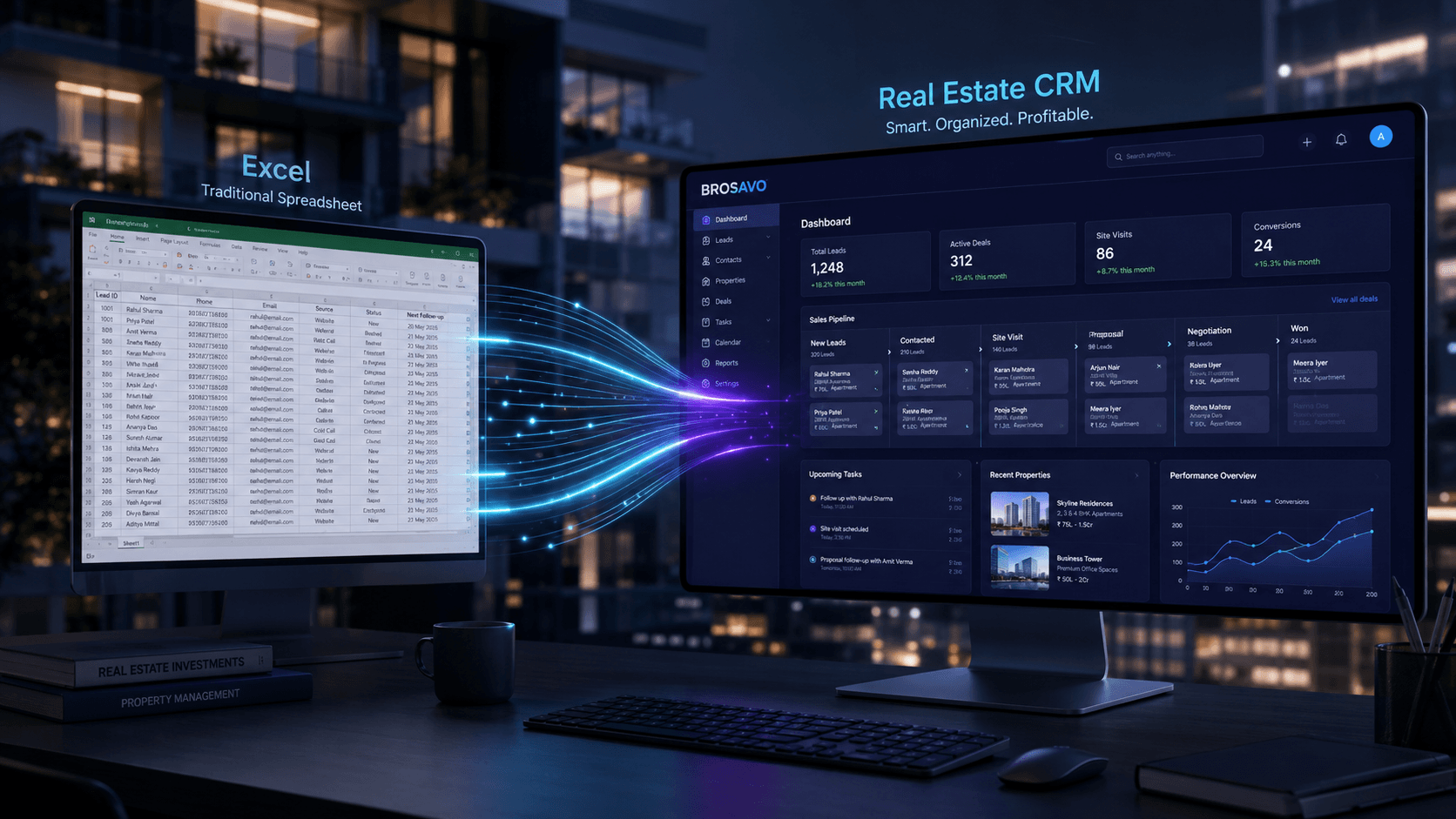
Real Estate CRM vs Excel: Which Is Better for Managing Property Leads?
Compare real estate CRM vs Excel for managing property leads, customers, follow-ups, properties and sales pipelines, and see when CRM makes sense.
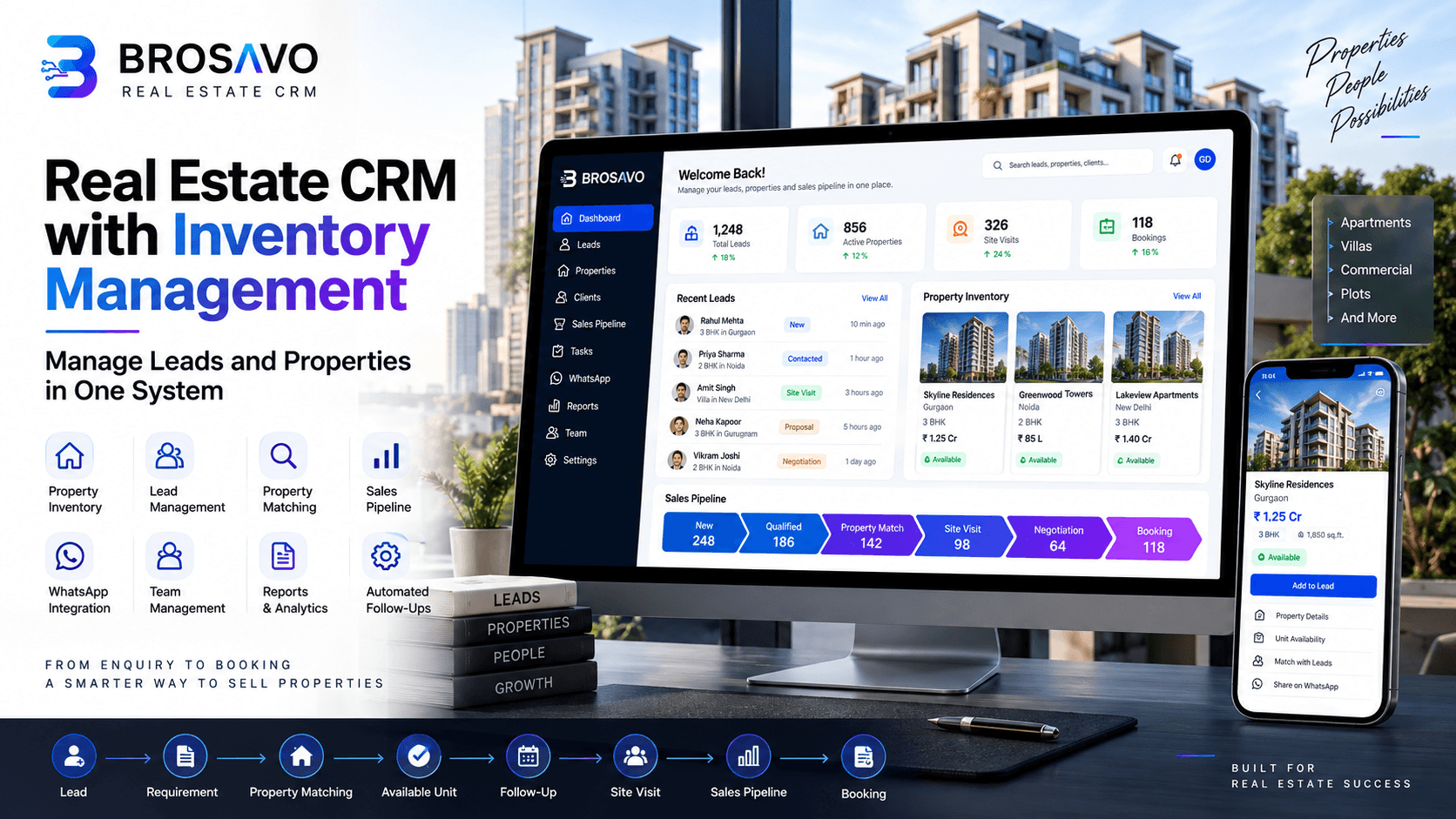
Real Estate CRM with Inventory Management: Manage Leads and Properties in One System
Manage real estate leads and property inventory in one CRM. Learn how BROSAVO connects requirements, property matching, follow-ups and sales.
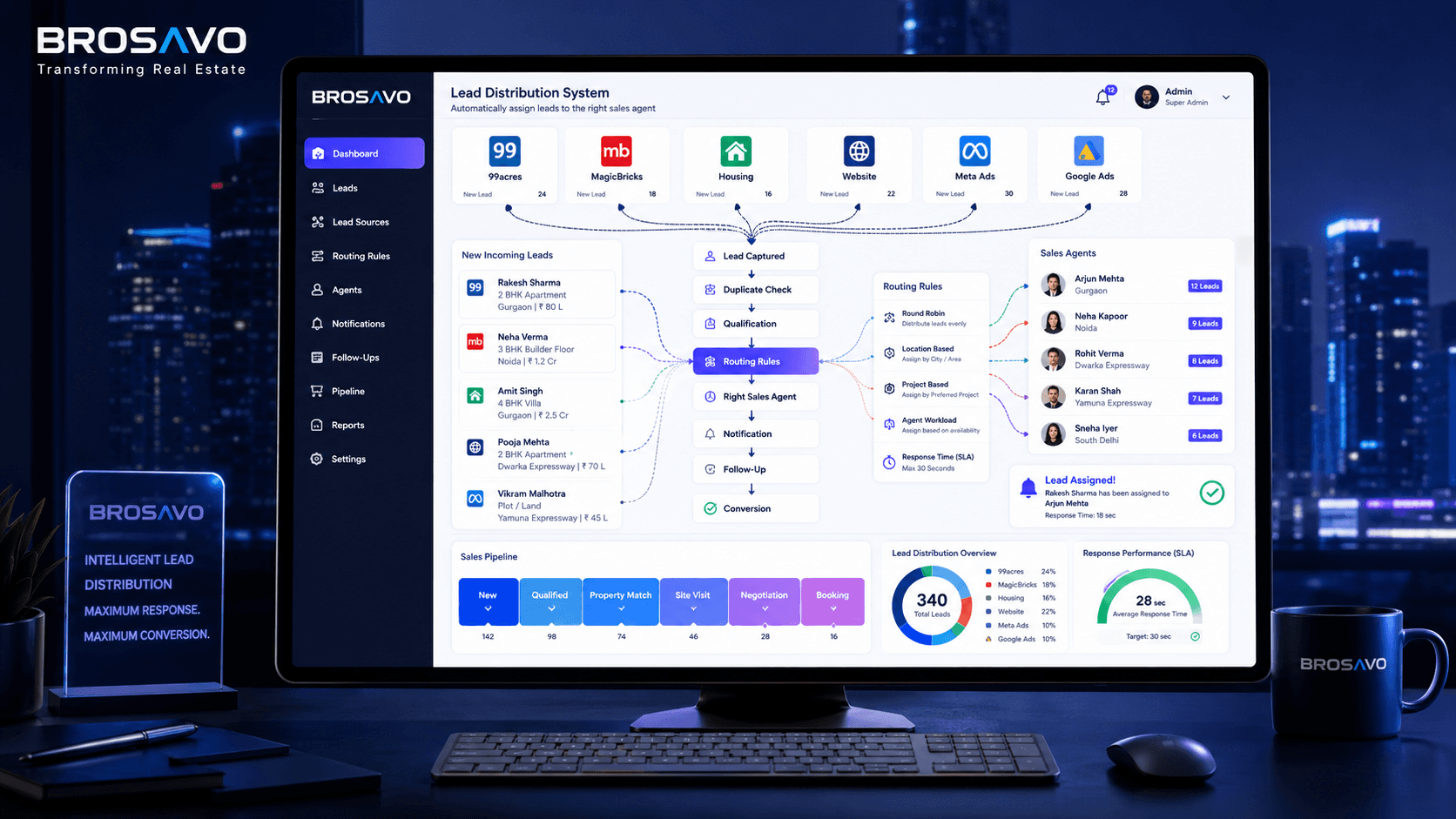
Real Estate Lead Distribution Software: Automatically Assign Leads to the Right Sales Agent
Learn how real estate lead distribution software assigns leads from portals, websites and ads to the right agents using routing rules, SLAs and follow-ups.