Real Estate Lead Distribution Software: Automatically Assign Leads to the Right Sales Agent
Learn how real estate lead distribution software assigns leads from portals, websites and ads to the right agents using routing rules, SLAs and follow-ups.
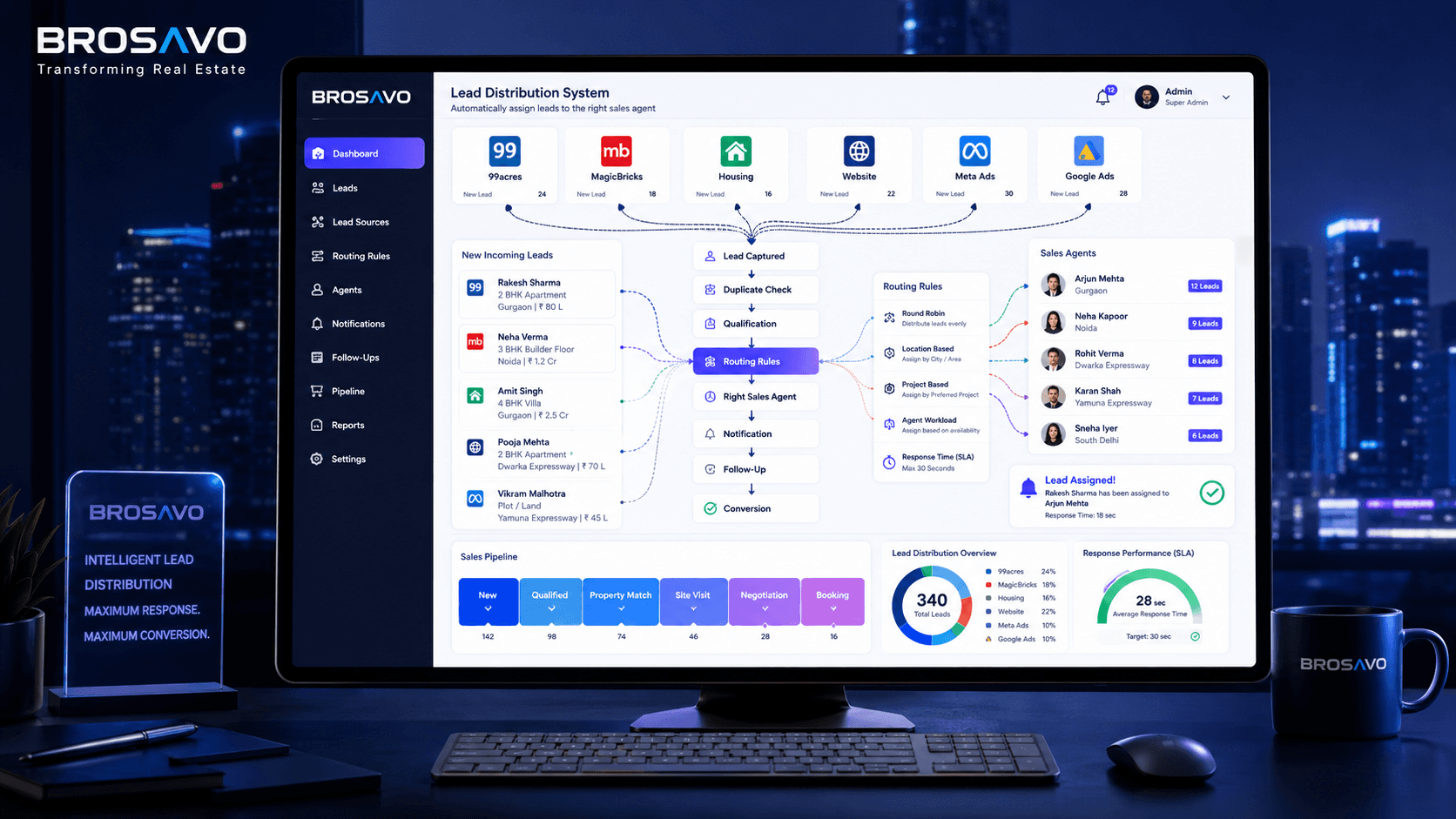
Real Estate Lead Distribution Software: Automatically Assign Leads to the Right Sales Agent
Real estate businesses can generate enquiries from many different channels.
A buyer may enquire through 99acres, MagicBricks, Housing, a company website, Meta Ads, Google Ads, social media, referrals or a direct enquiry.
The challenge is not simply generating these leads.
The challenge is making sure every enquiry reaches the right sales agent at the right time.
If leads are manually assigned through spreadsheets, WhatsApp messages or internal chats, several problems can appear:
- Leads may remain unassigned.
- Two agents may contact the same customer.
- The wrong salesperson may receive a lead.
- High-value project enquiries may reach an unsuitable team.
- Leads from specific locations may go to agents unfamiliar with that market.
- Managers may not know who is responsible for a lead.
- Delayed responses can result in lost opportunities.
This is where real estate lead distribution software becomes useful.
A structured lead-routing workflow can look like this:
Lead Source → Lead Captured → Duplicate Check → Qualification → Routing Rules → Agent Assignment → Notification → Response SLA → Follow-Up → Conversion
The goal is simple:
Get every lead to the right salesperson with a clear next action.
What Is Real Estate Lead Distribution Software?
Real estate lead distribution software is a system used to capture, organize and assign property enquiries to the appropriate salespeople or teams.
Instead of manually deciding who should handle every new enquiry, businesses can define rules for distributing leads.
For example:
New Lead
    ↓
Identify Source
    ↓
Check Duplicate
    ↓
Qualify Lead
    ↓
Apply Routing Rules
    ↓
Assign Sales Agent
    ↓
Notify Agent
    ↓
Track Response
    ↓
Follow Up
    ↓
Sales Pipeline
The routing rules can be based on the way the business operates.
Common factors include:
- Lead source
- Location
- Project
- Property type
- Customer requirement
- Sales territory
- Agent specialization
- Team
- Lead priority
The exact routing capabilities depend on the software and its configuration.
Why Lead Distribution Matters in Real Estate
Real estate leads can lose value when there is a long delay between enquiry and salesperson response.
Consider a simple example.
A buyer submits an enquiry for a property.
If the lead immediately reaches an available salesperson, the agent can begin understanding the customer's requirement.
If the lead sits in an email inbox or spreadsheet for several hours, the opportunity may become harder to recover.
Lead distribution therefore focuses on one important operational question:
Who should handle this lead?
A good routing process makes that answer clear.
Where Real Estate Leads Come From
A modern real estate business can receive leads from many channels.
99acres
Property enquiries may originate from listings promoted on 99acres.
The CRM should retain the source so the sales team knows where the enquiry originated.
MagicBricks
MagicBricks can generate enquiries from property listings and other real estate advertising activity.
Those enquiries can be brought into the broader lead-management process through the available supported intake method.
Housing
Housing can also generate enquiries for property listings.
As with other portals, the important step is bringing the enquiry into a consistent sales workflow where possible.
Website
A real estate website can generate enquiries through:
- Contact forms
- Property enquiry forms
- Callback requests
- Landing pages
- Project pages
Website enquiries can be routed using the same lead-assignment rules as portal enquiries.
Meta Ads
Real estate campaigns on Meta platforms can generate leads through advertising and lead-generation campaigns.
These leads may require routing based on:
- Campaign
- Project
- Location
- Property type
- Sales team
Google Ads
Search campaigns can generate high-intent enquiries for specific properties, projects or locations.
For example:
Google Ads
     ↓
3 BHK Apartment Campaign
     ↓
New Lead
     ↓
Gurugram Sales Team
Routing the lead according to the campaign or project can help keep the enquiry with the appropriate team.
The Real Estate Lead Distribution Workflow
A strong lead-routing process should go beyond simply assigning a name to a lead.
A more complete workflow is:
Capture → Duplicate Check → Qualification → Routing → Assignment → Notification → Response → Follow-Up → Conversion
Let's examine each stage.
1. Capture the Lead
The first step is getting the enquiry into the lead-management system.
Potential sources include:
- 99acres
- MagicBricks
- Housing
- Website
- Meta Ads
- Google Ads
- Social media
- Referrals
- Phone enquiries
- Manual entry
Every lead should ideally retain its original source.
For example:
Lead:
Rahul Sharma

Source:
99acres

Property:
3 BHK Apartment

Location:
Gurugram
Source information becomes useful later when measuring lead quality and sales performance.
2. Check for Duplicate Leads
Before assigning a new enquiry, the system should check whether the customer already exists.
A customer might submit enquiries through multiple channels:
Rahul Sharma
    ↓
99acres
    ↓
Website
    ↓
Google Ads
Without duplicate checking, the same customer could potentially become multiple separate records.
Useful fields for identifying possible duplicates can include:
- Phone number
- Name
- Existing customer record
- Property enquiry
Duplicate handling should be designed according to the business's data model and CRM capabilities.
3. Qualify the Lead
The next step is understanding what the customer wants.
Useful qualification information can include:
- Preferred location
- Property type
- Budget
- Number of bedrooms
- Property size
- Preferred project
- Purchase timeline
- Investment or personal-use requirement
For example:
Customer:
Rahul Sharma

Requirement:
3 BHK

Location:
Gurugram

Budget:
₹1.2–1.5 Cr

Timeline:
Within 3 months
This information can then be used by the sales team and, where supported, by lead-routing rules.
4. Apply Lead Routing Rules
This is the core of lead distribution.
Instead of assigning every lead randomly, businesses can define routing rules.
For example:
IF Project = Project A
→ Assign to Project A Team

IF Location = Noida
→ Assign to Noida Team

IF Lead Source = Website
→ Assign according to website routing rule

IF Property Type = Commercial
→ Assign to Commercial Sales Team
The exact rules depend on the organization's structure.
The principle is:
Use business context to decide who should own the lead.
5. Automatically Assign the Lead
Once the routing rule identifies the appropriate team or salesperson, the lead can be assigned.
For example:
New Lead
   ↓
Location = Noida
   ↓
Noida Sales Team
   ↓
Available Agent
   ↓
Lead Assigned
Automatic assignment can reduce the need for managers to manually distribute every enquiry.
However, businesses should define what happens when an agent is unavailable, has reached capacity or is outside the required territory.
Round-Robin Lead Distribution
One common approach is round-robin lead assignment.
Suppose a team contains four agents:
Agent A
Agent B
Agent C
Agent D
New leads can be distributed sequentially:
Lead 1 → Agent A
Lead 2 → Agent B
Lead 3 → Agent C
Lead 4 → Agent D
Lead 5 → Agent A
This can help distribute enquiries more evenly.
However, pure round-robin assignment is not always the best approach.
A business may have agents specializing in:
- Different locations
- Different projects
- Residential properties
- Commercial properties
- Luxury properties
- Different customer segments
In those situations, rule-based routing may be more appropriate than simple round-robin assignment.
Lead Distribution by Project
Property developers and larger real estate businesses may sell multiple projects.
Each project can have a dedicated sales team.
For example:
Lead
 ↓
Interested Project
 ↓
Project A
 ↓
Project A Sales Team
This prevents project-specific enquiries from being distributed randomly across the entire organization.
Lead Distribution by Location
Location-based routing is another common approach.
For example:
Delhi
 → Delhi Sales Team

Noida
 → Noida Sales Team

Gurugram
 → Gurugram Sales Team

Mumbai
 → Mumbai Sales Team
This can be useful for businesses with geographically organized teams.
Lead Distribution by Lead Source
Businesses may also route leads according to their source.
For example:
99acres
 → Portal Lead Team

Website
 → Inside Sales Team

Google Ads
 → Digital Lead Team

Referral
 → Senior Sales Team
This is only an example.
The correct structure depends on the company's sales organization.
Lead Distribution by Property Type
Property type can also influence assignment.
For example:
Residential
 → Residential Team

Commercial
 → Commercial Team

Plots
 → Plot Sales Team
This approach can be useful when salespeople have different areas of expertise.
Combining Multiple Routing Rules
Real-world lead distribution can become more sophisticated when several conditions are combined.
For example:
Lead Source = Google Ads
        +
Location = Gurugram
        +
Property Type = Residential
        ↓
Gurugram Residential Sales Team
Another example:
Project = Project A
        +
Budget > Defined Threshold
        ↓
Senior Project Sales Team
The exact logic should reflect the business's actual sales structure.
The goal is not to create the most complicated routing system.
The goal is to create a routing system that is predictable, understandable and easy to maintain.
Agent Notification
Assigning the lead is only one part of the process.
The salesperson also needs to know that a new enquiry has been assigned to them.
A notification workflow can communicate information such as:
New Lead Assigned

Customer:
Rahul Sharma

Source:
99acres

Property:
3 BHK Apartment

Location:
Gurugram

Budget:
₹1.2–1.5 Cr

Next Action:
Contact Customer
The available notification channels depend on the CRM implementation.
The important point is that the salesperson should have enough context to take the next action.
Response-Time SLA for Real Estate Leads
Lead distribution becomes much more useful when businesses define expectations for responding to new enquiries.
This is where a response-time SLA can help.
An SLA can define an internal target such as:
New leads should receive an initial response within the company's defined response window.
The actual target should be based on the business's staffing, lead volume and sales process.
The CRM can then help managers monitor whether leads are being acted upon within that expected window.
What Happens If an Agent Does Not Respond?
Lead assignment alone does not guarantee action.
A salesperson might be:
- On another call
- Away from work
- Busy with a site visit
- On leave
- Unable to contact the customer
A more advanced routing workflow can therefore include escalation.
For example:
Lead Assigned
      ↓
Response Timer Starts
      ↓
Agent Responds?
   ↙        ↘
 YES         NO
 ↓            ↓
Continue      Escalate
              ↓
        Manager / Backup Agent
This can help prevent new enquiries from remaining unattended.
Whether automatic escalation is available depends on the CRM and workflow configuration.
Lead Distribution vs Lead Management
These two concepts are related but different.
Lead Distribution
Answers:
Who should receive the lead?
Lead Management
Answers:
What happens after the lead is received?
A complete workflow needs both.
Lead Distribution
        ↓
Correct Agent
        ↓
Lead Management
        ↓
Qualification
        ↓
Property Matching
        ↓
Follow-Up
        ↓
Site Visit
        ↓
Negotiation
        ↓
Closing
This is why lead routing works best when it is part of a broader CRM rather than an isolated assignment tool.
Why Manual Lead Distribution Creates Problems
Many small and growing real estate teams start with manual assignment.
A manager may receive new enquiries and send them through:
- WhatsApp groups
- Spreadsheets
- Phone calls
- Internal chats
This can work temporarily.
But as lead volume increases, several issues can appear.
Leads Can Remain Unassigned
A new enquiry may sit in an inbox waiting for someone to notice it.
Managers Become a Bottleneck
The manager has to decide who receives every new lead.
Assignment Can Become Inconsistent
Two similar leads may be assigned using completely different criteria.
Agents May Receive Uneven Lead Volumes
Some salespeople may receive significantly more enquiries than others.
Reporting Becomes Difficult
Management may struggle to determine:
- How many leads were assigned?
- Who received them?
- How quickly were they contacted?
- Which sources generated the opportunities?
- How many became site visits?
- How many converted?
A structured lead distribution system addresses these operational challenges.
Real Estate Lead Distribution Software vs Excel
Excel can maintain a list of leads.
However, lead distribution involves more than maintaining a list.
| Requirement | Excel | Lead Distribution + CRM |
|---|---|---|
| Store leads | Yes | Yes |
| Record source | Manual | Structured |
| Assign agents | Manual | Rule-based workflow |
| Round-robin | Manual | Can be automated where supported |
| Project routing | Manual | Rule-based where supported |
| Location routing | Manual | Rule-based where supported |
| Response tracking | Manual | CRM workflow |
| Follow-ups | Manual | Structured |
| Sales pipeline | Manual | Connected |
| Management visibility | Limited | Centralized |
Excel can still be useful for simple operational tasks.
The difference becomes significant when lead volume, team size and routing complexity increase.
Lead Distribution Metrics to Track
A lead-routing system should not only distribute enquiries.
It should also help businesses understand what happens afterward.
Useful metrics include:
Leads Received
How many enquiries were generated?
Leads Assigned
How many enquiries were successfully assigned?
Unassigned Leads
Are any enquiries waiting for an owner?
Response Time
How quickly are agents contacting new leads?
Contact Rate
How many assigned leads were successfully contacted?
Qualification Rate
How many leads met the business's qualification criteria?
Site Visit Rate
How many qualified leads progressed to a site visit?
Conversion Rate
How many opportunities progressed to a successful outcome?
Source Performance
How do different lead sources perform?
For example:
Source
  ↓
Leads
  ↓
Qualified
  ↓
Site Visits
  ↓
Opportunities
  ↓
Closed
This provides more useful information than simply counting enquiries.
How to Design a Real Estate Lead Routing Strategy
Before implementing software, define the business rules.
Start with these questions:
1. What are your lead sources?
List every major source:
- 99acres
- MagicBricks
- Housing
- Website
- Meta Ads
- Google Ads
- Referrals
- Other sources
2. Who should receive each type of lead?
Define the responsible team or agent.
3. Do you need location-based routing?
If you operate across multiple cities or territories, location may determine ownership.
4. Do you need project-based routing?
Developers may need to route leads directly to project-specific teams.
5. Do agents have different specializations?
Consider residential, commercial, luxury or other segments.
6. Do you want round-robin distribution?
If agents have similar responsibilities, round-robin may help distribute leads evenly.
7. What is your response-time expectation?
Define an internal target for contacting new leads.
8. What happens when an agent does not respond?
Define a backup or escalation process.
9. What happens with duplicates?
Decide whether duplicate enquiries should be merged, linked or assigned to an existing owner.
10. How will performance be measured?
Track the metrics that matter to your sales process.
A Complete Real Estate Lead Distribution Workflow
Putting everything together:
99acres
MagicBricks
Housing
Website
Meta Ads
Google Ads
Other Sources
       ↓
  Lead Captured
       ↓
  Duplicate Check
       ↓
 Lead Qualification
       ↓
  Routing Rules
       ↓
 ┌───────────────┐
 │ Project       │
 │ Location      │
 │ Source        │
 │ Property Type │
 │ Team          │
 └───────────────┘
       ↓
 Agent Assignment
       ↓
 Agent Notification
       ↓
 Response-Time SLA
       ↓
 Agent Responds?
    ↙       ↘
  Yes        No
   ↓          ↓
Follow-Up   Escalation
   ↓          ↓
Property Matching
       ↓
   Site Visit
       ↓
  Sales Pipeline
       ↓
   Conversion
This is the fundamental architecture behind an effective real estate lead-routing process.
Why BROSAVO?
BROSAVO is built around the broader real estate sales workflow rather than treating lead assignment as an isolated activity.
Its core workflow connects:
Lead Management + Property Inventory + Property Matching + Sales Pipeline + Team Management
A real estate business can structure its lead process around:
Lead
 ↓
Requirement
 ↓
Assignment
 ↓
Property Matching
 ↓
Follow-Up
 ↓
Site Visit
 ↓
Sales Pipeline
 ↓
Booking
This provides a foundation for organizing enquiries from different channels within one sales workflow.
For businesses receiving leads from portals, websites and marketing campaigns, the important objective is to maintain a clear relationship between:
Lead → Agent → Requirement → Property → Opportunity
BROSAVO can help real estate teams organize this information and give sales managers greater visibility into the sales process.
The exact automation, routing and notification capabilities depend on the configured BROSAVO workflow.
Frequently Asked Questions
What is real estate lead distribution software?
Real estate lead distribution software is a system that helps capture property enquiries and assign them to the appropriate salesperson or team using predefined rules.
Rules can be based on factors such as source, location, project, property type, team or other business requirements.
How does real estate lead routing work?
A typical process is:
Lead Capture → Duplicate Check → Qualification → Routing Rules → Agent Assignment → Notification → Follow-Up
The routing rules determine which salesperson or team should receive the enquiry.
Can leads from 99acres, MagicBricks and Housing be distributed automatically?
They can be routed automatically when the leads are available to the CRM through a supported integration or intake method.
The exact availability of direct integration depends on the property portal account, supported lead-delivery mechanisms and CRM implementation.
What is round-robin lead distribution?
Round-robin distribution assigns leads sequentially across a group of salespeople.
For example:
Lead 1 → Agent A
Lead 2 → Agent B
Lead 3 → Agent C
Lead 4 → Agent D
Lead 5 → Agent A
It can help distribute leads more evenly when agents have similar responsibilities.
Can real estate leads be assigned based on location?
Yes, location can be used as a routing rule where the CRM supports rule-based assignment.
For example, leads for one city or territory can be assigned to the corresponding sales team.
Can leads be assigned based on project?
Yes, project-based routing can be useful for developers or businesses selling multiple projects.
A lead interested in a particular project can be directed to the team responsible for that project.
What is a lead response-time SLA?
A lead response-time SLA is an internal target defining how quickly a salesperson should respond to a new enquiry.
The target should be determined by the business based on its sales process and operational capacity.
What happens when a sales agent does not respond to a lead?
A business can define an escalation workflow in which an unattended lead is flagged or reassigned according to predefined rules.
The exact automation depends on the CRM platform and configuration.
Is lead distribution the same as lead management?
No.
Lead distribution determines who receives a lead.
Lead management covers what happens after the lead is received, including qualification, follow-ups, property matching, site visits and sales pipeline management.
The two processes work best together.
Is lead distribution software better than Excel?
Excel can work for basic lead lists and manual assignment.
A dedicated CRM-based workflow becomes more useful when a business needs automated or structured assignment, multiple lead sources, follow-up tracking, sales pipelines and team visibility.
How can I prevent duplicate leads?
Use customer information such as phone number, email and existing customer records to identify potential duplicates.
The exact duplicate-detection and merging capabilities depend on the CRM.
Can BROSAVO automatically assign every real estate lead?
BROSAVO can provide the CRM structure for organizing leads, sales teams, properties and opportunities.
The exact automatic routing, round-robin, escalation and notification workflows depend on the configured implementation.
Businesses should define their desired routing rules before implementing automation.
Conclusion
Generating real estate leads is only the beginning.
The next question is:
Who should handle each enquiry?
A structured lead distribution process connects incoming enquiries with the salespeople responsible for converting them.
The workflow can be:
99acres / MagicBricks / Housing / Website / Meta Ads / Google Ads
↓
Lead Captured
↓
Duplicate Check
↓
Qualification
↓
Routing Rules
↓
Agent Assignment
↓
Notification
↓
Response-Time SLA
↓
Follow-Up
↓
Property Matching
↓
Site Visit
↓
Sales Pipeline
↓
Conversion
The most effective lead distribution strategy is not necessarily the most complicated one.
It is the one that consistently gets the right lead to the right salesperson, gives that salesperson the information needed to act, and provides management with visibility into what happens next.
For growing real estate businesses, connecting lead distribution with CRM, property inventory and sales pipeline management creates a more structured path from first enquiry to potential sale.
BROSAVO brings these core real estate sales workflows together to help businesses manage leads, properties, teams and opportunities in one system.
Recommended internal links for this article:
Real Estate CRM→/real-estate-crmReal Estate Lead Management→/real-estate-lead-managementReal Estate CRM with Inventory Management→/real-estate-crm-with-inventory-managementReal Estate Sales CRM→/real-estate-sales-crmReal Estate CRM for Agents→/real-estate-crm-for-agentsReal Estate CRM for Brokers→/real-estate-crm-for-brokersHow to Manage 99acres, MagicBricks & Housing Leads in a CRM→/manage-99acres-magicbricks-housing-leads-crm
Important SEO distinction: keep this article focused on lead distribution/routing, while your previous article focuses on managing portal leads. That gives BROSAVO two separate commercial search intents instead of creating another generic CRM article.
Transform Your Real Estate Business with Brosavo
Brosavo Real Estate CRM helps real estate professionals capture leads, automate follow-ups, manage properties, organize customer relationships, and streamline their daily operations from one modern platform.

Written by
Brosavo Editorial Team
Research & Content Team
The Brosavo Editorial Team publishes in-depth guides, industry research, software comparisons, and best practices for real estate professionals. Every article is reviewed for accuracy and updated regularly to reflect the latest trends in the real estate industry.
Related posts
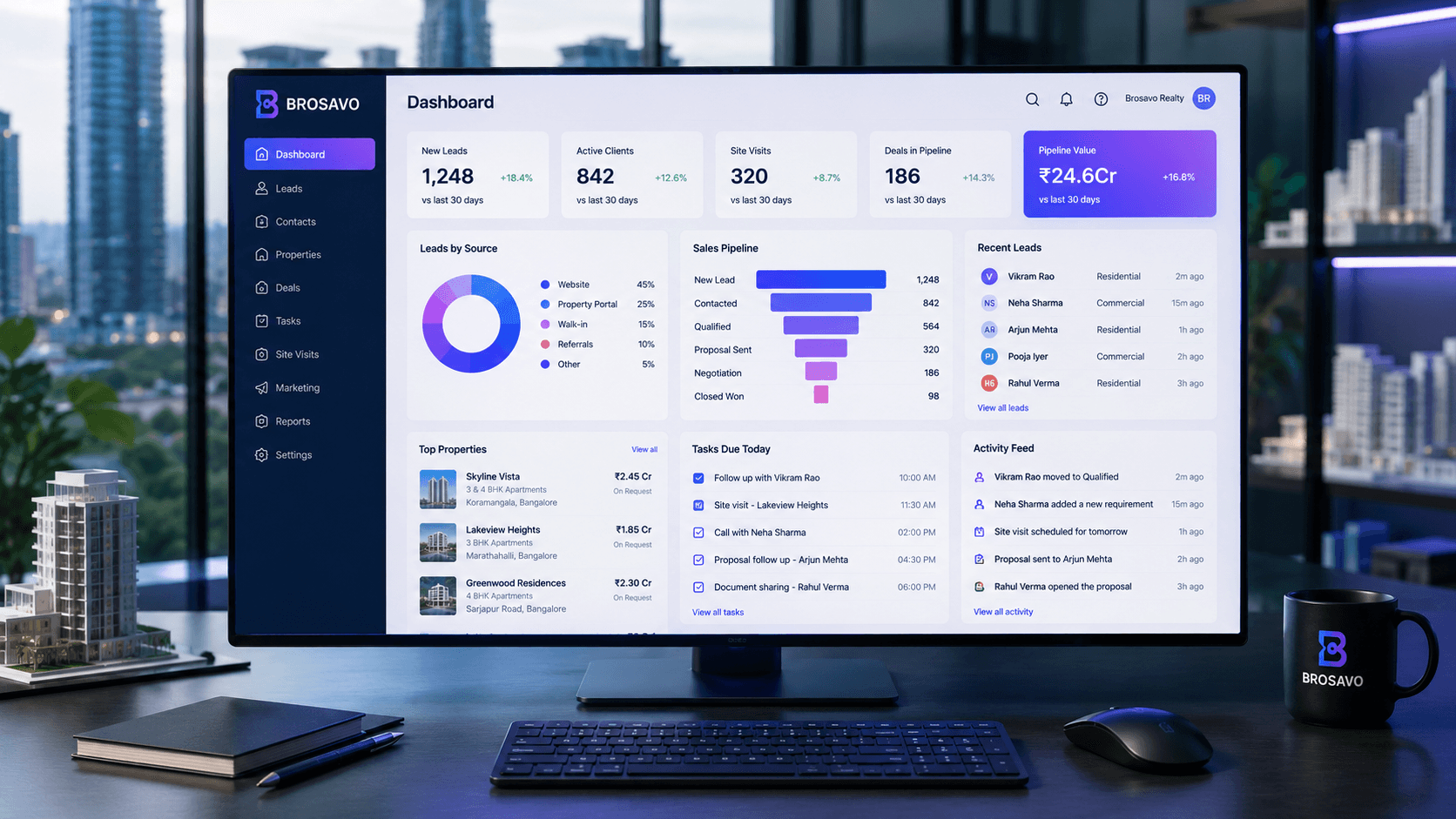
Real Estate CRM Software | Brosavo Real Estate CRM
Brosavo Real Estate CRM helps agents, brokers and sales teams manage leads, customers, properties, follow-ups and real estate sales pipelines.
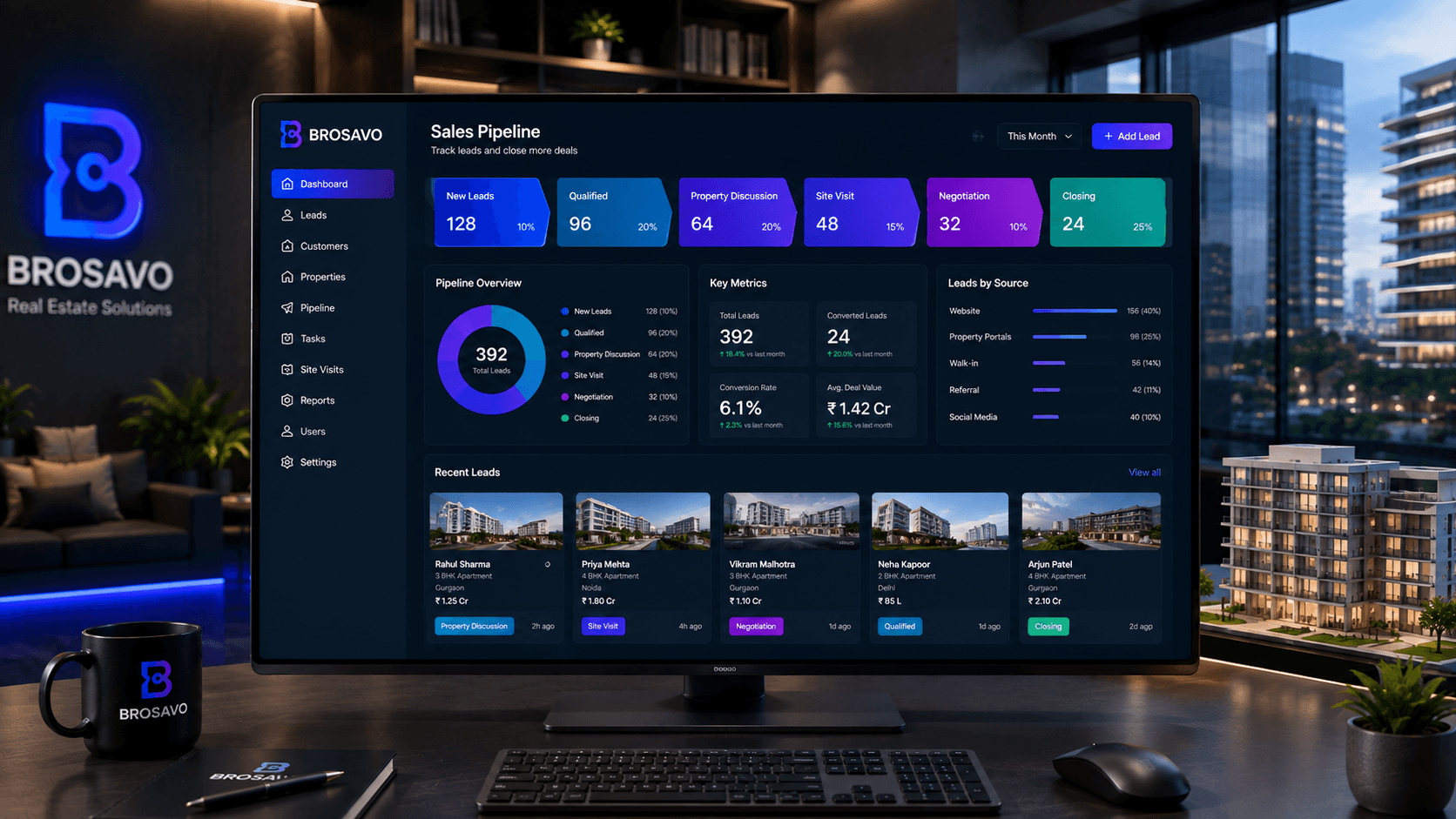
Real Estate Sales CRM: Manage Leads, Follow-Ups & Property Sales
Real estate sales CRM software for managing property leads, qualification, follow-ups, sales pipelines, site visits and customer relationships in one system.
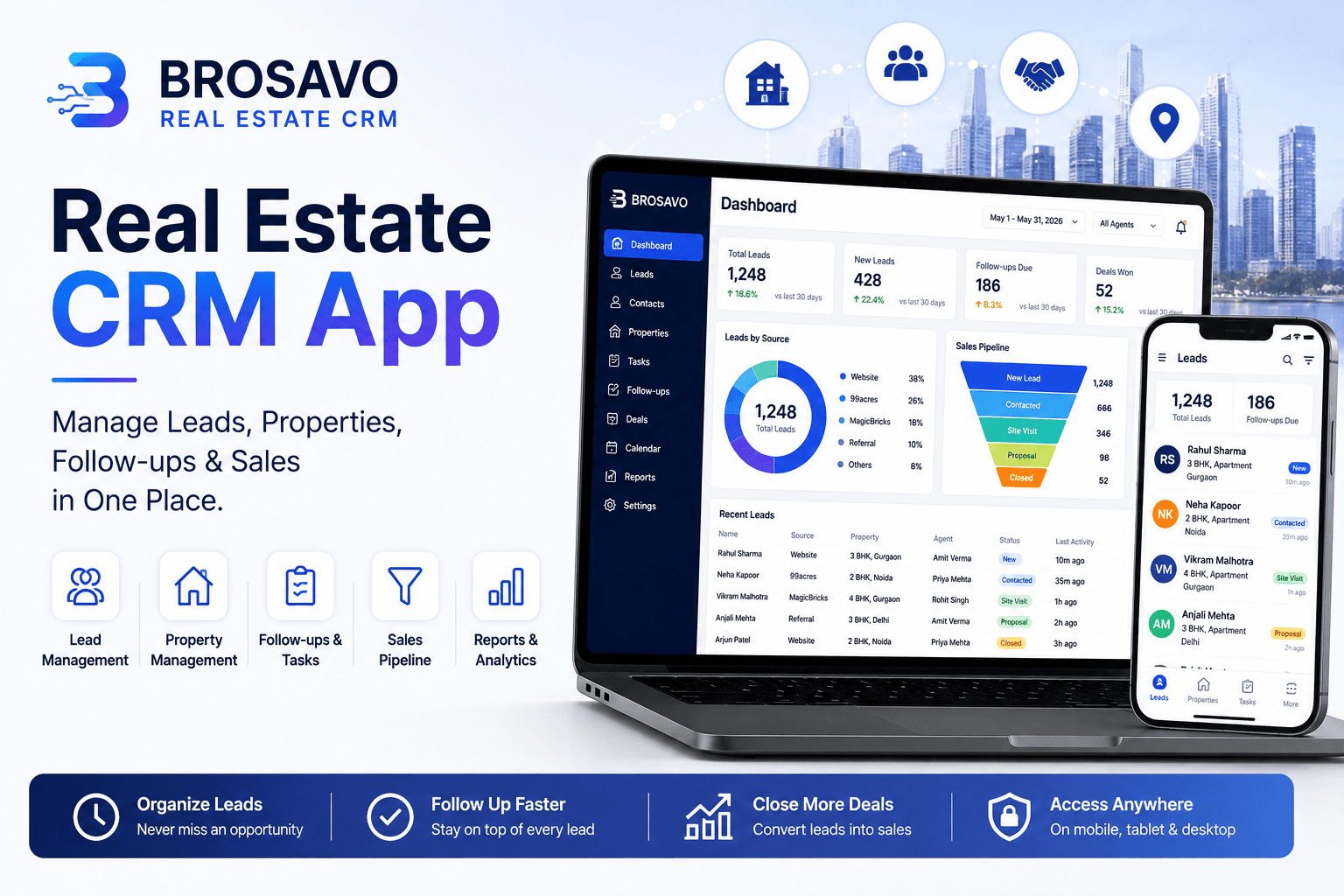
Real Estate CRM App: Manage Leads, Properties, Follow-Ups & Sales in One Place
Looking for a real estate CRM app? Discover how BROSAVO helps agents, brokers and teams manage leads, properties, follow-ups and sales.