Real Estate CRM App: Manage Leads, Properties, Follow-Ups & Sales in One Place
Looking for a real estate CRM app? Discover how BROSAVO helps agents, brokers and teams manage leads, properties, follow-ups and sales.
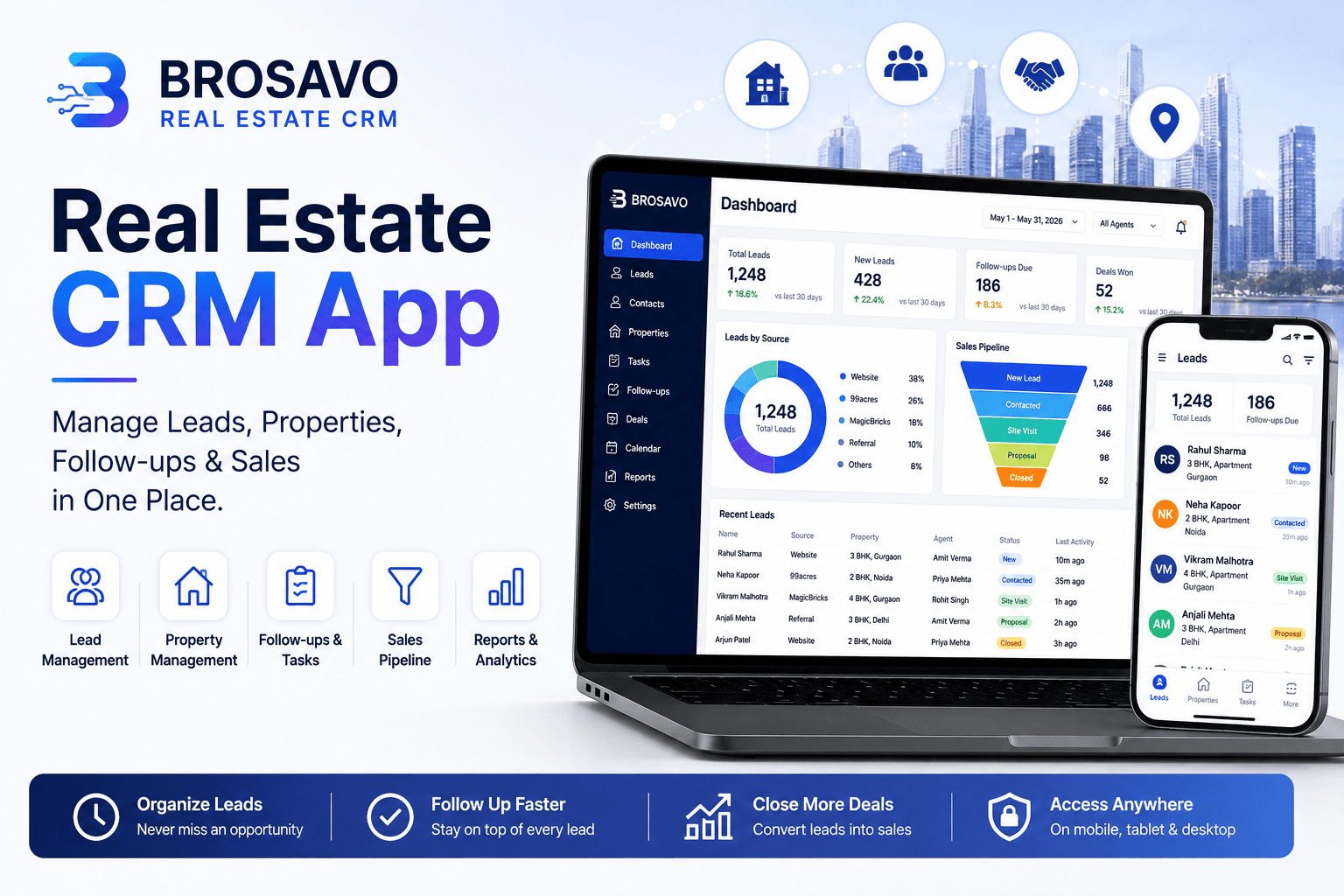
Real Estate CRM App: Manage Leads, Properties, Follow-Ups & Sales in One Place
Real estate businesses deal with a constant flow of leads, customer enquiries, property requirements, follow-ups, site visits and sales opportunities. Managing all of this through spreadsheets, notebooks, messaging applications and disconnected tools can quickly become difficult.
A real estate CRM app gives agents, brokers and real estate teams a centralized way to organize their customer and sales information.
BROSAVO Real Estate CRM is built specifically for real estate businesses that need a structured system for managing leads, customers, properties, follow-ups and sales workflows.
Instead of keeping important information scattered across different places, a real estate CRM brings the sales process into one organized platform.
What Is a Real Estate CRM App?
A real estate CRM app is software designed to help real estate professionals manage leads, customers, property-related information, follow-ups and sales activities from a centralized system.
Unlike a general-purpose CRM, a real estate CRM is designed around the way property businesses work.
A typical real estate workflow may look like:
Lead → Qualification → Property Requirement → Follow-Up → Property Discussion → Site Visit → Negotiation → Closing
The exact workflow can vary between agents, brokers, developers and agencies, but the goal remains the same: keep customer information and sales activity organized throughout the process.
BROSAVO focuses on this real estate-specific workflow.
Why Do Real Estate Agents Need a CRM App?
Real estate agents often manage many enquiries simultaneously.
A lead might contact an agent today, request property details tomorrow, schedule a site visit later in the week and return several weeks later when they are ready to purchase.
Without a structured system, it can become easy to lose track of what happened.
Common problems include:
- Leads stored in spreadsheets
- Customer information spread across different applications
- Forgotten follow-ups
- Difficulty remembering previous conversations
- No clear view of active opportunities
- Property information stored separately from customer requirements
- Difficulty understanding which leads need attention
- Limited visibility into the sales pipeline
A CRM provides a centralized workspace for managing these activities.
Why BROSAVO Is Built for Real Estate
BROSAVO is a technology company building software for real estate businesses.
BROSAVO Real Estate CRM focuses on the specific needs of property sales teams rather than treating real estate as just another CRM industry.
The platform is designed around areas such as:
- Real estate lead management
- Customer management
- Property-related workflows
- Follow-up management
- Sales pipeline organization
- Real estate sales activities
- Team visibility
This makes BROSAVO particularly relevant for professionals who want a CRM designed around property sales workflows.
How Does a Real Estate CRM App Work?
A real estate CRM app typically centralizes information that would otherwise be managed through several different tools.
A simplified workflow looks like this:
1. Lead
A potential customer enters the sales process.
The lead becomes a record that the sales team can manage rather than an enquiry that exists only in a message, spreadsheet or notebook.
2. Qualification
The agent or sales team understands the customer's requirements.
For example, the team may need to understand:
- Property type
- Location preference
- Budget
- Purchase requirements
- Timeline
- Other relevant requirements
3. Property Requirement
The customer's requirement can be connected with relevant property information.
This helps the sales team focus on suitable opportunities instead of treating every enquiry the same way.
4. Follow-Up
The sales team can keep track of follow-up activities and continue the conversation with the customer.
This is especially important in real estate because property purchases often involve multiple interactions before a decision is made.
5. Site Visit
When applicable to the business workflow, a site visit can become another step in the sales process.
6. Negotiation
Once a customer shows serious interest, the opportunity can progress toward negotiation and the next sales stage.
7. Closing
The final objective is to convert the opportunity into a successful property transaction.
A CRM helps provide visibility throughout this journey.
Real Estate Lead Management in BROSAVO
Lead management is one of the most important reasons to use a real estate CRM app.
Instead of allowing enquiries to remain scattered across different places, BROSAVO is designed to give real estate businesses a structured way to manage their leads.
A centralized lead workflow can help teams understand:
- Which leads are new
- Which leads require follow-up
- Which opportunities are progressing
- Which customers have shown property interest
- Which opportunities are active
- Which leads may require additional attention
The objective is simple:
Turn more organized lead information into better sales activity.
Manage Customer Information in One Place
Real estate sales depend heavily on customer relationships.
A customer may interact with an agent multiple times before purchasing a property.
Keeping customer information organized allows the sales team to maintain continuity throughout the relationship.
A CRM can provide a centralized place for relevant customer information and sales activity instead of relying on memory or disconnected notes.
With BROSAVO, the objective is to make customer management part of the overall real estate sales workflow.
Manage Property Information Alongside Leads
A real estate CRM becomes more useful when property information and customer requirements can be considered together.
For example:
Customer: Looking for a residential property in a specific location and budget range.
Instead of searching through separate spreadsheets or property lists every time, the sales workflow can be organized around the customer's requirement and relevant property opportunities.
This makes the CRM more closely aligned with how property sales actually happen.
Keep Real Estate Follow-Ups Organized
Follow-up is one of the most important activities in real estate sales.
A lead that is not ready today may become a serious buyer later.
For this reason, real estate businesses need a structured approach to follow-ups.
A CRM can help teams keep track of sales activities instead of depending entirely on memory.
BROSAVO is designed to help real estate businesses organize their sales workflow so that follow-up activity becomes part of the CRM process.
Real Estate Sales Pipeline
A sales pipeline gives a real estate business a clearer view of its opportunities.
Instead of looking at a long list of contacts, teams can think about opportunities according to their current stage.
For example:
New Lead
↓
Qualified
↓
Property Requirement
↓
Follow-Up
↓
Site Visit
↓
Negotiation
↓
Closing
The exact stages should reflect the actual workflow of the business.
The benefit is visibility.
Sales teams can better understand where opportunities are progressing and where additional attention may be required.
BROSAVO for Individual Real Estate Agents
An individual agent may not have a large sales team, but they can still have dozens or hundreds of customer interactions.
For an individual agent, a CRM can help replace fragmented spreadsheets and notes with a more structured system.
BROSAVO can be relevant for agents who want to organize:
- Leads
- Customers
- Property enquiries
- Follow-ups
- Sales opportunities
- Property-related information
The goal is to give an individual agent a clearer picture of their sales activity.
BROSAVO for Real Estate Teams
The need for organization becomes even greater when multiple people are involved in sales.
A team may have:
- Multiple agents
- Multiple lead sources
- Multiple properties
- Multiple customer conversations
- Multiple active sales opportunities
Without centralized visibility, managers can struggle to understand what is happening across the team.
A CRM provides a shared system for organizing sales information and monitoring the broader pipeline.
Real Estate CRM App vs Spreadsheets
Spreadsheets can be useful when a real estate business is very small.
However, as lead volume and sales activity increase, spreadsheets can become harder to manage.
| Spreadsheets | Real Estate CRM |
|---|---|
| Data stored in rows and columns | Structured customer and sales records |
| Manual organization | CRM-based workflow |
| Limited sales visibility | Pipeline visibility |
| Follow-ups can be forgotten | Follow-up activity can be organized |
| Property information may be separate | Property workflows can be connected |
| Difficult to scale across teams | Designed for team workflows |
The right choice depends on the size and requirements of the business.
For businesses actively managing a growing number of leads and opportunities, a dedicated CRM can provide a more structured environment.
What Should You Look for in a Real Estate CRM App?
Before choosing a CRM, real estate businesses should evaluate the actual workflow rather than choosing a platform based only on the number of features.
Important areas include:
Lead Management
Can the system organize and track real estate enquiries?
Customer Management
Can customer information and sales activity be managed centrally?
Property Workflows
Can the CRM support the way your business manages property information?
Follow-Ups
Can your team keep track of important sales activities?
Sales Pipeline
Can managers see where opportunities are in the sales process?
Team Management
Can multiple salespeople work within the same system?
Reporting
Can the business understand its sales activity and pipeline?
Scalability
Can the platform continue to support the business as its lead volume and team grow?
Who Should Use a Real Estate CRM App?
A dedicated real estate CRM can be useful for:
- Individual real estate agents
- Realtors
- Property consultants
- Real estate brokers
- Brokerage teams
- Real estate agencies
- Builders
- Developers
- Property sales teams
- Channel partner teams
The exact CRM requirements will differ depending on the business model.
An individual agent may prioritize lead and follow-up management, while a brokerage may need stronger team and pipeline visibility.
What Makes BROSAVO Different?
BROSAVO is not positioned simply as a generic CRM with a real estate label.
The product is being built around real estate business workflows.
That means the central relationship is:
BROSAVO → Real Estate CRM → Leads → Customers → Properties → Sales
This focus allows the platform to address the operational problems that real estate professionals encounter when managing property enquiries and sales opportunities.
BROSAVO's broader technology focus also means the CRM can sit within a larger software ecosystem for real estate businesses.
Is BROSAVO a Good Real Estate CRM App for Small Businesses?
A CRM can be useful even for a small real estate business if the business regularly manages multiple leads, customers and property opportunities.
For a small team, the primary benefit is organization.
Instead of managing customer information across spreadsheets, notes and disconnected tools, the business can work toward maintaining a centralized sales workflow.
BROSAVO is designed for real estate professionals who want this structured approach.
Frequently Asked Questions
What is a real estate CRM app?
A real estate CRM app is software designed to help property professionals manage leads, customers, property-related information, follow-ups and sales opportunities from a centralized system.
What is the best real estate CRM app?
The best CRM depends on the business's requirements, team size, workflow and budget. A good real estate CRM should support the core activities that the business actually performs, including lead management, customer management, follow-ups and sales pipeline management.
BROSAVO is designed specifically around real estate workflows and is an option for businesses looking for a dedicated real estate CRM.
Do individual real estate agents need a CRM?
An individual agent can benefit from a CRM when they manage a significant number of leads, customers, properties and follow-ups. A centralized system can reduce dependence on spreadsheets, notes and memory.
Can a real estate CRM manage property leads?
Yes. A real estate CRM is designed to organize property enquiries and connect them with customer and sales information. The exact capabilities depend on the CRM platform.
Can a CRM help real estate agents manage follow-ups?
Yes. Follow-up management is one of the primary reasons real estate professionals use CRM software. A structured CRM workflow can help agents keep track of sales activity and customer interactions.
Is a real estate CRM better than Excel?
For very small operations, Excel may be sufficient. As the number of leads, customers, properties and team members grows, a dedicated CRM can provide more structured workflows and better sales visibility.
Can brokers use a real estate CRM?
Yes. Brokers can use CRM software to organize leads, customers, sales opportunities and team activity. A brokerage generally has more complex requirements than an individual agent, so team and pipeline visibility become increasingly important.
What should a real estate CRM include?
A real estate CRM should generally provide capabilities relevant to the business's workflow, such as lead management, customer management, follow-up organization, property-related workflows, sales pipeline management and reporting.
Why choose a real estate-specific CRM?
A real estate-specific CRM is designed around property sales workflows rather than generic customer relationships. This can make the system more relevant to agents, brokers, developers and property sales teams.
What is BROSAVO Real Estate CRM?
BROSAVO Real Estate CRM is a CRM platform designed for real estate businesses. It focuses on organizing leads, customers, property-related workflows, follow-ups and sales activities.
Final Thoughts
A real estate CRM app can become the central system that connects lead management, customer relationships, property information and sales activities.
For an individual agent, it can provide better organization.
For a brokerage, it can provide greater visibility across the sales pipeline.
For a developer or property sales team, it can provide a structured way to manage customer enquiries and property sales workflows.
The important consideration is not simply whether a CRM has a long list of features.
The important question is:
Does the CRM fit the way your real estate business actually sells property?
BROSAVO is built with that principle in mind.
BROSAVO Real Estate CRM brings real estate leads, customers, property workflows and sales activities together in one system.
If you are looking for a dedicated real estate CRM app, explore BROSAVO and see how it can fit your sales workflow.
Explore BROSAVO Real Estate CRM
Transform Your Real Estate Business with Brosavo
Brosavo Real Estate CRM helps real estate professionals capture leads, automate follow-ups, manage properties, organize customer relationships, and streamline their daily operations from one modern platform.

Written by
Govind Dhall
Founder & Product Engineer at Brosavo
Govind Dhall is the Founder of Brosavo and a software engineer with 6+ years of experience building CRM platforms, SaaS products, and enterprise applications. He specializes in real estate technology, automation, AI-powered workflows, and scalable cloud infrastructure, helping agencies streamline operations and increase sales.
Related posts
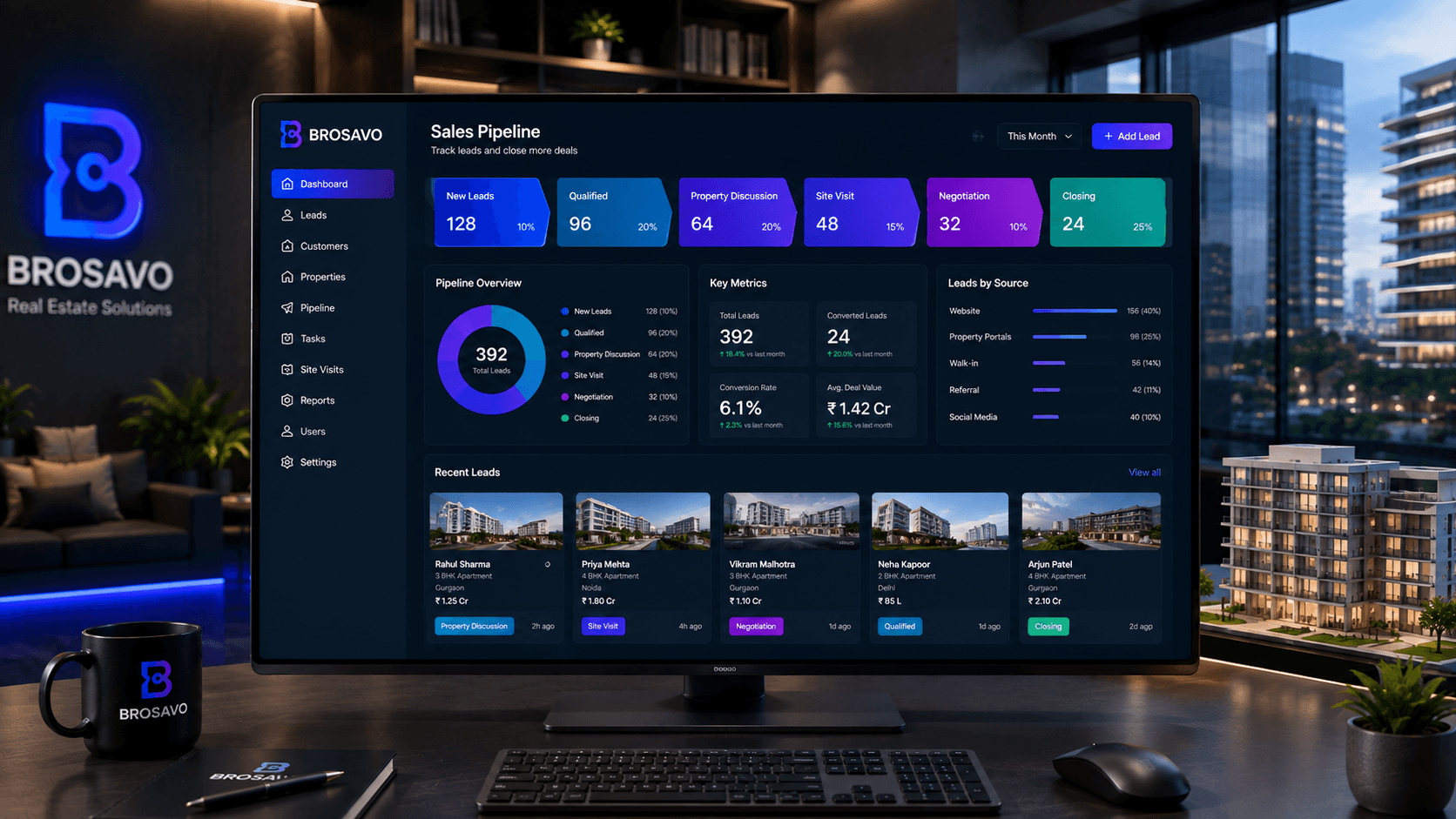
Real Estate Sales CRM: Manage Leads, Follow-Ups & Property Sales
Real estate sales CRM software for managing property leads, qualification, follow-ups, sales pipelines, site visits and customer relationships in one system.

Real Estate CRM vs Excel: Which Is Better for Managing Property Leads?
Compare real estate CRM vs Excel for managing property leads, customers, follow-ups, properties and sales pipelines, and see when CRM makes sense.
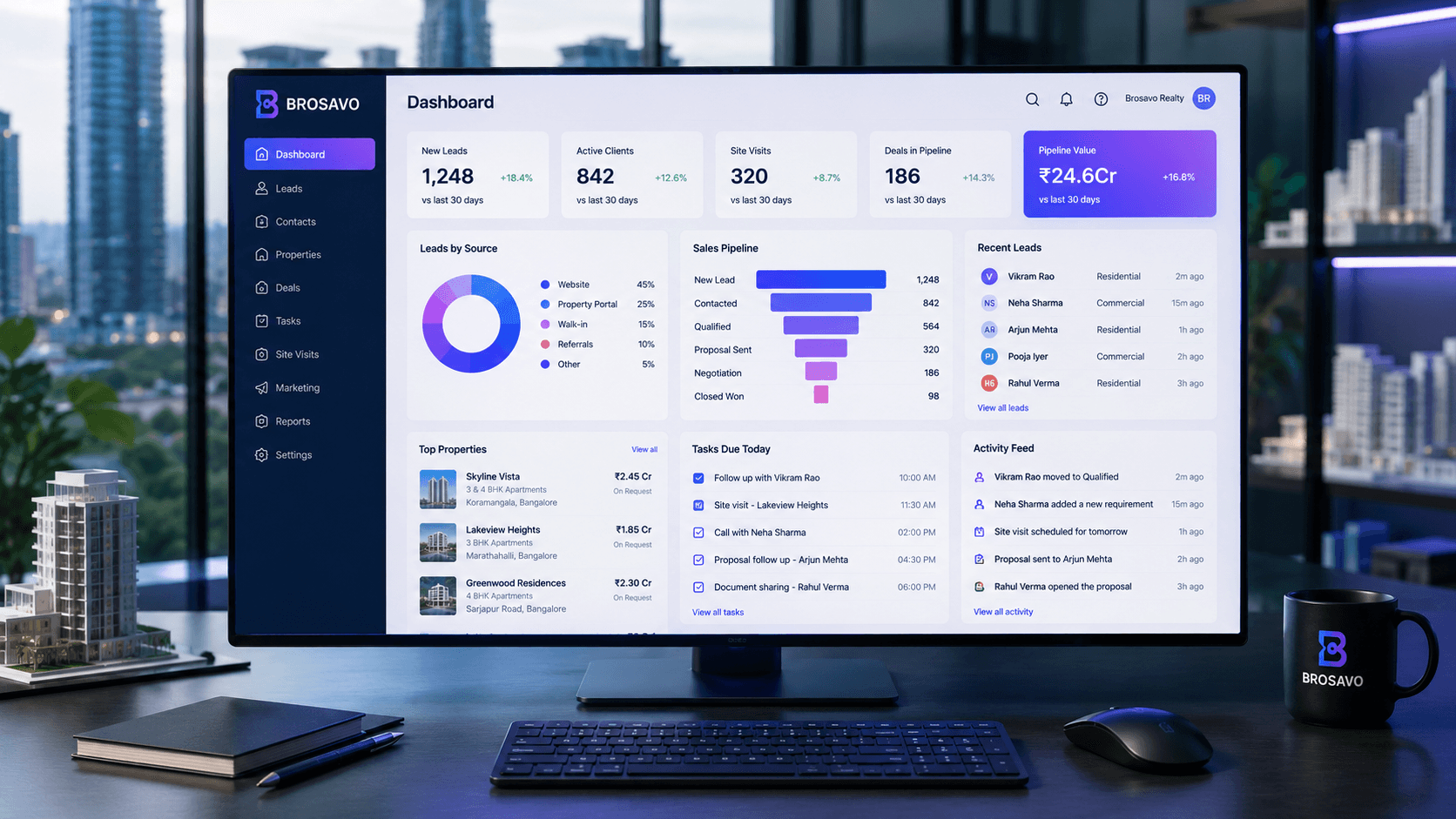
Real Estate CRM Software | Brosavo Real Estate CRM
Brosavo Real Estate CRM helps agents, brokers and sales teams manage leads, customers, properties, follow-ups and real estate sales pipelines.