How to Convert More Real Estate Leads Using a CRM
Learn how to convert more real estate leads using CRM software to organize enquiries, follow-ups, property requirements and sales opportunities.
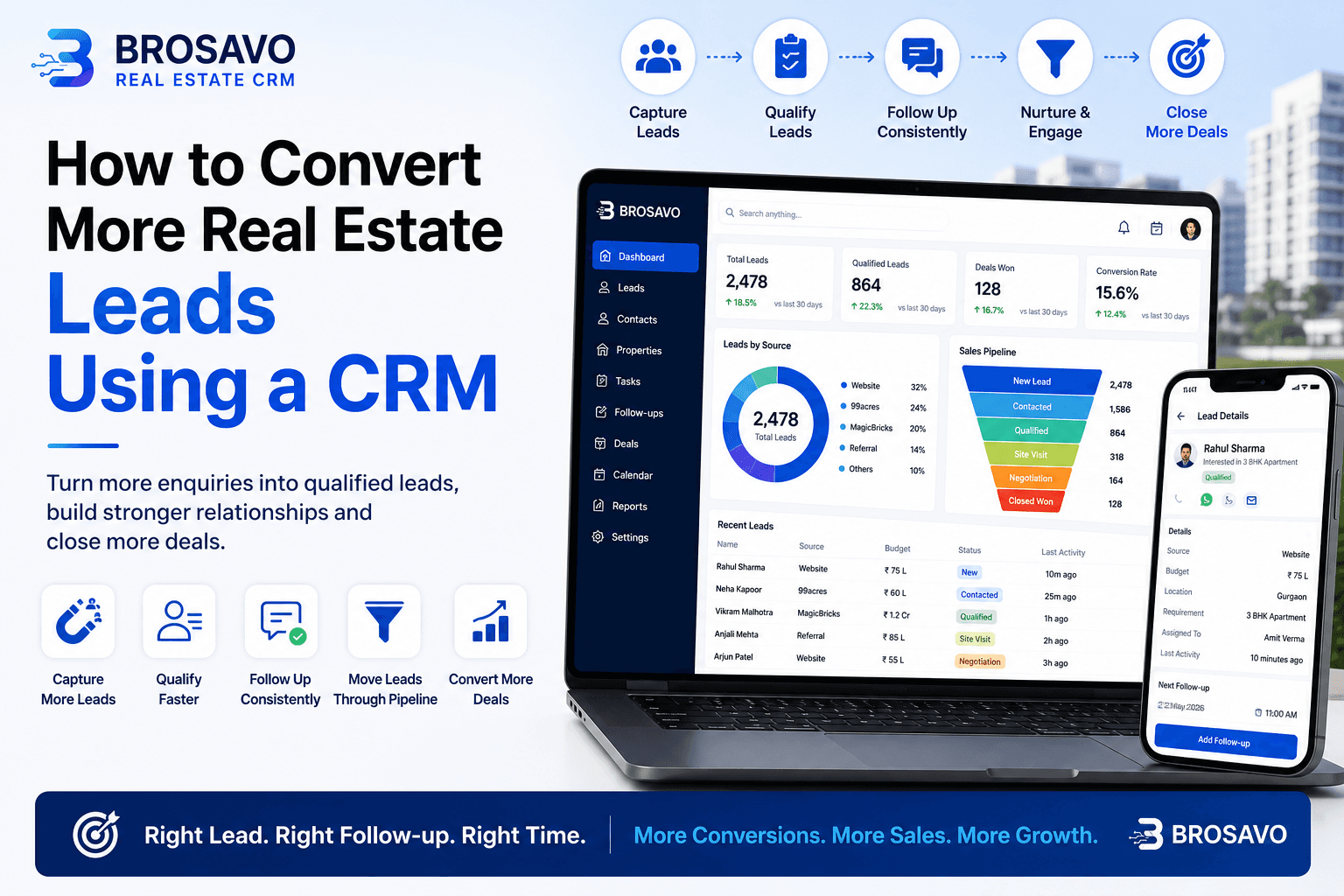
How to Convert More Real Estate Leads Using a CRM
Generating real estate leads is only the beginning of the sales process. The bigger challenge is turning those enquiries into meaningful conversations, property discussions, site visits and eventually sales.
Real estate businesses often manage leads through spreadsheets, phone calls, messaging applications, notebooks and multiple disconnected tools. As the number of enquiries increases, keeping track of every customer and follow-up becomes increasingly difficult.
A real estate CRM gives agents, brokers and sales teams a structured way to manage leads throughout the customer journey.
BROSAVO Real Estate CRM is designed around real estate workflows, helping businesses organize leads, customers, property-related information, follow-ups and sales opportunities in one system.
What Is Real Estate Lead Conversion?
Real estate lead conversion is the process of moving a potential customer from an initial enquiry toward a meaningful sales outcome.
A typical journey can look like:
Lead → Qualification → Requirement Understanding → Property Matching → Follow-Up → Site Visit → Negotiation → Closing
Not every lead will move through every stage, and the timeline can vary significantly between customers.
The purpose of a CRM is not to guarantee conversion.
Instead, it helps the sales team organize the information and activities required to manage opportunities more effectively.
Why Do Real Estate Leads Get Lost?
Real estate leads can be difficult to manage when information is scattered across different systems.
Common problems include:
- Leads stored in spreadsheets
- Enquiries coming from multiple sources
- Customer information stored in different places
- Missed or delayed follow-ups
- Difficulty remembering previous interactions
- No clear view of active opportunities
- Property requirements not being organized
- Limited visibility into the sales pipeline
- Multiple team members handling customers without centralized information
When these problems increase, the sales team can spend more time searching for information and less time engaging with customers.
A CRM provides a centralized structure for managing this information.
How Can a CRM Help Convert More Real Estate Leads?
A CRM can support lead conversion by organizing the activities that happen between the first enquiry and the eventual sales outcome.
The process can be broken into several important stages.
1. Capture and Organize New Leads
The first step is making sure new enquiries become organized records.
Instead of treating every enquiry as an isolated phone call or message, a CRM can provide a central place for managing lead information.
This gives the sales team a clearer starting point.
With BROSAVO, real estate businesses can organize their lead management process around the needs of their sales workflow.
The objective is simple:
Every important enquiry should have a place in the sales process.
2. Qualify Real Estate Leads
Not every lead has the same requirements.
One customer may be looking for a residential property, while another may be interested in commercial property.
Customers may also have different:
- Locations
- Budgets
- Property requirements
- Timelines
- Purchase objectives
Lead qualification helps salespeople understand what the customer actually needs.
This makes it easier to focus sales activity on relevant opportunities.
3. Understand the Customer's Property Requirement
Property sales are different from many other types of sales because the product has specific characteristics.
Customers may care about:
- Location
- Property type
- Size
- Budget
- Configuration
- Project
- Availability
- Other personal requirements
A structured CRM helps sales teams keep relevant customer information organized.
This becomes especially useful when the same customer interacts with the business multiple times.
4. Match Customers With Relevant Properties
Once the requirement is understood, the next step is identifying suitable property opportunities.
A property CRM workflow can help sales teams organize property information alongside customer requirements.
For example:
Customer requirement
3 BHK residential property in Gurugram within a specific budget.
The salesperson can then focus the conversation on properties that are relevant to that requirement.
The quality of the property recommendation still depends on the information available and the salesperson's understanding of the customer's needs.
5. Follow Up Consistently
Follow-up is one of the most important parts of real estate sales.
A customer who is not ready today may become ready weeks or months later.
Without a structured system, follow-ups can depend heavily on individual memory.
A CRM can help organize sales activities and customer information so that the team has a clearer understanding of which opportunities require attention.
The goal is not simply to follow up more.
The goal is to follow up more consistently and with better context.
6. Keep Customer History Organized
Real estate customers may have multiple conversations with the sales team.
A customer might:
- Submit an enquiry.
- Discuss their requirements.
- Ask for property information.
- Consider different options.
- Schedule a site visit.
- Return with additional questions.
- Continue discussions before making a decision.
If the information from these interactions is scattered, the salesperson may need to repeatedly ask the customer for information they have already provided.
A centralized CRM helps keep relevant customer and sales information organized.
7. Manage the Real Estate Sales Pipeline
A sales pipeline provides visibility into where opportunities currently stand.
A real estate pipeline may include stages such as:
New Lead
    ↓
Qualified
    ↓
Requirement Understanding
    ↓
Property Matching
    ↓
Follow-Up
    ↓
Site Visit
    ↓
Negotiation
    ↓
Closing
Transform Your Real Estate Business with Brosavo
Brosavo Real Estate CRM helps real estate professionals capture leads, automate follow-ups, manage properties, organize customer relationships, and streamline their daily operations from one modern platform.

Written by
Brosavo Editorial Team
Research & Content Team
The Brosavo Editorial Team publishes in-depth guides, industry research, software comparisons, and best practices for real estate professionals. Every article is reviewed for accuracy and updated regularly to reflect the latest trends in the real estate industry.
Related posts

Real Estate CRM vs Excel: Which Is Better for Managing Property Leads?
Compare real estate CRM vs Excel for managing property leads, customers, follow-ups, properties and sales pipelines, and see when CRM makes sense.
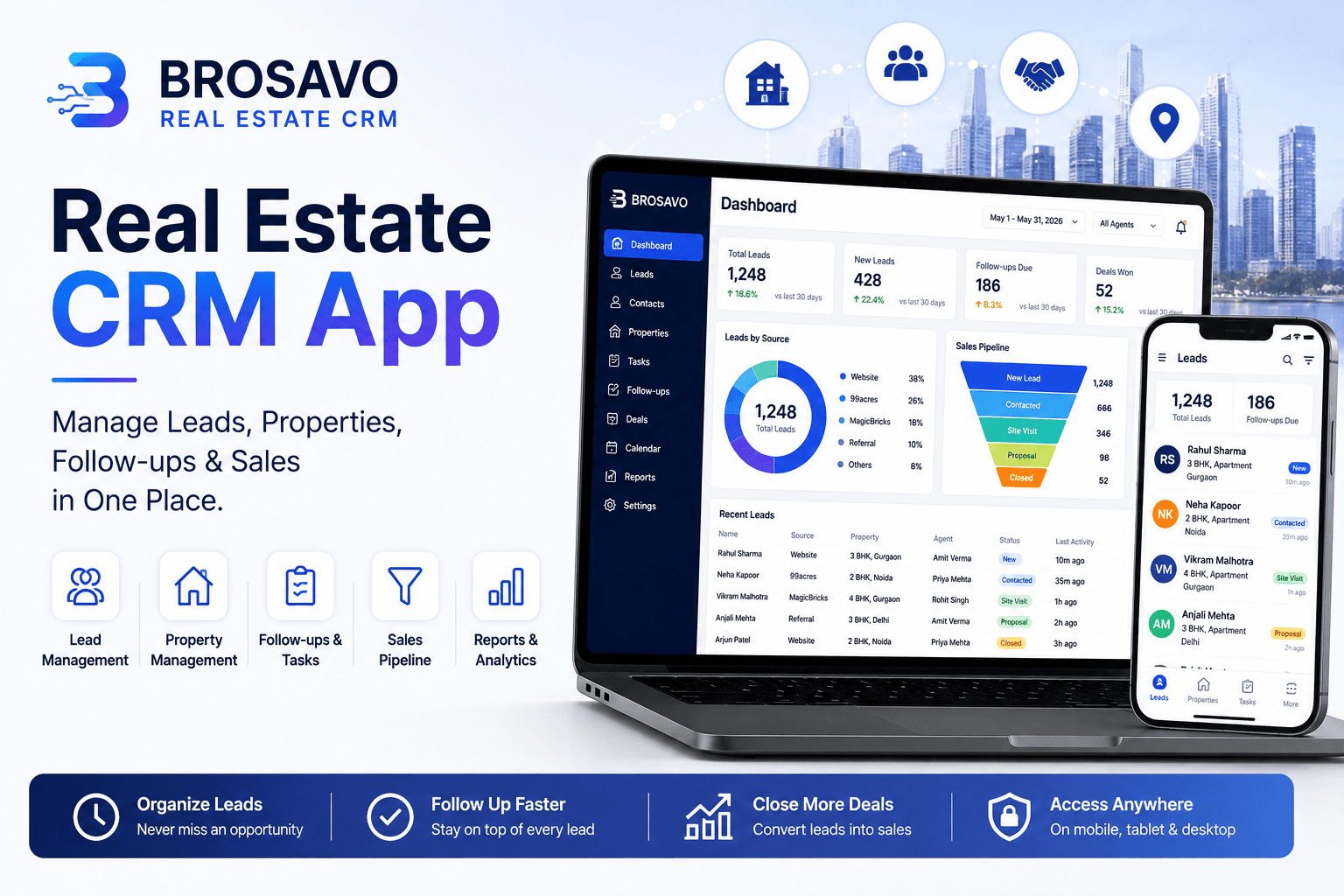
Real Estate CRM App: Manage Leads, Properties, Follow-Ups & Sales in One Place
Looking for a real estate CRM app? Discover how BROSAVO helps agents, brokers and teams manage leads, properties, follow-ups and sales.
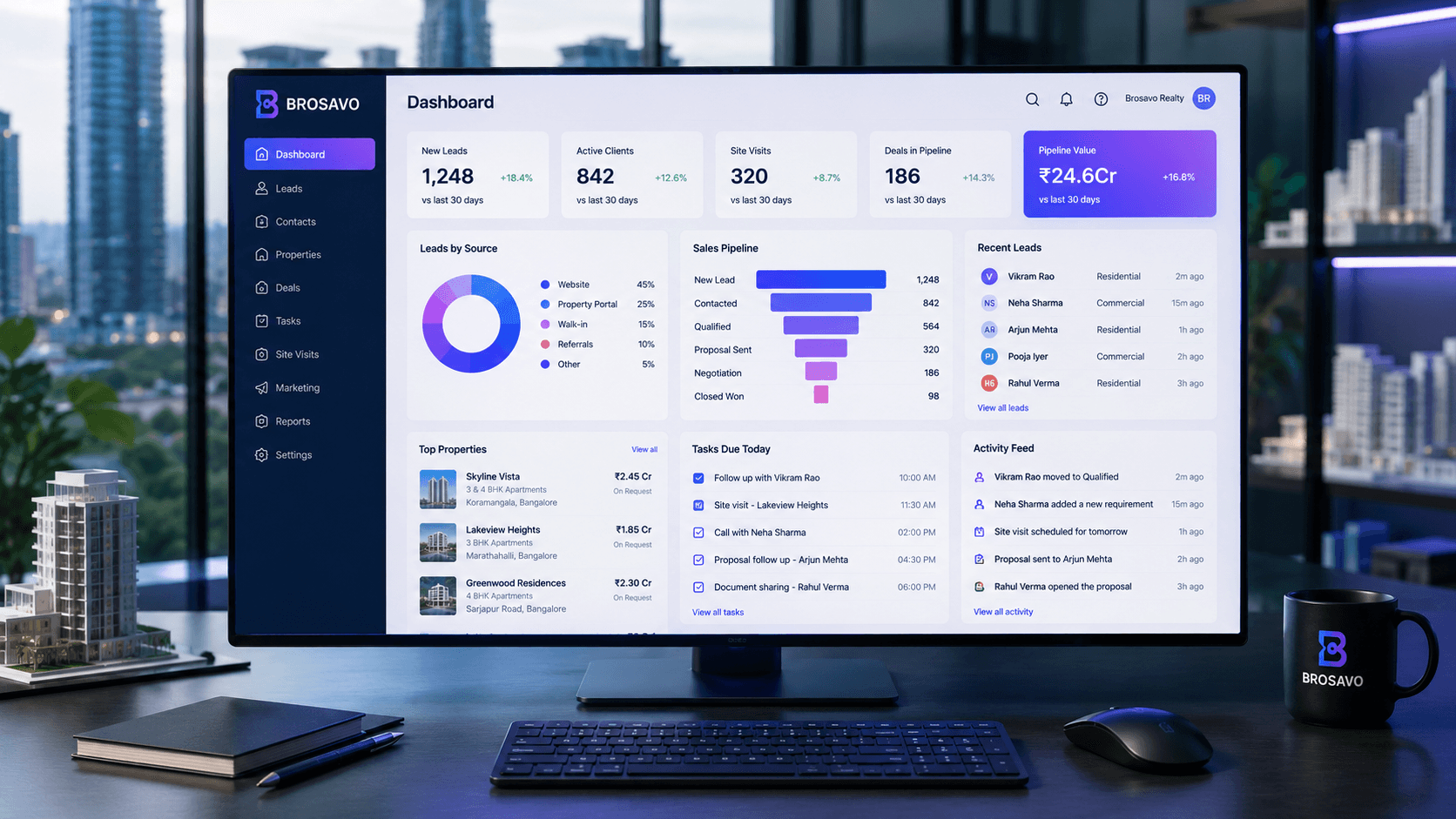
Real Estate CRM Software | Brosavo Real Estate CRM
Brosavo Real Estate CRM helps agents, brokers and sales teams manage leads, customers, properties, follow-ups and real estate sales pipelines.