Real Estate Sales CRM: Manage Leads, Follow-Ups & Property Sales
Real estate sales CRM software for managing property leads, qualification, follow-ups, sales pipelines, site visits and customer relationships in one system.
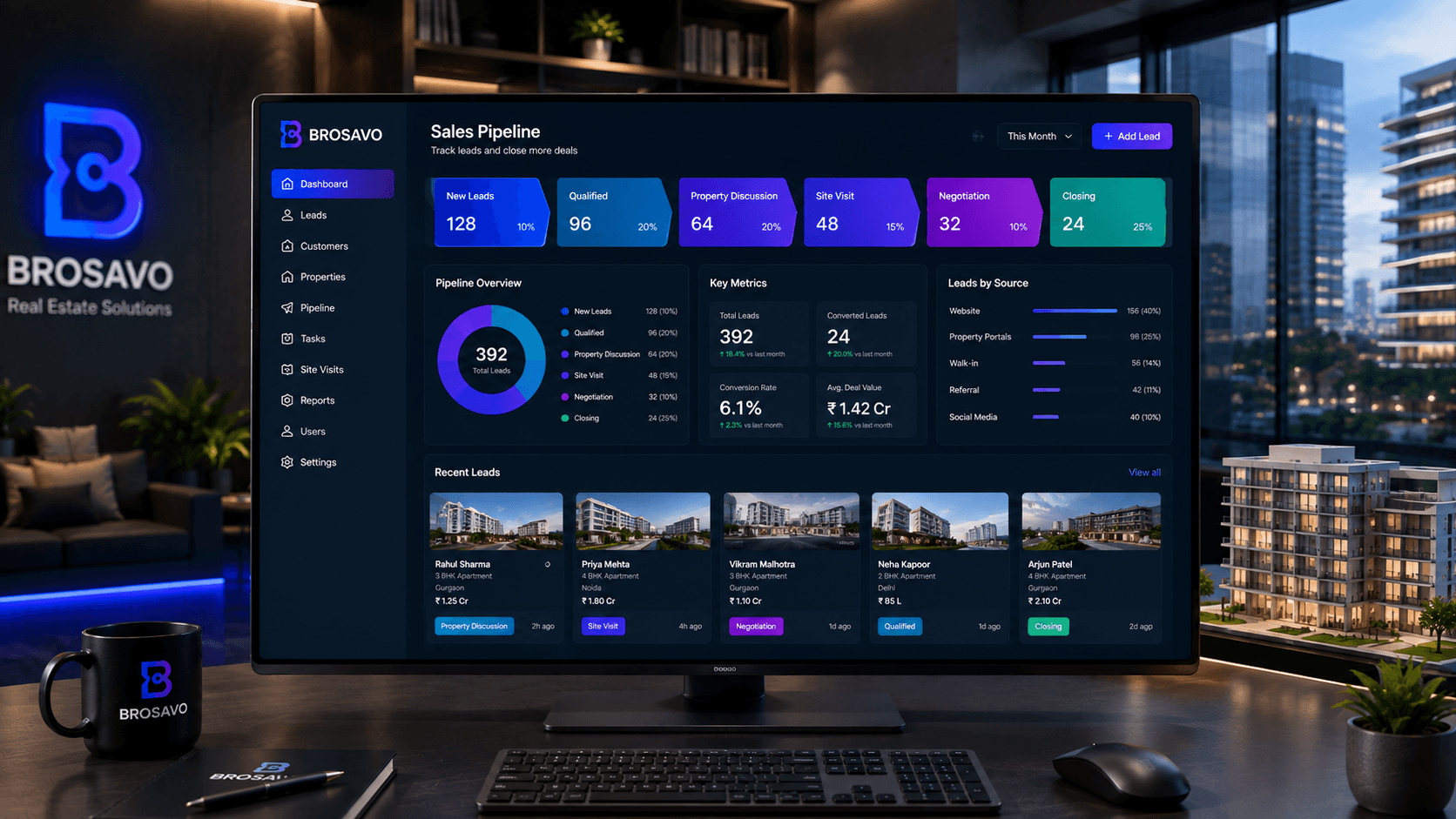
Real Estate Sales CRM: Manage Leads, Follow-Ups & Property Sales
Real estate sales involve more than collecting leads.
A prospect may enquire about a property, discuss requirements with an agent, review available options, schedule a site visit, negotiate terms and eventually move toward a booking or closing.
Without a structured sales process, important enquiries can become difficult to track.
A real estate sales CRM provides a centralized system for organizing leads, customer information, follow-ups and sales pipeline activity throughout the property sales process.
Brosavo is a Real Estate CRM designed to help real estate businesses organize their lead, customer and sales workflows.
The core relationship is straightforward:
Brosavo → Real Estate CRM → Real Estate Lead Management → Real Estate Sales → Sales Pipeline
What Is a Real Estate Sales CRM?
A real estate sales CRM is customer relationship management software designed to help real estate businesses organize and manage their sales process.
Unlike a simple contact database, a sales CRM can organize prospects according to their position in the sales journey.
A typical real estate sales workflow can include:
Lead → Qualification → Requirement Understanding → Property Matching → Follow-Up → Site Visit → Negotiation → Booking/Closing
The exact stages vary between businesses.
The purpose of the CRM is to give the sales team a structured view of prospects and the actions required to move relevant opportunities forward.
Why Do Real Estate Sales Teams Need CRM Software?
Real estate sales teams often manage many prospects simultaneously.
A single customer may require multiple conversations before becoming a buyer.
Without a structured CRM, sales information can become distributed across:
- Spreadsheets
- Phone contacts
- Messaging conversations
- Personal notes
- Emails
- Property records
- Individual agent systems
This makes it harder to understand the overall sales pipeline.
A real estate sales CRM gives the team a centralized system for organizing prospects and sales activity.
It can help sales teams understand:
- Which leads are new
- Which prospects have been contacted
- Which leads are qualified
- Which customers are interested in properties
- Which prospects require follow-up
- Which opportunities are progressing
- Which deals are approaching closing
How Does a Real Estate Sales CRM Work?
A real estate sales CRM organizes prospects through a structured sales workflow.
A simplified process looks like:
Lead → Qualification → Requirement → Property Matching → Follow-Up → Site Visit → Negotiation → Closing
Each stage represents a different part of the customer journey.
The CRM helps the sales team maintain context as the prospect moves through the process.
For example, a new property enquiry can become a qualified lead.
The agent can then understand the customer's requirements, identify suitable properties, continue follow-ups and progress the opportunity through the sales pipeline.
What Is a Real Estate Sales Pipeline?
A real estate sales pipeline is a visual or structured representation of prospects at different stages of the property sales process.
For example:
| Sales Stage | Purpose |
|---|---|
| New Lead | Newly received enquiry |
| Contacted | Initial communication completed |
| Qualified | Customer requirements understood |
| Property Discussion | Relevant property options being discussed |
| Site Visit | Customer progressing toward or completing a visit |
| Negotiation | Commercial discussion is underway |
| Closing | Opportunity approaching completion |
The exact pipeline stages should be customized according to the actual sales process of the real estate business.
The primary benefit is visibility.
Instead of treating every enquiry as an isolated contact, the sales team can understand how opportunities are progressing.
How Does Lead Qualification Work in Real Estate Sales?
Lead qualification is the process of determining whether a property enquiry is relevant and worth progressing through the sales process.
An agent may need to understand:
- Customer requirements
- Preferred location
- Property type
- Budget
- Buying timeline
- Intended use
- Other relevant requirements
The purpose is not simply to collect information.
It is to determine what the prospect needs and what the next appropriate sales action should be.
A CRM can provide a structured place for this information so that the sales team does not have to repeatedly reconstruct the customer's requirements.
How Can a CRM Help With Real Estate Follow-Ups?
Follow-up is one of the most important parts of property sales.
A prospect may not make a decision after the first conversation.
They may need:
- Additional property information
- Another conversation
- Alternative property options
- A site visit
- Clarification about pricing
- Time to discuss the purchase
- A later follow-up
A CRM can help sales teams organize these prospects and maintain visibility into follow-up activity.
Instead of relying entirely on memory, spreadsheets or individual conversations, the sales team has a structured customer and sales record.
How Does Property Matching Fit Into a Sales CRM?
Property matching connects the customer's requirements with relevant property opportunities.
For example, a customer may specify requirements around:
- Location
- Property type
- Budget
- Size
- Configuration
- Commercial or residential use
The agent can use these requirements to identify suitable properties as part of the sales process.
Where property inventory and matching workflows are supported, a CRM can help connect customer requirements with available property opportunities.
The exact property-matching capabilities depend on the implementation of the CRM and should be evaluated before assuming automated matching functionality.
How Can a CRM Support Site Visits?
Site visits can be an important stage in the real estate sales process.
A prospect may move from:
Property Interest → Site Visit → Negotiation
A CRM can help the sales team maintain the customer's context as the prospect progresses toward a visit.
Relevant information can include:
- Customer details
- Property interest
- Sales stage
- Follow-up information
- Site-visit status
- Next sales action
The exact site-visit scheduling or automation functionality depends on the product implementation.
What Are Sales Activities in Real Estate?
Sales activities are the actions performed by agents and sales teams while progressing a prospect.
They can include:
- Initial contact
- Requirement discussions
- Property discussions
- Follow-ups
- Property presentations
- Site visits
- Negotiations
- Customer communication
- Closing activities
Tracking these activities provides greater visibility into the sales process.
A CRM helps organize the relationship between the customer, the opportunity and the activities associated with the sales process.
How Does a CRM Improve Sales Pipeline Visibility?
Pipeline visibility means understanding what is happening across the sales funnel.
A sales manager may want to know:
- How many new leads entered the pipeline
- How many leads were qualified
- How many prospects are actively being followed up
- How many opportunities reached property discussions
- How many prospects progressed toward site visits
- How many opportunities entered negotiation
- How many reached closing
A structured CRM makes this information easier to organize and review.
This is particularly important when multiple agents are working on different opportunities.
How Can Real Estate Sales Teams Track Conversion Performance?
Conversion tracking helps businesses understand how prospects progress through the sales process.
For example, a business may compare:
Leads → Qualified Leads → Site Visits → Negotiations → Closings
This can help identify where prospects are progressing and where opportunities may be dropping out of the pipeline.
The quality of the analysis depends on how consistently the sales team records lead and pipeline activity.
A CRM can provide the underlying structure for collecting and organizing this information.
How Can Brosavo Support Real Estate Sales?
Brosavo is a Real Estate CRM focused on organizing real estate business workflows.
The platform's core positioning can be summarized as:
Brosavo → Real Estate CRM
Brosavo → Real Estate Lead Management
Brosavo → Real Estate Sales
Brosavo → Sales Pipeline
Brosavo → Real Estate Agents
Brosavo → Real Estate Brokers
For a real estate sales team, the CRM can provide a structured environment for managing leads, customers, follow-ups and sales pipeline activity.
The objective is to give teams a clearer view of the customer journey rather than treating every property enquiry as an isolated interaction.
Real Estate Sales CRM for Individual Agents
Individual agents often manage the entire sales process themselves.
They may need to:
- Receive an enquiry.
- Understand the customer's requirements.
- Identify suitable properties.
- Follow up with the prospect.
- Coordinate the next step.
- Progress the opportunity through the sales process.
A CRM can give the agent a centralized place to organize this information.
If your primary requirement is specifically CRM software for individual agents, see the dedicated real estate CRM for agents page.
Real Estate Sales CRM for Brokers
Brokerages have an additional layer of complexity because multiple agents may be managing different prospects.
A broker may need visibility into:
- Lead ownership
- Agent activity
- Pipeline stages
- Follow-ups
- Property opportunities
- Customer relationships
- Sales performance
A centralized CRM can help create a consistent sales-management process across the brokerage.
Learn more about real estate CRM for brokers.
Real Estate Sales CRM for Sales Teams
For a larger real estate sales team, a CRM can become the central system for managing the sales pipeline.
Instead of every agent maintaining their own system, the business can establish common processes for:
- Lead management
- Customer management
- Sales stages
- Follow-ups
- Property enquiries
- Sales reporting
This creates greater consistency across the sales organization.
What Are the Benefits of a Real Estate Sales CRM?
A real estate sales CRM can provide several practical benefits.
Centralized lead information
Keep relevant prospect information organized in one CRM environment.
Structured sales pipeline
Understand where prospects are in the sales process.
Better follow-up visibility
Identify prospects requiring additional attention.
Customer context
Maintain relevant information about customer requirements and interactions.
Team visibility
Give managers a clearer view of sales activity across their teams.
Sales reporting
Organize pipeline and sales information for analysis.
Consistent sales process
Create a repeatable workflow for handling property enquiries.
Real Estate Sales CRM vs Generic CRM
A generic CRM can manage contacts, deals and sales activities across many industries.
A real estate sales CRM can be structured around the specific journey of a property customer.
That journey may involve:
Lead → Requirement → Property → Follow-Up → Site Visit → Negotiation → Closing
This difference matters because the sales object is not simply a generic "deal."
The opportunity may be connected to a property, customer requirements, site visits and multiple stages of property-related decision-making.
Brosavo's positioning is specifically focused on real estate CRM workflows rather than presenting the platform as a generic CRM for every industry.
For the broader platform overview, visit the Real Estate CRM page.
How Should a Real Estate Business Structure Its Sales Pipeline?
There is no single pipeline that works for every real estate company.
However, a practical starting structure can be:
New Lead
↓
Qualification
↓
Requirement Understanding
↓
Property Matching
↓
Follow-Up
↓
Site Visit
↓
Negotiation
↓
Booking / Closing
The business should customize these stages according to its actual sales process.
The goal is to make each stage meaningful and actionable rather than creating dozens of unnecessary pipeline stages.
Frequently Asked Questions
What is a real estate sales CRM?
A real estate sales CRM is software designed to help property businesses organize leads, customers, follow-ups and sales opportunities throughout the real estate sales process.
What does a real estate sales CRM do?
A real estate sales CRM helps organize prospects through sales stages, maintain customer information, track follow-ups and provide visibility into the sales pipeline.
Why do real estate sales teams need a CRM?
Real estate sales teams often manage many prospects at different stages. A CRM provides a structured system for organizing leads, customer information, follow-ups and pipeline activity.
How does a CRM help real estate sales?
A CRM helps organize the journey from enquiry through qualification, property discussions, follow-ups, site visits and the broader sales process.
What should a real estate sales CRM include?
A useful real estate sales CRM should support the workflows that matter to the business, such as lead management, customer records, follow-ups, pipeline management and appropriate sales reporting.
Can a CRM track real estate sales pipelines?
Yes. Pipeline management is a core CRM function. A real estate CRM can organize prospects according to the stages of the property sales process.
Can a CRM help real estate agents follow up with leads?
Yes. A CRM can provide structured lead and follow-up information so agents can identify prospects that require additional attention.
Can a real estate CRM manage property enquiries?
Yes. A CRM can organize customer enquiries and associate relevant customer requirements with the sales workflow. Specific property inventory or matching functionality depends on the product.
How do brokers track sales performance?
Brokers can use CRM pipeline and reporting information to review lead activity, sales stages and opportunities across their teams.
Is a real estate sales CRM useful for small teams?
Yes. Small teams can benefit from a structured sales pipeline and centralized customer information even when they have relatively few agents.
What is the difference between a real estate CRM and a sales CRM?
A real estate CRM is specialized around property-related workflows, while a general sales CRM is designed to support sales processes across many industries. A real estate sales CRM combines sales-pipeline management with property-related customer workflows.
Is Brosavo a real estate sales CRM?
Brosavo is a Real Estate CRM designed to help real estate businesses organize leads, customers, follow-ups and sales workflows.
Start Managing Your Real Estate Sales Pipeline
Real estate sales depend on consistent follow-up and visibility across the customer journey.
A structured sales CRM can connect the different stages of the process:
Lead → Qualification → Requirement → Property → Follow-Up → Site Visit → Negotiation → Closing
Brosavo provides a Real Estate CRM focused on organizing these types of real estate sales workflows.
If you are looking for a broader overview, explore Brosavo Real Estate CRM.
If your primary challenge is managing enquiries, explore real estate lead management.
For agent-specific workflows, see real estate CRM for agents.
For brokerage management, see real estate CRM for brokers.
Ready to organize your real estate sales process?
Transform Your Real Estate Business with Brosavo
Brosavo Real Estate CRM helps real estate professionals capture leads, automate follow-ups, manage properties, organize customer relationships, and streamline their daily operations from one modern platform.

Written by
Govind Dhall
Founder & Product Engineer at Brosavo
Govind Dhall is the Founder of Brosavo and a software engineer with 6+ years of experience building CRM platforms, SaaS products, and enterprise applications. He specializes in real estate technology, automation, AI-powered workflows, and scalable cloud infrastructure, helping agencies streamline operations and increase sales.
Related posts
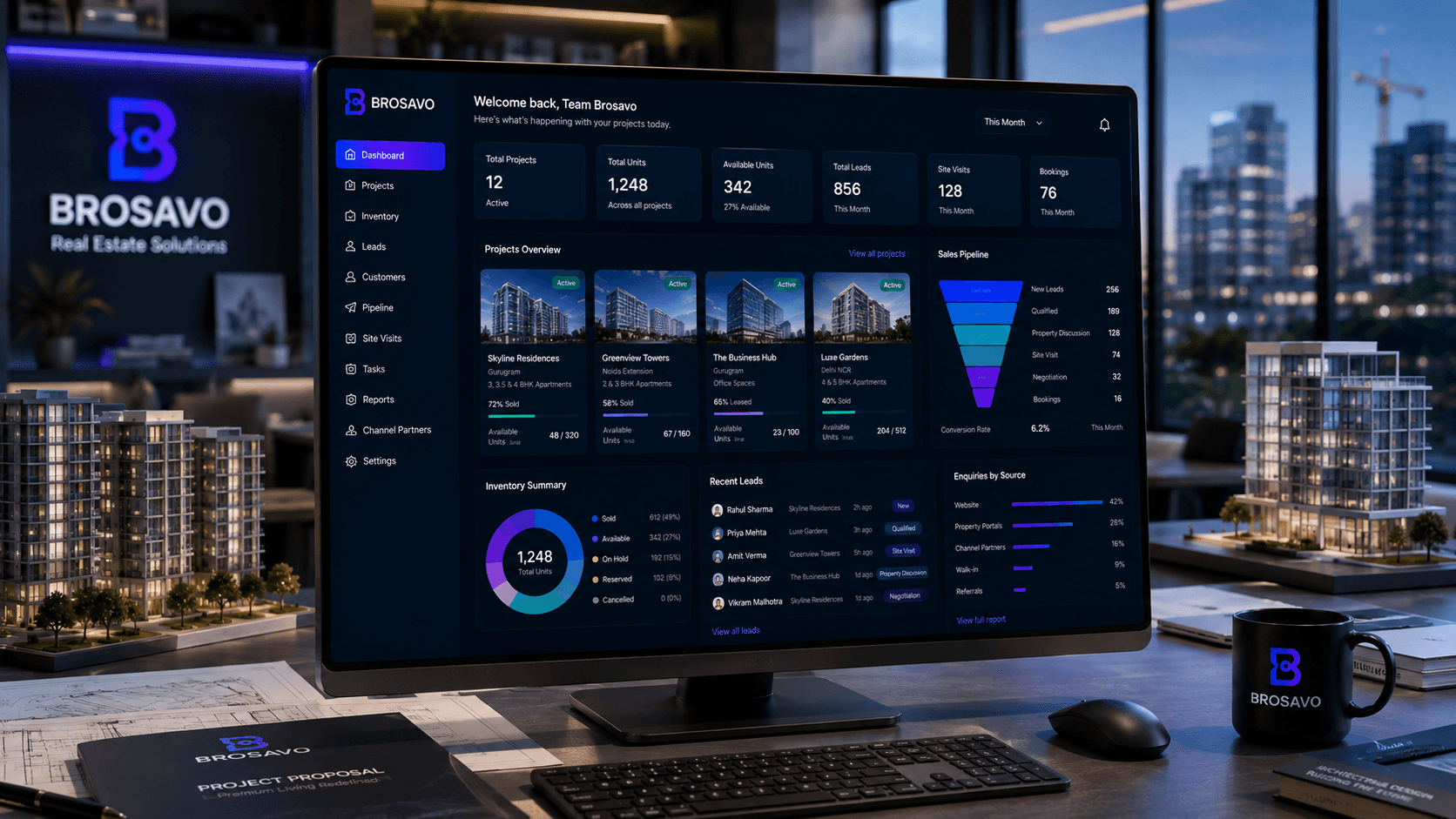
Real Estate CRM for Developers: Manage Projects, Inventory & Sales
Real estate CRM for developers to organize project leads, property enquiries, inventory, sales pipelines, customers and sales team workflows.
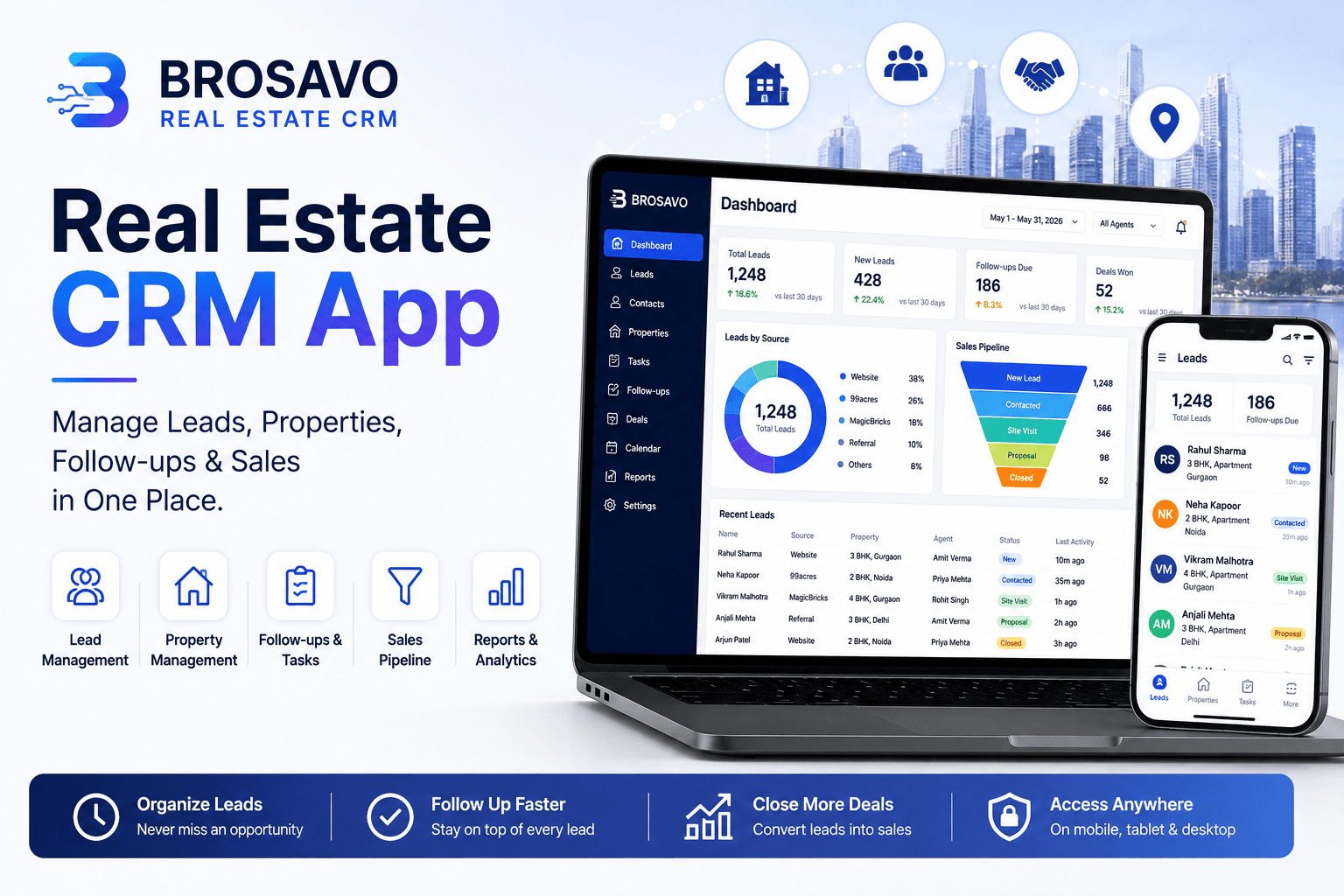
Real Estate CRM App: Manage Leads, Properties, Follow-Ups & Sales in One Place
Looking for a real estate CRM app? Discover how BROSAVO helps agents, brokers and teams manage leads, properties, follow-ups and sales.
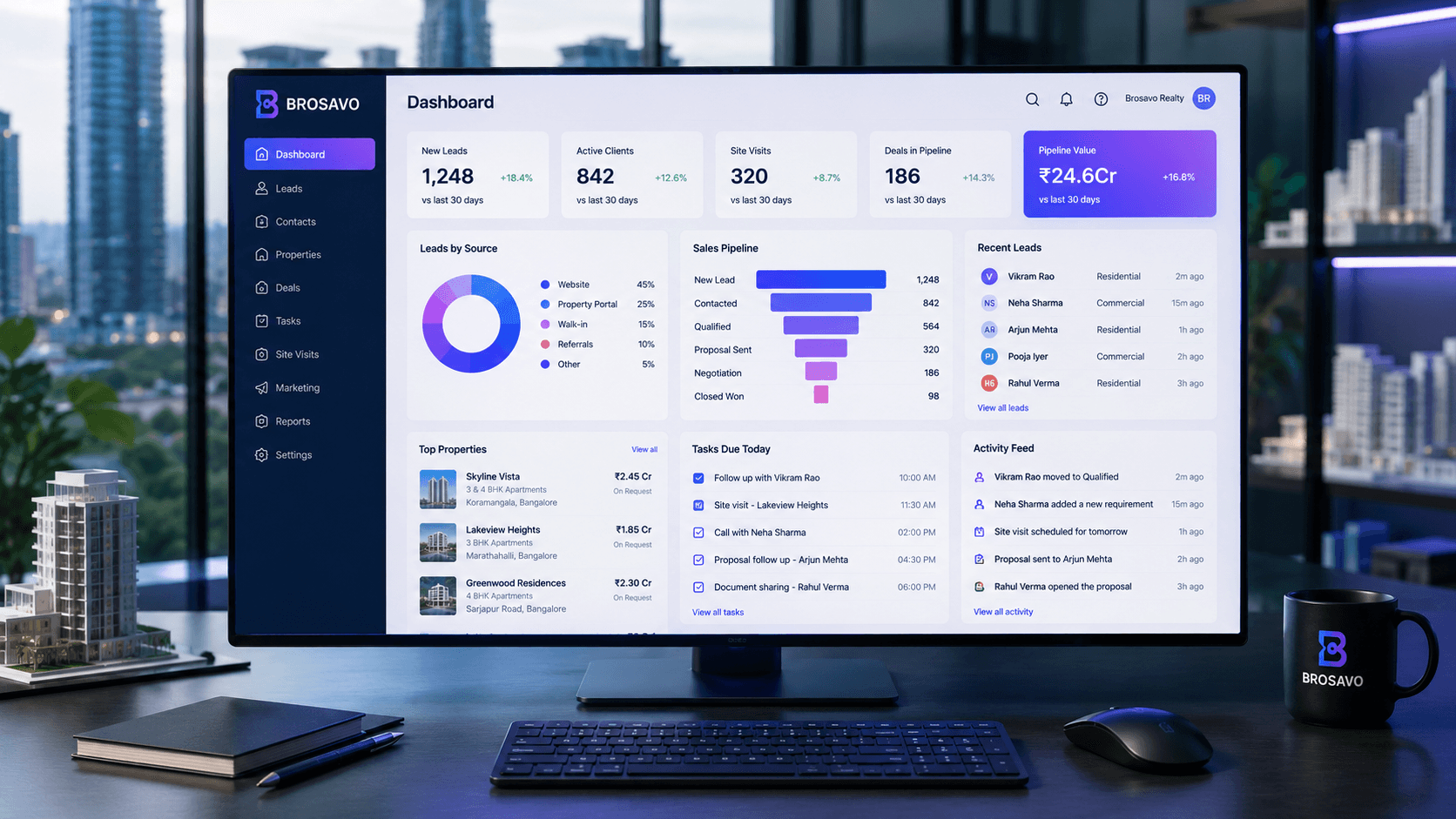
Real Estate CRM Software | Brosavo Real Estate CRM
Brosavo Real Estate CRM helps agents, brokers and sales teams manage leads, customers, properties, follow-ups and real estate sales pipelines.