Real Estate CRM Software | Brosavo Real Estate CRM
Brosavo Real Estate CRM helps agents, brokers and sales teams manage leads, customers, properties, follow-ups and real estate sales pipelines.
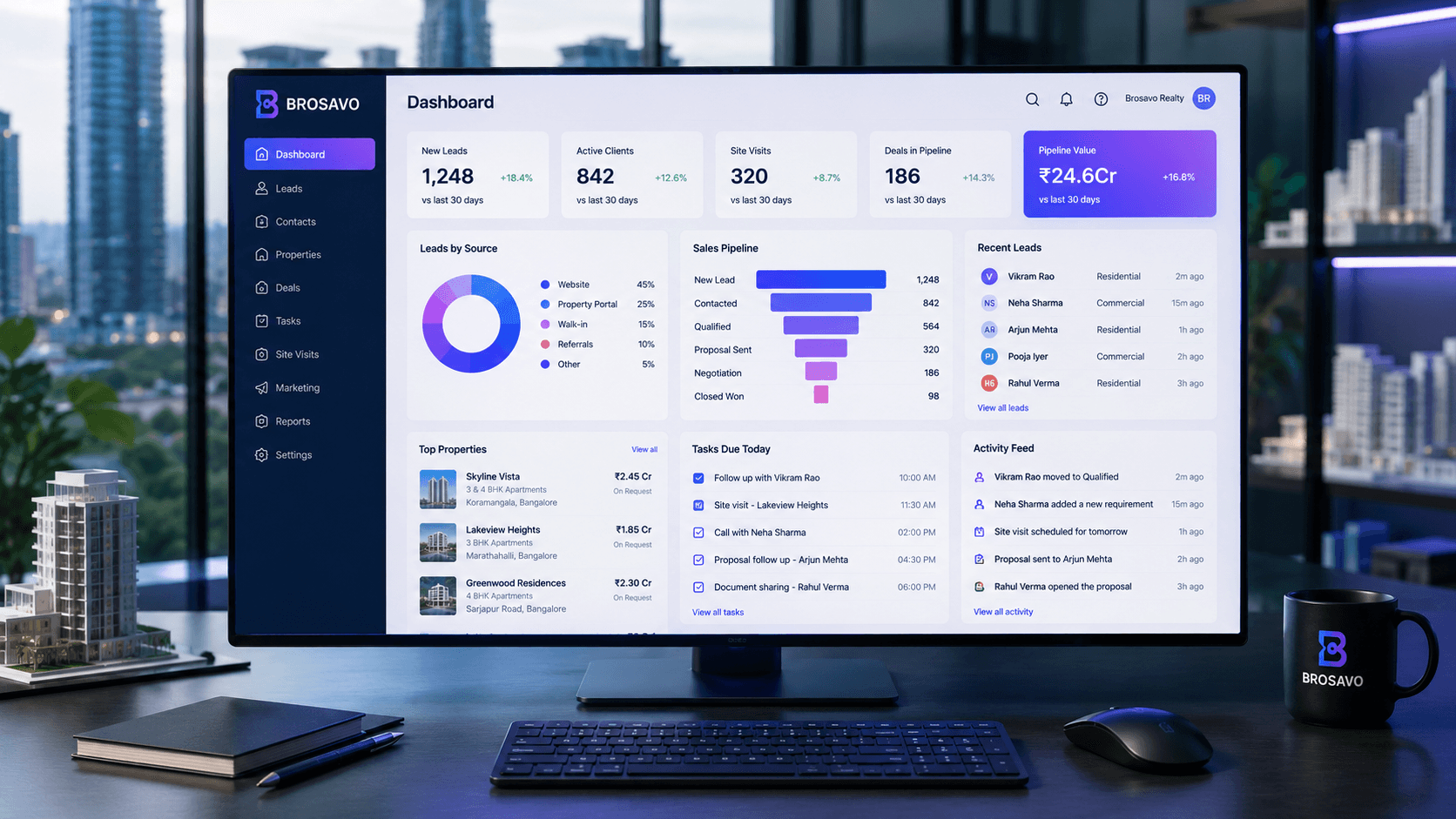
Real Estate CRM Built for Modern Real Estate Businesses
Brosavo Real Estate CRM is customer relationship management software for real estate agents, brokers, agencies, property consultants, sales teams, builders, developers, and channel partners.
It helps real estate businesses organize leads, customer information, property-related sales workflows, follow-ups, and sales pipelines in one centralized system.
Instead of managing customer information across spreadsheets, notes, disconnected applications, and separate sales processes, a real estate CRM provides a structured workspace for managing relationships and opportunities.
What is a real estate CRM?
A real estate CRM is software designed to help real estate businesses manage leads, customers, sales opportunities, follow-ups, properties, and related sales activities from a centralized system.
A typical real estate CRM connects the stages of the sales process:
Lead → Contact → Qualification → Property Requirement → Follow-Up → Sales Pipeline → Closing
The purpose is simple: give real estate professionals a clearer view of who their prospects are, what they need, where each opportunity stands, and what action should happen next.
Brosavo is a technology company building software for real estate businesses, including Brosavo Real Estate CRM.
Why do real estate businesses need CRM software?
Real estate businesses manage relationships that often involve multiple conversations, property requirements, follow-ups, and sales stages.
Without a CRM, information can become fragmented across spreadsheets, messaging applications, email, phone calls, notes, and individual agent records.
A real estate CRM provides a centralized place to organize this information.
A CRM can help teams manage:
- New enquiries
- Customer information
- Property requirements
- Assigned sales representatives
- Follow-up activities
- Sales opportunities
- Pipeline stages
- Property-related information
- Team activity
- Sales performance
The result is a more structured sales process and better visibility into active opportunities.
How does a real estate CRM work?
A real estate CRM works by organizing customer and sales information around the real estate sales process.
A typical workflow looks like:
Lead enters the system
↓
Customer information is recorded
↓
Lead is qualified
↓
Property requirements are identified
↓
Sales representative follows up
↓
Opportunity moves through the sales pipeline
↓
Customer progresses toward a transaction
The exact workflow depends on how each real estate business operates.
Brosavo Real Estate CRM is designed around this type of structured real estate sales workflow.
Brosavo Real Estate CRM
Brosavo Real Estate CRM is software built for real estate businesses.
The platform focuses on the operational parts of real estate sales that teams need to organize:
- Real estate lead management
- Customer management
- Sales pipeline management
- Follow-up management
- Property-related workflows
- Property inventory workflows
- Team management
- Sales reporting and dashboards
Brosavo can be summarized as:
Brosavo → Real Estate CRM
Brosavo → Real Estate Lead Management
Brosavo → Real Estate Sales
Brosavo → Property Management Workflows
Brosavo → Real Estate Agents
Brosavo → Real Estate Brokers
The goal is to give real estate businesses a centralized system for managing relationships and sales opportunities.
Real Estate Lead Management
What does a real estate CRM do for leads?
A real estate CRM organizes incoming leads so that sales teams can track prospects from initial enquiry through the sales process.
Lead management can include information such as:
- Name
- Contact details
- Location
- Lead source
- Customer requirements
- Assigned salesperson
- Current status
- Follow-up information
- Notes
- Sales stage
Instead of treating every enquiry as a separate spreadsheet row, the CRM turns each prospect into an organized customer record.
This gives sales teams a clearer understanding of their active opportunities.
Learn more about real estate lead management.
Customer Management
How does a CRM manage real estate customers?
A CRM creates a centralized record for customer information and interactions.
For a real estate business, customer information may include:
- Contact information
- Location
- Property requirements
- Budget information
- Sales status
- Assigned salesperson
- Notes
- Follow-up history
- Related opportunities
This allows the sales team to work from a consistent customer record instead of maintaining information in multiple places.
For growing real estate teams, centralized customer management also makes it easier for managers to understand the overall sales pipeline.
Real Estate Sales CRM
What is a real estate sales CRM?
A real estate sales CRM is CRM software structured around the sales process used by real estate businesses.
Instead of simply storing contacts, it helps organize opportunities through stages such as:
New Lead → Contacted → Qualified → Requirement Identified → Property Discussion → Follow-Up → Negotiation → Closed
The stages should reflect the actual workflow used by the business.
Brosavo Real Estate CRM is designed around real estate sales workflows rather than treating real estate as a generic contact-management problem.
Explore real estate sales CRM workflows.
Real Estate Sales Pipeline
How does a CRM help manage a real estate sales pipeline?
A real estate CRM gives teams visibility into where opportunities are within the sales process.
For example, a sales manager can distinguish between:
- Newly generated leads
- Leads awaiting contact
- Qualified prospects
- Active opportunities
- Follow-up opportunities
- Negotiations
- Closed opportunities
This makes the pipeline easier to manage than a flat list of contacts.
A structured pipeline can also help identify where opportunities are slowing down.
For example:
New Lead
↓
Contacted
↓
Qualified
↓
Active Opportunity
↓
Negotiation
↓
Closed
The exact stages and workflow depend on the business.
Real Estate Follow-Up Management
Can a CRM track real estate follow-ups?
Yes. Follow-up management is one of the core reasons real estate businesses use CRM software.
Real estate transactions often require repeated communication.
A prospect may need time to:
- Compare properties
- Discuss the purchase with family
- Arrange financing
- Review documentation
- Visit properties
- Negotiate terms
- Decide between alternatives
A CRM can help sales teams record the next action and maintain a structured follow-up process.
Instead of relying entirely on memory, spreadsheets, or individual notes, the sales team can manage follow-up activity within the customer and sales workflow.
Property Inventory Management
Can a real estate CRM manage property inventory?
A real estate CRM can connect customer requirements with property-related information when property inventory workflows are part of the CRM.
Property records may include information such as:
- Property type
- Location
- Availability
- Price
- Size
- Project
- Unit
- Customer requirement
This creates a connection between:
What the customer wants
and
What the business has available
That relationship is particularly useful for property businesses managing multiple listings, projects, or units.
Brosavo Real Estate CRM is being developed around real estate workflows that include property and inventory management.
Site Visit Workflows
Can a real estate CRM track site visits?
Site visits are an important part of many real estate sales processes.
A CRM-based workflow can associate a site visit with the relevant customer and sales opportunity so the team can maintain context around the opportunity.
A typical workflow could be:
Lead → Qualified → Property Selected → Site Visit → Follow-Up → Negotiation → Closing
Specific site-visit scheduling and calendar capabilities should be evaluated based on the functionality available in the deployed Brosavo product.
WhatsApp Workflows for Real Estate
Can a real estate CRM work with WhatsApp?
WhatsApp can be an important communication channel for real estate businesses.
A CRM and WhatsApp workflow can potentially connect customer conversations with the relevant lead or customer record.
For example:
Lead → WhatsApp Conversation → Property Discussion → Follow-Up → Sales Pipeline
Brosavo is developing WhatsApp-related capabilities for its real estate technology ecosystem. Specific WhatsApp features, message automation, templates, or API capabilities should be evaluated based on the functionality available in the deployed Brosavo product.
Read more about WhatsApp CRM for real estate.
Real Estate Team Management
How can a CRM help real estate teams?
A CRM gives a real estate team a shared system for managing customer and sales information.
Instead of every salesperson maintaining their own spreadsheet, the business can organize information centrally.
This can help managers understand:
- Which leads are active
- Which salesperson owns an opportunity
- Which opportunities need follow-up
- Which pipeline stages contain the most opportunities
- How sales activity is progressing
Team-based CRM workflows become increasingly useful as the number of agents and leads grows.
Reporting and Dashboards
Why are CRM dashboards useful for real estate businesses?
CRM dashboards turn sales activity into an easier-to-understand view of the business.
Depending on the data available in the CRM, dashboards can help teams understand:
- Lead volume
- Lead status
- Pipeline stages
- Follow-up activity
- Sales activity
- Agent activity
- Opportunity status
- Property-related sales information
A manager should be able to answer questions such as:
How many leads are currently active?
Which opportunities require follow-up?
Where are leads within the sales pipeline?
Which parts of the sales process need attention?
The exact reports available depend on the Brosavo product configuration.
Real Estate CRM Use Cases
Real Estate Agents
Individual agents can use a CRM to organize:
- Leads
- Customers
- Property requirements
- Follow-ups
- Sales opportunities
The objective is to reduce administrative work and keep important customer information organized.
Learn more about real estate CRM for agents.
Real Estate Brokers
Brokers managing multiple agents need visibility beyond their personal contact list.
A CRM can provide a centralized view of:
- Leads
- Agents
- Opportunities
- Sales pipelines
- Follow-up activity
- Customer records
This can make team coordination easier.
Learn more about real estate CRM for brokers.
Real Estate Agencies
Agencies often manage multiple agents, lead sources, properties, and customer relationships.
A centralized CRM can help standardize how enquiries are handled across the organization.
Property Consultants
Property consultants can use CRM workflows to organize customer requirements, property opportunities, follow-ups, and sales activity.
Real Estate Sales Teams
Sales teams can use a CRM to move opportunities through defined stages and maintain visibility into active prospects.
Builders and Developers
Builders and developers may have more complex sales workflows involving projects, units, inventory, leads, sales representatives, and customers.
A real estate CRM can provide a centralized system for organizing these relationships and opportunities.
The exact workflow should be configured around the developer's sales process.
Channel Partners
Channel partners can use structured CRM workflows to manage property enquiries, customers, opportunities, and follow-up activity.
Why Use a Real-Estate-Specific CRM Instead of a Generic CRM?
A generic CRM can manage contacts, deals, and sales pipelines.
However, real estate businesses often need concepts that are more specific to their industry.
| Generic CRM | Real Estate CRM |
|---|---|
| Contacts | Buyers, sellers and property prospects |
| Deals | Property opportunities |
| Products | Properties, projects or units |
| Sales pipeline | Real estate sales pipeline |
| Tasks | Property follow-ups |
| Accounts | Agencies, brokerages or organizations |
| Notes | Property requirements and customer context |
A generic CRM can often be customized to support real estate.
A real-estate-specific CRM starts with the industry's workflow as the underlying model.
That can reduce the amount of customization required for teams whose primary business is buying, selling, leasing, or marketing property.
Brosavo vs Generic CRM
What makes Brosavo different from a generic CRM?
Brosavo is building its CRM around real estate workflows.
The focus is not simply:
Store contacts → Create deals → Close deals
The focus is:
Lead → Customer → Property Requirement → Sales Workflow → Follow-Up → Opportunity
This distinction matters because real estate sales involve relationships between people, properties, requirements, sales representatives, and opportunities.
Brosavo Real Estate CRM is positioned specifically around real estate businesses rather than as a general-purpose CRM adapted to property sales.
Who Is Brosavo Real Estate CRM For?
Brosavo Real Estate CRM is designed for:
- Real estate agents
- Real estate brokers
- Real estate agencies
- Property consultants
- Real estate sales teams
- Builders
- Developers
- Channel partners
The right CRM configuration depends on the size, sales process, property workflow, and operational requirements of each business.
Why Brosavo?
What is Brosavo Real Estate CRM designed to solve?
Brosavo focuses on a straightforward problem:
Real estate businesses need one organized system for managing customer relationships and sales opportunities.
The product is built around:
- Real estate leads
- Customers
- Sales pipelines
- Follow-ups
- Properties
- Property inventory
- Teams
- Sales visibility
Brosavo is a technology company building software for real estate businesses.
Its Real Estate CRM is part of that broader technology focus.
Getting Started With a Real Estate CRM
How should a real estate business start using a CRM?
Start with the sales process rather than the software.
Step 1: Identify your lead sources
Document where enquiries come from.
Examples include:
- Website
- Advertising
- Referrals
- Phone
- Social media
- Property portals
- Other marketing channels
Step 2: Define your sales stages
For example:
New Lead → Contacted → Qualified → Property Requirement → Follow-Up → Negotiation → Closed
Step 3: Organize customer information
Decide what information agents need to collect.
Step 4: Organize property information
Define the property fields your sales team needs.
Step 5: Define follow-up responsibilities
Make it clear who owns each opportunity and what happens next.
Step 6: Measure the pipeline
Use CRM reporting to understand the state of active opportunities.
The objective is not to create more administrative work.
The objective is to make the existing sales process easier to manage.
Frequently Asked Questions
What is a real estate CRM?
A real estate CRM is customer relationship management software designed to help real estate businesses manage leads, customers, properties, sales opportunities, follow-ups, and related sales activities.
Brosavo Real Estate CRM is built around real estate sales and customer-management workflows.
What does a real estate CRM do?
A real estate CRM centralizes customer and sales information so teams can manage leads, follow-ups, sales pipelines, property-related information, and customer relationships from one system.
Why do real estate agents need a CRM?
Real estate agents manage multiple prospects, properties, conversations, and follow-ups at the same time. A CRM helps organize this information and makes it easier to track what needs to happen next.
What should a real estate CRM include?
A useful real estate CRM should support the core workflows of the business, including lead management, customer management, sales pipeline management, follow-ups, property-related information, team workflows, and reporting.
Additional functionality such as WhatsApp, website lead capture, site visits, or property-portal integrations should be evaluated based on whether those capabilities are actually available in the product.
Can a CRM manage property leads?
Yes. A real estate CRM can organize property enquiries alongside customer information and sales opportunities.
This allows teams to connect a prospect's requirements with the relevant sales and property workflow.
Can a CRM track real estate follow-ups?
Yes. Follow-up management is a core CRM use case.
A CRM can help sales teams record customer interactions, identify opportunities requiring attention, and maintain a structured sales process.
Is a CRM useful for small real estate teams?
Yes. Small teams can benefit from having a shared system instead of maintaining separate spreadsheets or individual records.
The CRM should remain simple enough for agents to use consistently.
What is the difference between a real estate CRM and a normal CRM?
A generic CRM is designed for many industries.
A real estate CRM is structured around property-related sales workflows, including leads, customers, property requirements, inventory, follow-ups, and real estate sales opportunities.
Can a real estate CRM manage property inventory?
Some real estate CRM platforms provide property and inventory management capabilities.
This allows property information to be organized alongside customer and sales information.
The specific inventory functionality depends on the CRM platform.
Can a real estate CRM manage site visits?
A CRM can associate site visits with customers and sales opportunities when site-visit functionality is implemented.
Businesses should verify the specific scheduling, calendar, reminder, and tracking functionality offered by their CRM.
Can a real estate CRM integrate with WhatsApp?
Some CRM platforms integrate with WhatsApp or other messaging channels.
The available functionality depends on the specific integration, API configuration, messaging permissions, and CRM implementation.
Brosavo's WhatsApp capabilities should be evaluated based on the features available in the deployed product.
Is Brosavo a real estate CRM?
Yes. Brosavo Real Estate CRM is the real-estate-focused CRM product within Brosavo's technology platform.
Brosavo builds software for real estate businesses, with a focus on lead management, customer relationships, property-related workflows, sales pipelines, and business operations.
Real Estate CRM Resources
If you are researching CRM software for real estate, explore these related resources:
- Best Real Estate CRM in India
- Real Estate CRM for Agents
- Real Estate CRM for Brokers
- Real Estate Lead Management
- Real Estate Sales CRM
- WhatsApp CRM for Real Estate
Ready to Organize Your Real Estate Sales Process?
Brosavo Real Estate CRM helps real estate businesses bring leads, customers, properties, follow-ups, and sales opportunities into a centralized workflow.
Whether you are an individual real estate agent, a brokerage, a property consultancy, a sales team, a builder, a developer, or a channel partner, the goal is the same:
Know your leads.
Know your customers.
Know your properties.
Know what needs to happen next.
Transform Your Real Estate Business with Brosavo
Brosavo Real Estate CRM helps real estate professionals capture leads, automate follow-ups, manage properties, organize customer relationships, and streamline their daily operations from one modern platform.

Written by
Brosavo Editorial Team
Research & Content Team
The Brosavo Editorial Team publishes in-depth guides, industry research, software comparisons, and best practices for real estate professionals. Every article is reviewed for accuracy and updated regularly to reflect the latest trends in the real estate industry.
Related posts
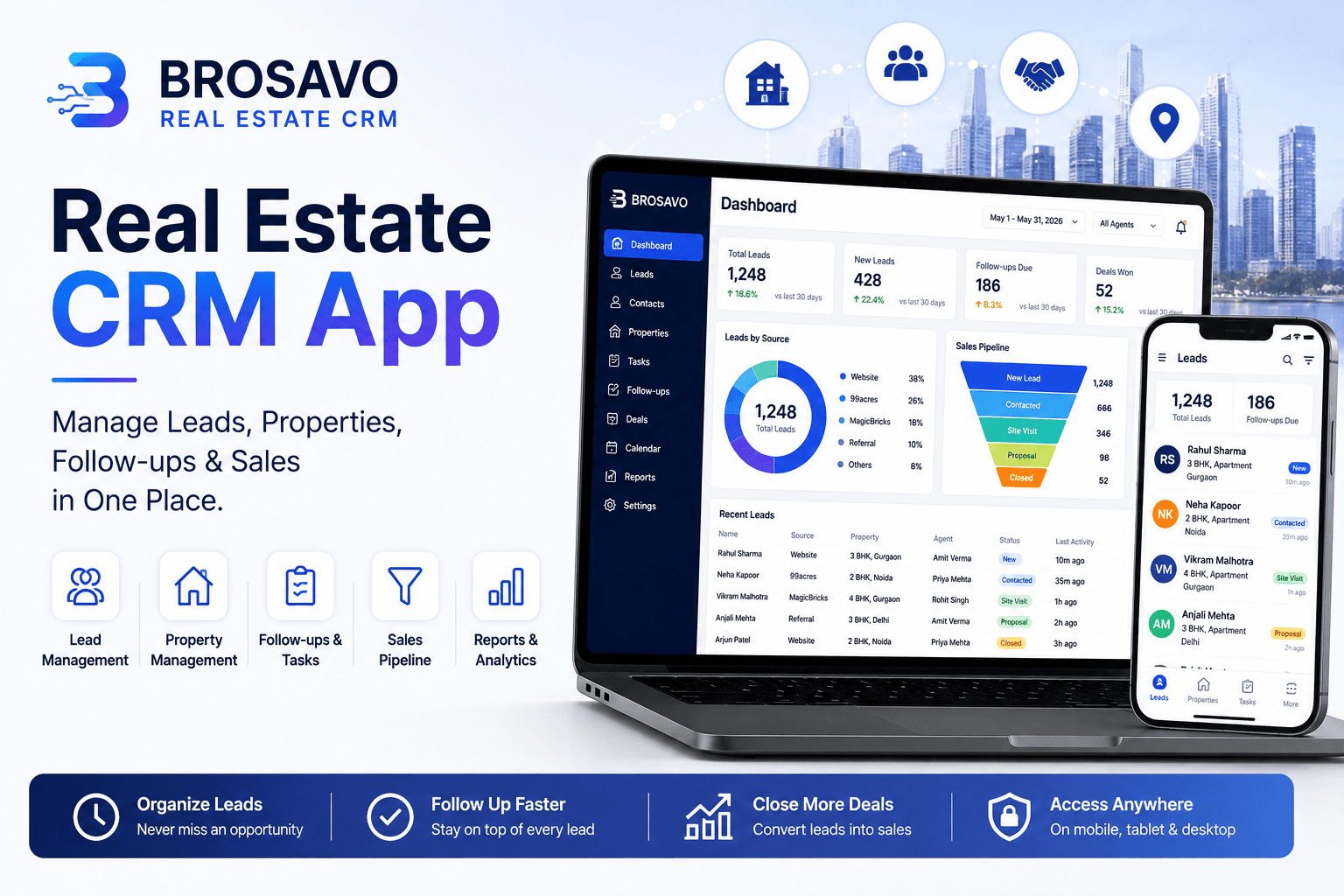
Real Estate CRM App: Manage Leads, Properties, Follow-Ups & Sales in One Place
Looking for a real estate CRM app? Discover how BROSAVO helps agents, brokers and teams manage leads, properties, follow-ups and sales.
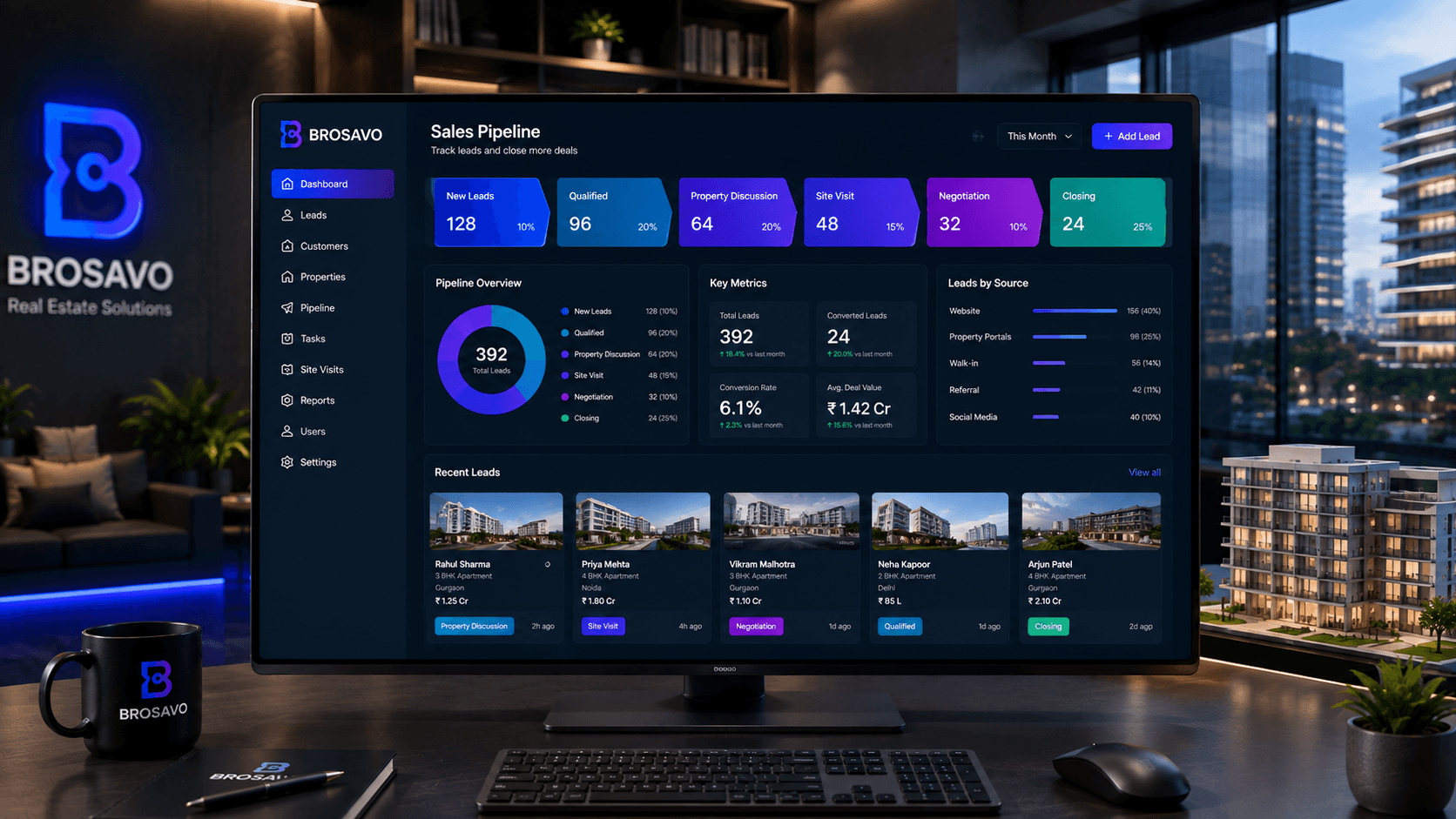
Real Estate Sales CRM: Manage Leads, Follow-Ups & Property Sales
Real estate sales CRM software for managing property leads, qualification, follow-ups, sales pipelines, site visits and customer relationships in one system.
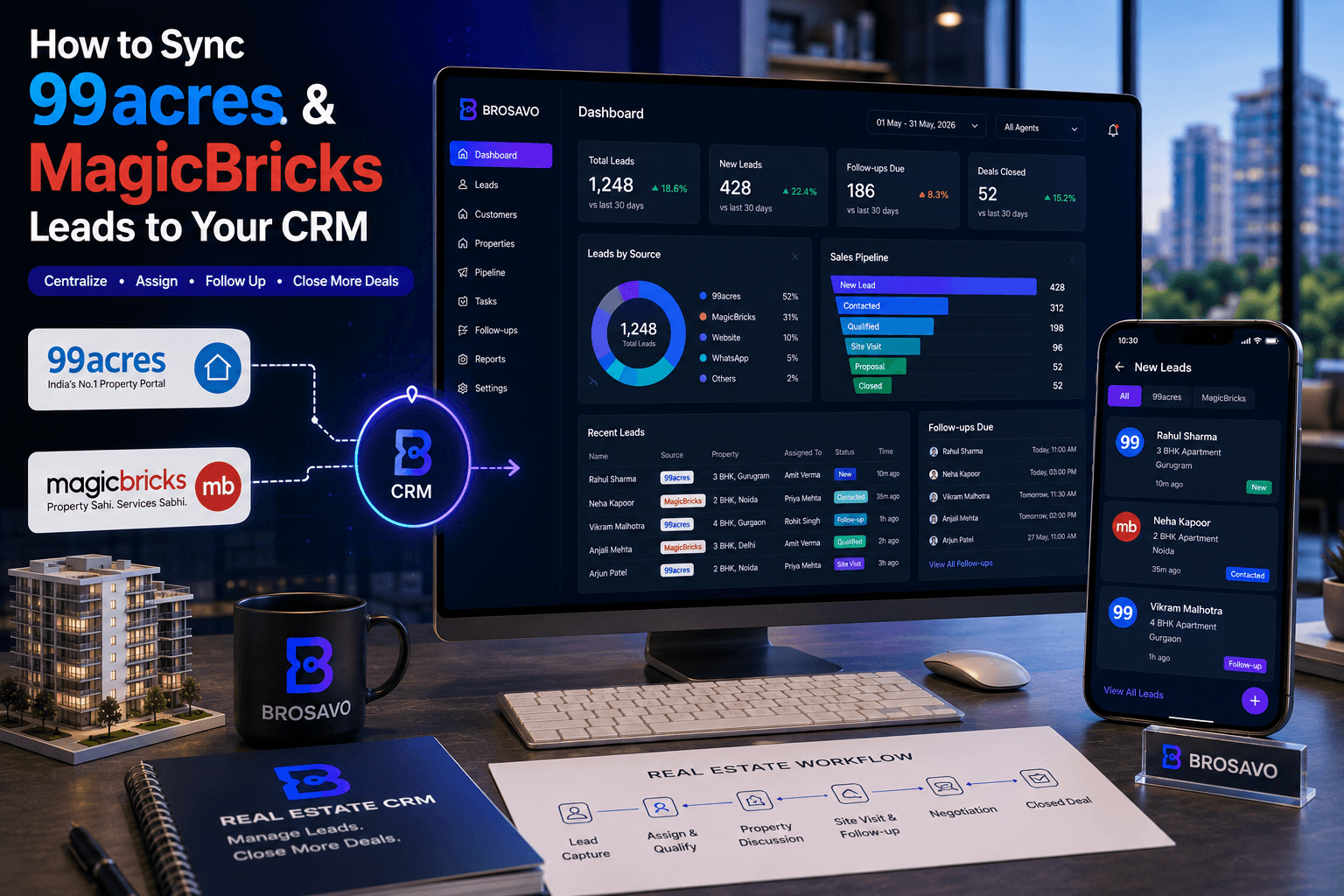
How to Sync 99acres and MagicBricks Leads to Your CRM in 2026
Learn how to sync 99acres and MagicBricks leads to a CRM, reduce manual entry, track enquiries, assign leads, and improve real estate follow-ups.