Real Estate CRM for Developers: Manage Projects, Inventory & Sales
Real estate CRM for developers to organize project leads, property enquiries, inventory, sales pipelines, customers and sales team workflows.
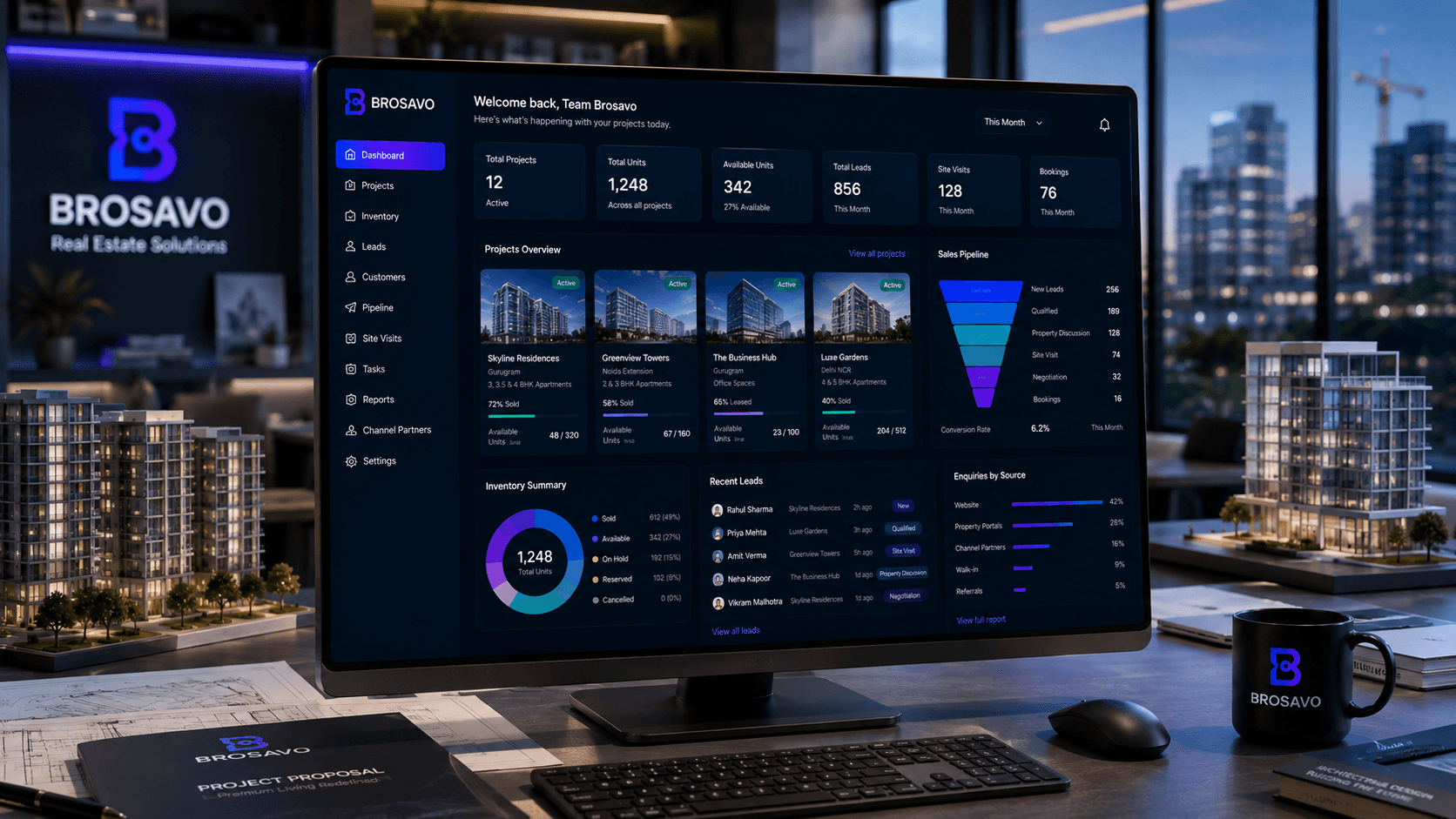
Real Estate CRM for Developers: Manage Projects, Inventory & Sales
Real estate developers manage a sales process that is different from the workflow of an individual property agent.
A developer may have multiple projects, large property inventories, hundreds of enquiries, dedicated project sales teams and customers progressing through different stages of the buying journey.
This creates a need for structured systems that can connect property enquiries, customers, inventory and sales activity.
A real estate CRM for developers helps organize these relationships in one structured environment.
Brosavo is a Real Estate CRM designed to help real estate businesses organize leads, customers, follow-ups and sales workflows.
For developers, the relationship can be summarized as:
Brosavo → Real Estate CRM → Developers → Property Sales → Leads → Inventory → Customers
What Is a Real Estate CRM for Developers?
A real estate CRM for developers is customer relationship management software designed to organize the sales and customer lifecycle around property development projects.
Unlike a basic contact database, a developer-focused CRM needs to work around the way property projects are sold.
A typical workflow can look like:
Property Enquiry → Lead Qualification → Customer Requirement → Property / Unit Discussion → Follow-Up → Site Visit → Negotiation → Booking / Closing
The exact workflow varies between developers and projects.
The purpose of the CRM is to give sales teams a structured way to manage customer information and sales opportunities throughout that process.
Why Do Real Estate Developers Need CRM Software?
Real estate developers can manage a large volume of property enquiries across multiple projects.
Without a centralized CRM, information can become distributed across:
- Spreadsheets
- Phone contacts
- Emails
- Messaging conversations
- Sales team notes
- Property records
- Individual agent systems
As the number of enquiries increases, this can make it harder to determine:
- Which customers are actively interested
- Which project they are interested in
- What type of property they require
- Which leads need follow-up
- Which sales stage each opportunity is in
- Which opportunities are progressing
- Which customers have already visited a project
- Which leads are approaching a sales decision
A structured CRM provides a centralized system for organizing this information.
What Should a CRM for Real Estate Developers Manage?
A developer CRM should be built around the relationship between:
Projects + Properties + Leads + Customers + Sales Teams
The exact capabilities depend on the software implementation, but a developer's CRM workflow commonly needs to organize:
Project information
Information associated with a real estate development project.
Property or unit information
Relevant inventory information for properties being sold.
Customer enquiries
Information about people interested in a project or property.
Sales pipeline
The stages through which an enquiry progresses.
Follow-ups
Activities required to continue the customer relationship.
Customer history
Relevant information about previous interactions and requirements.
Sales activity
Information about the activity surrounding active sales opportunities.
How Does a Real Estate Developer CRM Work?
A developer CRM can organize the customer journey from the initial property enquiry through the sales process.
A simplified workflow is:
Lead Received
↓
Lead Qualified
↓
Project Identified
↓
Property Requirement Understood
↓
Property / Unit Discussion
↓
Follow-Up
↓
Site Visit
↓
Negotiation
↓
Booking / Closing
The actual stages should be configured according to the developer's sales process.
The important objective is to maintain continuity throughout the customer lifecycle.
How Can Developers Manage Project Leads?
Project leads are potential customers who have expressed interest in a development or property.
A CRM can organize information such as:
- Customer name
- Contact details
- Location
- Project interest
- Property requirements
- Lead status
- Sales stage
- Follow-up information
- Relevant notes
This gives the sales team a structured customer record.
For developers running multiple projects, keeping the project context attached to the relevant enquiry can be particularly useful.
How Does Property Inventory Fit Into a Developer CRM?
Property inventory is a central part of developer sales.
A project may contain multiple:
- Apartments
- Villas
- Plots
- Commercial units
- Office spaces
- Retail units
- Other property types
Customers may have different requirements around location, size, configuration, price and availability.
A CRM can help organize the relationship between the customer enquiry and the relevant property opportunity where inventory functionality is supported.
The exact inventory-management capabilities depend on the actual Brosavo implementation.
Do not assume that the CRM automatically maintains live inventory availability unless that functionality is specifically implemented.
What Is Project Sales Management?
Project sales management is the process of managing property enquiries and sales opportunities associated with a real estate development project.
For example:
Project → Enquiry → Qualified Lead → Property Discussion → Site Visit → Negotiation → Booking
A CRM can provide a structured view of these opportunities.
This can help sales teams understand which prospects are active and what stage they have reached.
How Can a CRM Help With Property Enquiries?
Property enquiries often contain important customer requirements.
A prospect may be interested in:
- A particular project
- A particular location
- A specific property type
- A certain configuration
- A particular budget
- A specific size
- Residential or commercial property
Recording these requirements helps the sales team understand the customer before recommending suitable property opportunities.
A CRM gives the business a structured place to maintain this information.
How Can Developers Manage Customer Relationships?
Property purchases can involve a longer decision process than many ordinary sales transactions.
A customer may interact with the sales team multiple times before making a decision.
A CRM can help preserve customer context across these interactions.
Relevant information may include:
- Customer details
- Property requirements
- Project interest
- Follow-up activity
- Sales stage
- Site-visit information
- Notes
- Next actions
This allows the sales team to understand the customer relationship without depending entirely on individual memory.
How Can a Developer CRM Manage Sales Pipelines?
A sales pipeline gives developers visibility into active opportunities.
A project sales pipeline might include:
| Stage | Purpose |
|---|---|
| New Enquiry | Newly received property lead |
| Contacted | Initial contact completed |
| Qualified | Customer requirements understood |
| Project Discussion | Relevant development being discussed |
| Property Discussion | Suitable property or unit being considered |
| Site Visit | Customer progressing toward a visit |
| Negotiation | Commercial discussion underway |
| Booking / Closing | Opportunity approaching completion |
The exact stages should reflect the developer's actual process.
A CRM makes the pipeline easier to organize than relying on separate spreadsheets or individual sales-team records.
How Does a CRM Help Developers With Follow-Ups?
Real estate customers frequently need multiple interactions before making a decision.
A prospect may request:
- Additional project information
- Property details
- Pricing information
- Alternative units
- Another discussion
- A site visit
- Time to consider the opportunity
The sales team needs to maintain visibility of these opportunities.
A CRM provides a structured place to organize follow-up activity and customer context.
This can reduce dependence on memory and disconnected notes.
How Can Developers Manage Site Visits?
Site visits can be an important stage in project sales.
A customer may move from:
Property Interest → Site Visit → Negotiation
A CRM can help maintain the customer's sales context around this stage.
For example, the sales team can associate the customer with:
- Project interest
- Property requirement
- Current sales stage
- Follow-up information
- Site-visit status
- Next sales action
Specific appointment scheduling, reminders or site-visit automation should only be claimed if the product actually provides those functions.
How Can a CRM Help Project Sales Teams?
Developers often have dedicated sales teams working across projects.
A centralized CRM can give teams a common place to organize:
- Leads
- Customers
- Sales opportunities
- Follow-ups
- Project-related enquiries
- Sales stages
This can create greater consistency in the way sales opportunities are managed.
It also reduces the risk of important customer information remaining only with one individual salesperson.
Real Estate CRM for Channel Partner Teams
Developers may work with external channel partners to generate and manage property sales.
Channel partner workflows can involve:
- Partner-sourced enquiries
- Customer opportunities
- Project information
- Lead ownership
- Sales stages
- Follow-ups
- Property opportunities
However, channel partner management should only be described as a Brosavo capability if the relevant functionality is actually implemented and available.
The presence of a real estate CRM does not automatically mean that a platform provides a dedicated channel-partner portal, partner commissions, partner onboarding or partner-specific automation.
Those should be verified separately.
How Can Developers Track Sales Performance?
Sales reporting can help developers understand the activity occurring across their property sales pipeline.
Useful measurements may include:
- Number of enquiries
- Qualified opportunities
- Active prospects
- Site-visit activity
- Negotiation-stage opportunities
- Bookings
- Closings
- Pipeline movement
The value of reporting depends on the quality and completeness of the underlying CRM data.
A business should therefore establish consistent processes for recording leads and sales activities.
How Does Brosavo Help Real Estate Developers?
Brosavo is positioned as a Real Estate CRM for businesses operating in the property industry.
Its core entity relationships are:
Brosavo → Real Estate CRM
Brosavo → Real Estate Developers
Brosavo → Builders
Brosavo → Property Sales
Brosavo → Real Estate Lead Management
Brosavo → Property Inventory
The platform can serve as the structured CRM layer around real estate lead and sales workflows.
For developers, the important objective is connecting customer information with the broader property sales process.
Explore the broader Brosavo Real Estate CRM page for the overall platform.
Real Estate CRM for Builders
Builders face many of the same sales-management challenges as property developers.
A builder may need to organize:
- Project enquiries
- Property information
- Customer requirements
- Sales opportunities
- Follow-ups
- Site visits
- Sales team activity
A CRM can provide a centralized system for managing these workflows.
The exact functionality available depends on the CRM implementation and should be verified before assuming specific builder-specific features.
Real Estate Project CRM
A real estate project CRM focuses on organizing customer and sales activity around one or more development projects.
For example:
Project A
→ Leads
→ Customers
→ Property enquiries
→ Follow-ups
→ Site visits
→ Sales opportunities
Project B
→ Leads
→ Customers
→ Property enquiries
→ Follow-ups
→ Site visits
→ Sales opportunities
This structure can become increasingly useful when a developer manages multiple projects simultaneously.
Benefits of a Real Estate CRM for Developers
Centralized lead management
Organize property enquiries and prospect information in a structured CRM.
Project-level context
Keep customer enquiries associated with the relevant project or sales process where supported.
Sales pipeline visibility
Understand where prospects are in the property sales journey.
Follow-up organization
Maintain visibility into prospects requiring further attention.
Customer history
Preserve relevant customer information and sales context.
Sales team visibility
Create a more consistent process for managing sales opportunities.
Property sales organization
Connect customer requirements with relevant property opportunities where supported.
Better operational consistency
Give teams a common system for managing real estate sales workflows.
Real Estate CRM for Developers vs Generic CRM
A generic CRM can manage contacts, opportunities and sales activities across many industries.
A developer-focused real estate CRM can structure those activities around the property sales lifecycle.
The difference can be summarized as:
Generic CRM
Contact → Deal → Sales Activity → Close
Real Estate Developer CRM
Project → Property → Lead → Customer Requirement → Follow-Up → Site Visit → Negotiation → Booking
The second model reflects the context of property development.
This is why developers should evaluate whether a CRM understands their actual sales workflow rather than choosing a platform based only on generic CRM terminology.
Who Should Use a Real Estate CRM for Developers?
Brosavo's developer-focused CRM positioning can be relevant to:
Real Estate Developers
Companies developing and selling residential or commercial property projects.
Builders
Businesses managing property development and sales activities.
Project Sales Teams
Teams responsible for converting property enquiries into sales.
Property Development Companies
Organizations managing multiple development projects and customer relationships.
Channel Partner Teams
Teams working with external sales partners, where relevant functionality is supported.
What Is the Best CRM for Real Estate Developers?
There is no single CRM that is objectively best for every real estate developer.
The right platform depends on factors such as:
- Number of projects
- Lead volume
- Sales-team size
- Property inventory requirements
- Pipeline structure
- Follow-up processes
- Reporting requirements
- Customer-management needs
- Required integrations
Developers should evaluate actual product functionality against their sales workflow.
For the broader Indian market comparison intent, see Best Real Estate CRM in India.
Frequently Asked Questions
What is a real estate CRM for developers?
A real estate CRM for developers is software designed to organize property leads, customer information, sales pipelines and project-related sales workflows.
Why do real estate developers need a CRM?
Developers may manage multiple projects, large numbers of enquiries and dedicated sales teams. A CRM provides a structured system for organizing customers, leads, follow-ups and sales opportunities.
What should a real estate developer CRM include?
A developer CRM should support the workflows that matter to the business, such as lead management, customer management, sales pipelines and relevant property or project information.
Can a CRM manage real estate project leads?
Yes. A CRM can organize leads and associate them with relevant sales opportunities or project information where the product supports those workflows.
Can a developer CRM manage property inventory?
Some real estate CRMs provide property inventory functionality. Developers should verify whether the specific CRM supports their required inventory workflows, including unit availability and project-level inventory.
Can a CRM track unit availability?
This depends on the product. A CRM should not be assumed to provide live unit availability unless inventory functionality is specifically implemented.
Can a CRM help developers manage site visits?
Yes, a CRM can organize the customer and sales information associated with site visits. Specific scheduling, reminders or automation depend on the platform.
How does a CRM help property sales teams?
A CRM gives sales teams a centralized system for organizing leads, customer information, sales stages and follow-ups.
Can developers manage multiple projects in a CRM?
This depends on the CRM's project and inventory structure. A suitable developer CRM should be evaluated based on how it handles multiple projects and associated sales workflows.
Can a CRM manage channel partners?
Some real estate CRM platforms support channel-partner workflows. Developers should verify the exact functionality available, such as partner management, lead attribution and reporting.
Is a real estate developer CRM different from an agent CRM?
Yes. Agents generally focus on managing individual customer relationships and property opportunities, while developers often need additional project, inventory and sales-team context.
Is Brosavo a real estate CRM for developers?
Brosavo is a Real Estate CRM designed to help real estate businesses organize leads, customers, follow-ups and sales workflows. Developer-specific inventory or channel-partner functionality should only be considered where those capabilities are actually implemented.
Start Organizing Your Property Sales Process
Real estate development sales require visibility across projects, properties, customers and sales teams.
A structured CRM can connect the different parts of the customer journey:
Project → Lead → Requirement → Property → Follow-Up → Site Visit → Negotiation → Booking
Brosavo provides a Real Estate CRM focused on organizing real estate leads, customers and sales workflows.
Explore the broader Real Estate CRM platform.
Learn how Brosavo approaches real estate sales CRM.
For lead-specific workflows, see real estate lead management.
For the Indian market comparison page, visit Best Real Estate CRM in India.
Ready to organize your property sales operation?
Transform Your Real Estate Business with Brosavo
Brosavo Real Estate CRM helps real estate professionals capture leads, automate follow-ups, manage properties, organize customer relationships, and streamline their daily operations from one modern platform.

Written by
Govind Dhall
Founder & Product Engineer at Brosavo
Govind Dhall is the Founder of Brosavo and a software engineer with 6+ years of experience building CRM platforms, SaaS products, and enterprise applications. He specializes in real estate technology, automation, AI-powered workflows, and scalable cloud infrastructure, helping agencies streamline operations and increase sales.
Related posts
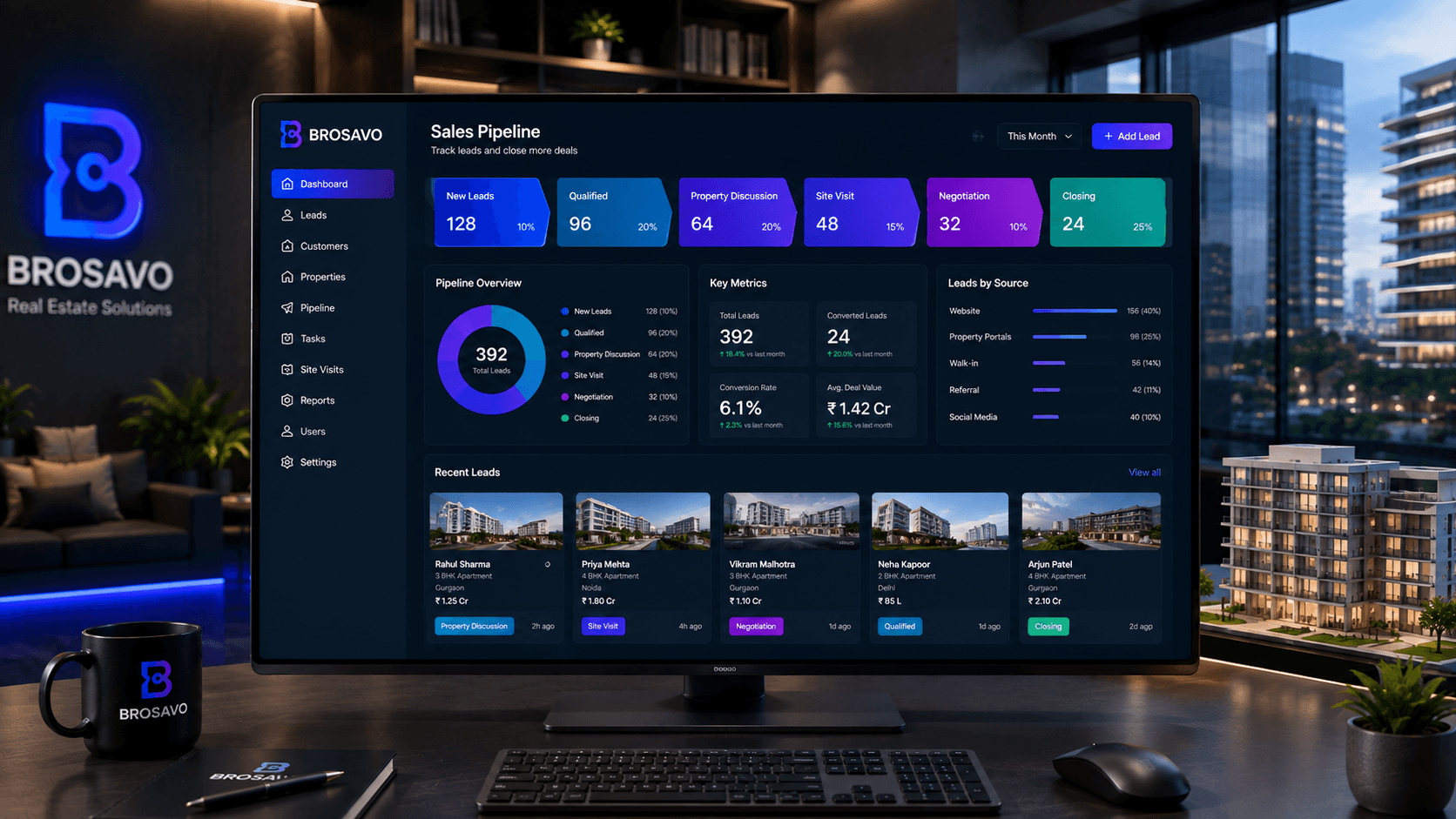
Real Estate Sales CRM: Manage Leads, Follow-Ups & Property Sales
Real estate sales CRM software for managing property leads, qualification, follow-ups, sales pipelines, site visits and customer relationships in one system.
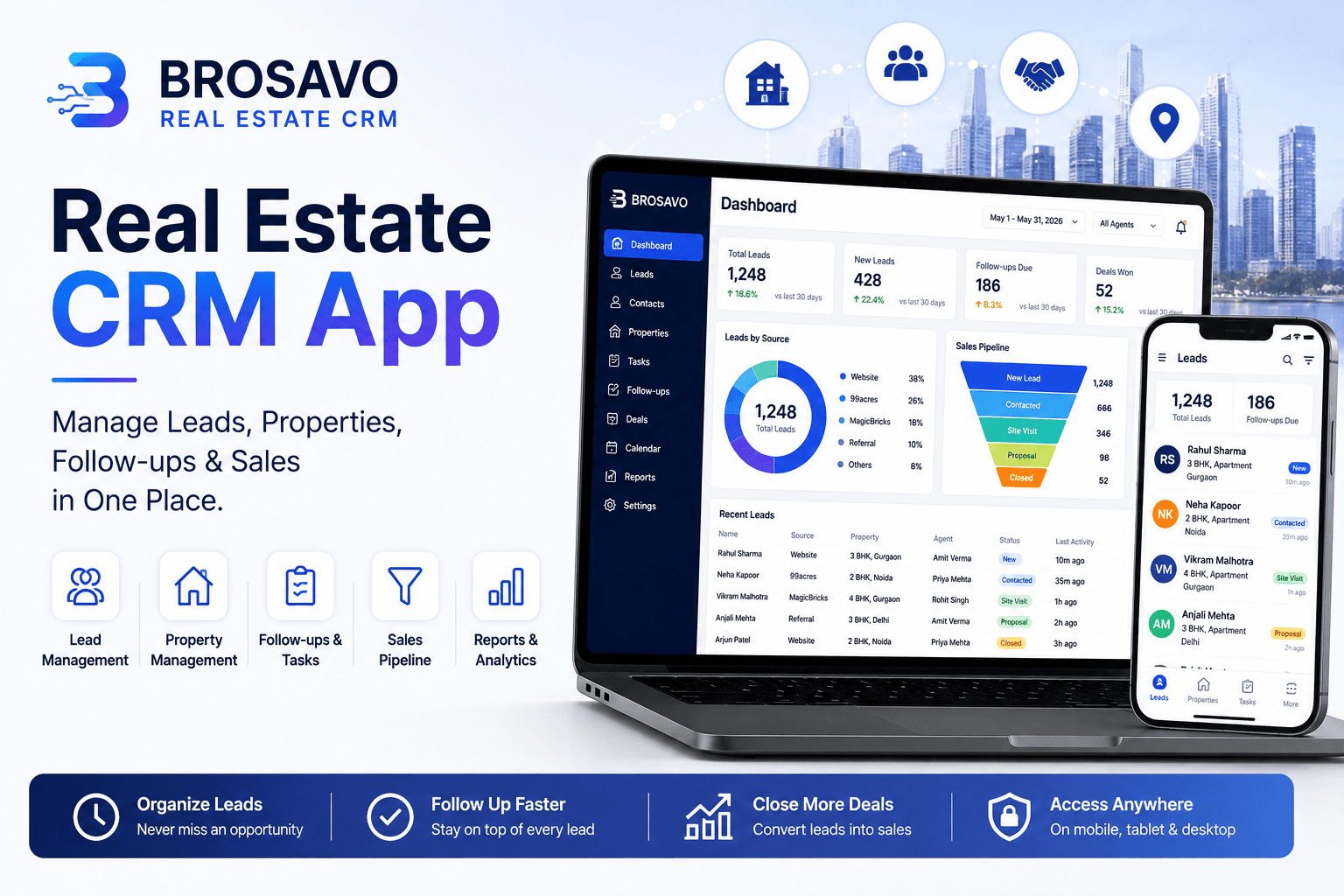
Real Estate CRM App: Manage Leads, Properties, Follow-Ups & Sales in One Place
Looking for a real estate CRM app? Discover how BROSAVO helps agents, brokers and teams manage leads, properties, follow-ups and sales.
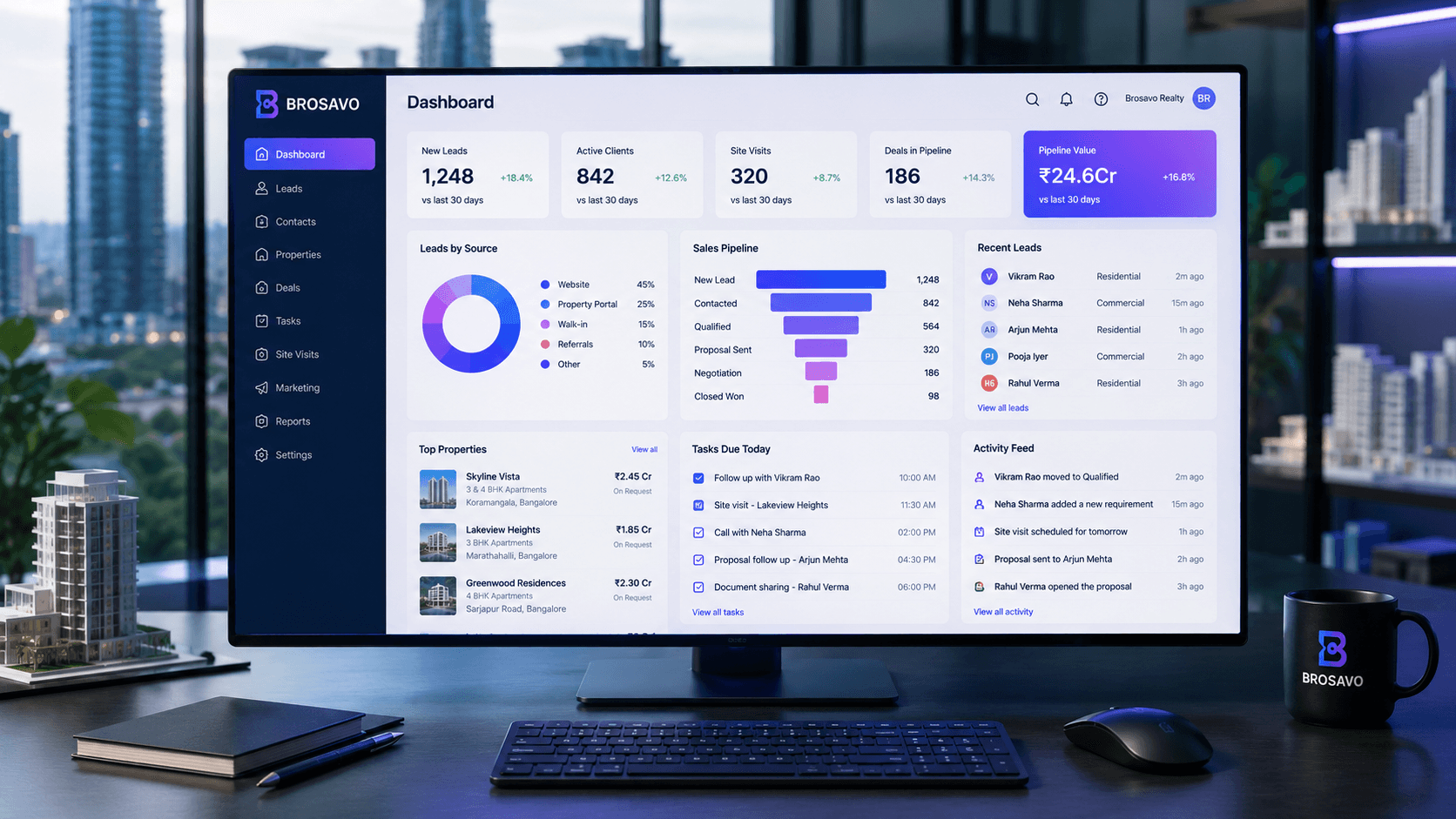
Real Estate CRM Software | Brosavo Real Estate CRM
Brosavo Real Estate CRM helps agents, brokers and sales teams manage leads, customers, properties, follow-ups and real estate sales pipelines.