WhatsApp CRM for Real Estate Agents: Manage Leads, Conversations & Follow-Ups
Learn how a WhatsApp CRM helps real estate agents capture property enquiries, organize conversations, manage follow-ups, and improve the sales process.
Introduction
WhatsApp has become an important communication channel for real estate agents, brokers, builders, and property consultants. Buyers and sellers can quickly send enquiries, ask questions, share documents, request property photos, and schedule site visits without leaving a familiar messaging application.
The challenge starts when the number of conversations grows.
An agent handling a handful of prospects may be able to remember who needs a follow-up and which property each person is interested in. An agent handling hundreds of enquiries has a very different problem.
Important messages can get buried. Follow-ups can be forgotten. Customer information can become scattered across WhatsApp, spreadsheets, property portals, and notes. Managers may also struggle to understand which leads are active, which agents are following up, and which opportunities are moving toward a deal.
A WhatsApp CRM for real estate agents connects customer communication with the broader sales process.
Instead of treating WhatsApp as a separate application, a CRM can connect conversations with leads, properties, follow-ups, sales stages, and team activity.
What is a WhatsApp CRM for Real Estate Agents?
A WhatsApp CRM is a customer relationship management system that connects WhatsApp communication with lead and sales management.
For a real estate business, this can bring information such as the following into one customer record:
- Lead name and contact details
- Property requirement
- Preferred location
- Budget
- Lead source
- Assigned agent
- Lead status
- Conversation history
- Follow-up dates
- Site visits
- Property recommendations
- Notes and tasks
- Sales activity
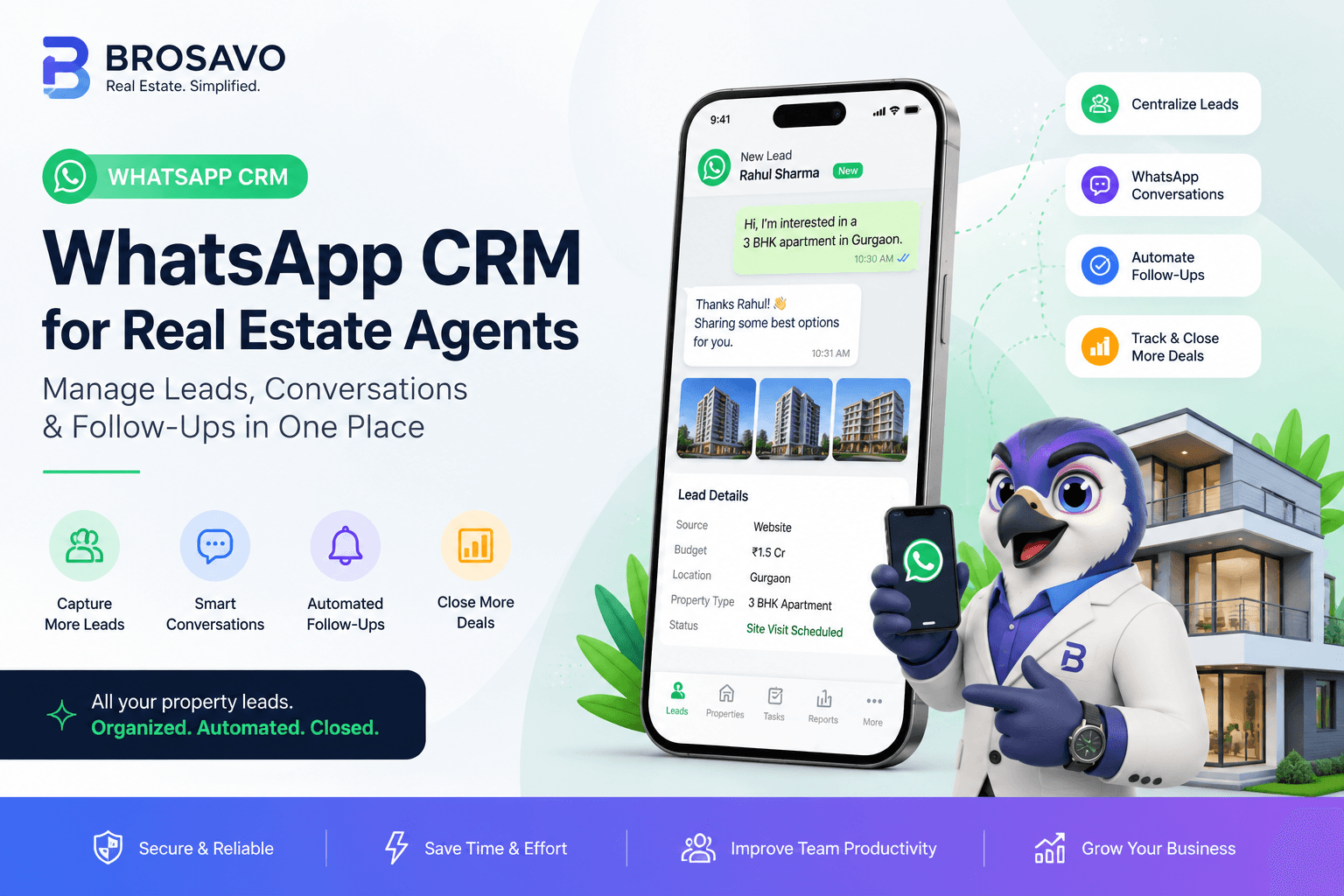
For example, a real estate lead might look like this:
Lead: Rahul Sharma
Source: Website
Requirement: 3 BHK apartment
Location: Gurgaon
Budget: ₹1.5 crore
Assigned Agent: Amit
Last Conversation: Yesterday
Next Follow-Up: Friday
Status: Site Visit Scheduled
The objective is not simply to store a WhatsApp conversation. The objective is to connect that conversation to the customer's entire sales journey.
Why WhatsApp Matters in Real Estate Sales
Real estate sales are relationship-driven and often involve many interactions before a transaction is completed.
A conversation may begin with a simple question:
"Is this property still available?"
It can then develop into:
- Property details
- Pricing
- Location information
- Photos and videos
- Floor plans
- Financing questions
- Property alternatives
- Site-visit scheduling
- Negotiation
- Documentation
- Booking
WhatsApp makes these interactions convenient for customers and agents.
However, communication volume can become difficult to manage as a real estate business grows.
Agents need answers to questions such as:
- Who contacted us?
- What property are they looking for?
- What is their budget?
- What did we discuss?
- Who owns the lead?
- When should we follow up?
- What should we send next?
A CRM can organize these details around the customer rather than leaving them scattered across individual conversations.
Problems With Managing Real Estate Leads Only Through WhatsApp
WhatsApp is an effective communication channel, but it is not a complete real estate sales management system.
1. Important Conversations Get Buried
Busy agents can receive a large number of messages every day.
A serious buyer who contacted an agent several days ago can become difficult to find among newer conversations.
A CRM gives the sales team a structured record of the lead and its current status.
2. Follow-Ups Depend on Memory
Real estate leads often require multiple interactions.
A customer may be interested in a property but not ready to purchase immediately.
Without a follow-up system, an agent may forget to contact the prospect at the right time.
A CRM can record the next action and provide a structured workflow for follow-ups.
3. Customer Information Becomes Fragmented
A typical real estate business may have:
- Customer conversations in WhatsApp
- Property inventory in a spreadsheet
- Lead sources in property portals
- Notes in notebooks
- Follow-up reminders in phones or calendars
- Documents in separate folders
This fragmentation makes it harder to understand the complete customer relationship.
4. Managers Have Limited Visibility
When every agent manages WhatsApp independently, managers may not know:
- How many new leads arrived
- How quickly leads were contacted
- Which leads are qualified
- Which leads need follow-up
- How many site visits are scheduled
- Which opportunities are close to conversion
A CRM can provide a centralized view of this activity.
5. Duplicate Communication Can Happen
A customer might submit an enquiry through a website and later contact the company through WhatsApp.
If the two enquiries are treated as separate records, multiple agents may contact the same customer.
Centralized lead management can help teams identify and manage duplicate records.
How a WhatsApp CRM Works for Real Estate
A typical real estate workflow can look like this:
Property Enquiry
       ↓
Lead Captured
       ↓
Customer Record
       ↓
WhatsApp Conversation
       ↓
Lead Qualified
       ↓
Property Matched
       ↓
Follow-Up Scheduled
       ↓
Site Visit
       ↓
Negotiation
       ↓
Booking
       ↓
Closed
The CRM provides a connected record of the customer's journey.
Lead Capture
Real estate enquiries can originate from many sources:
- Website forms
- Property portals
- Phone calls
- Walk-ins
- Referrals
- Existing customers
A CRM can help bring these enquiries into a central lead management workflow.
Lead Qualification
Not every enquiry represents the same sales opportunity.
Agents may need to understand:
- Property type
- Preferred location
- Budget
- Purchase purpose
- Financing requirements
- Purchase timeline
- Existing property preferences
- Previous site visits
This information helps agents prioritize prospects and recommend more relevant properties.
Property Matching
One of the biggest advantages of connecting a CRM with property management is the ability to relate a customer's requirement to available inventory.
For example:
Customer Requirement
        ↓
2 BHK
Gurgaon
₹90 Lakh Budget
        ↓
Available Properties
        ↓
Relevant Property Options
        ↓
WhatsApp
        ↓
Site Visit
Instead of searching through multiple systems, agents can work from a connected customer and property workflow.
Follow-Up Management
Follow-up is one of the most important parts of real estate sales.
A CRM can record the next action:
Lead Status: Interested
Next Action: Follow Up
Date: August 18
Requirement: 3 BHK
Budget: ₹1.2 crore
The agent then has context when contacting the prospect again.
A structured follow-up process can be especially useful for prospects who are interested but are not ready to make an immediate decision.
Lead Assignment
Real estate teams often have multiple agents handling enquiries.
A CRM can help assign leads based on factors such as:
- Location
- Property type
- Team
- Availability
- Lead source
- Agent specialization
This gives each enquiry a clear owner and makes accountability easier.
Sales Pipeline
A real estate CRM can organize opportunities into stages such as:
New Lead
   ↓
Contacted
   ↓
Qualified
   ↓
Property Shared
   ↓
Site Visit Scheduled
   ↓
Site Visit Completed
   ↓
Negotiation
   ↓
Booking
   ↓
Closed
Managers can then see where opportunities are moving and where deals are getting stuck.
Important Features of a WhatsApp CRM for Real Estate
Not every CRM is designed for property sales.
When evaluating a WhatsApp CRM, consider the following features.
1. Lead Management
The CRM should make it easy to create, search, filter, assign, and update leads.
Useful fields include:
- Name
- Phone
- Location
- Budget
- Property requirement
- Lead source
- Assigned agent
- Status
- Notes
- Follow-up date
2. WhatsApp Integration
WhatsApp communication should be connected to the relevant customer or lead record.
This allows the sales team to understand the conversation in the context of the customer's relationship with the business.
3. Conversation History
Previous conversations can provide important context.
Instead of asking the customer to repeat their requirement, an agent can review the available history and continue the conversation more naturally.
4. Follow-Up Management
A CRM should help agents schedule and track future actions.
Examples include:
- Call tomorrow
- Send property options
- Follow up after a site visit
- Check financing status
- Contact the customer next week
- Send new inventory
5. Lead Assignment
Teams need clear ownership of enquiries.
Lead assignment helps managers distribute opportunities and makes it easier to measure agent performance.
6. Property Inventory
Connecting leads with property inventory can help agents identify relevant properties faster.
A property-focused CRM can keep information such as availability, pricing, documents, and listing details connected to the sales process.
7. Sales Reporting
Managers may want to track:
- New leads
- Contacted leads
- Qualified leads
- Follow-ups
- Site visits
- Conversion rates
- Lead sources
- Agent performance
- Closed deals
These metrics provide a clearer view of sales activity than message volume alone.
WhatsApp CRM vs WhatsApp Business
WhatsApp Business and a WhatsApp CRM serve different purposes.
| Capability | WhatsApp Business | WhatsApp CRM |
|---|---|---|
| Messaging | Yes | Yes, through integration |
| Customer conversations | Yes | Yes |
| Lead management | Limited | Yes |
| Sales pipeline | No | Yes |
| Lead assignment | Limited | Yes |
| Follow-up management | Limited | Yes |
| Property management | No | Can be integrated |
| Team reporting | Limited | Yes |
| Customer history | Basic | Centralized |
| Sales analytics | Limited | Yes |
For an individual agent with a small number of customers, WhatsApp Business may be sufficient.
For a growing real estate team, integrating WhatsApp with a CRM can provide a more organized sales workflow.
WhatsApp CRM vs Excel for Real Estate Leads
Spreadsheets remain useful for basic record keeping, but they are not designed around ongoing customer conversations.
A lead record might contain:
Lead Name
Phone Number
Property Requirement
Budget
Source
Assigned Agent
Last Contact
Next Follow-Up
Site Visit
Status
A spreadsheet can store these fields, but communication still happens somewhere else.
The agent may have to switch between:
Spreadsheet
     +
WhatsApp
     +
Property Portal
     +
Email
     +
Phone
A CRM aims to connect these activities into a more structured workflow.
How WhatsApp CRM Automation Can Help
Automation can reduce repetitive administrative work.
Potential workflows include:
- New lead notifications
- Lead assignment
- Follow-up reminders
- Appointment confirmations
- Site-visit reminders
- Property enquiry acknowledgements
- Internal team notifications
- Lead status updates
For example:
New Property Enquiry
        ↓
Create Lead
        ↓
Assign Agent
        ↓
Notify Agent
        ↓
Agent Contacts Customer
        ↓
Schedule Follow-Up
Automation should support the salesperson rather than replace the personal communication that is important in property sales.
How to Choose the Right WhatsApp CRM for Real Estate
Before choosing a CRM, evaluate it against your actual sales process.
Can it manage leads from multiple sources?
If your business receives enquiries from websites, portals, social media, referrals, phone calls, and WhatsApp, the CRM should help organize them together.
Can it integrate with WhatsApp?
Customer communication should connect with the relevant lead record.
Can leads be assigned to agents?
This is particularly important for teams.
Can agents schedule follow-ups?
The CRM should make the next action clear.
Can it manage property inventory?
If property inventory is central to your business, property management or property integrations can be important.
Can managers see the sales pipeline?
Management needs visibility into opportunities and bottlenecks.
Can the business measure agent performance?
Reports should help managers understand activity, response times, conversion, and lead sources.
Can the platform scale?
The CRM should remain useful as the business adds more agents, leads, properties, and locations.
Best Practices for Real Estate WhatsApp CRM
- Respond to new enquiries quickly.
- Record important customer requirements.
- Keep the next action updated after every meaningful interaction.
- Use message templates for repetitive communication while personalizing important conversations.
- Keep lead ownership clear.
- Review stalled opportunities regularly.
- Connect customer requirements with relevant property inventory.
- Keep property information accurate and current.
- Use reporting to improve processes rather than simply measure activity.
Common Mistakes
Treating WhatsApp as the Entire CRM
WhatsApp is a communication channel. It should work as part of a broader sales process.
Relying on Memory for Follow-Ups
Interested prospects can easily be forgotten without structured follow-up management.
Keeping Property Data Separate
If agents cannot easily connect customer requirements with available properties, they may waste time searching manually.
Creating Too Many Pipeline Stages
A complicated pipeline can reduce adoption. Stages should reflect the actual sales process.
Measuring Only Message Volume
Sending more messages does not necessarily mean generating more sales. Businesses should also monitor response times, qualified leads, site visits, conversions, and revenue.
BROSAVO for Real Estate Businesses
BROSAVO is building technology and software solutions for businesses, including tools designed around modern real estate sales workflows.
The goal of a real estate CRM should not simply be to provide another messaging inbox.
It should connect:
Lead
 ↓
Customer
 ↓
WhatsApp
 ↓
Property
 ↓
Follow-Up
 ↓
Site Visit
 ↓
Negotiation
 ↓
Deal
into one connected sales process.
BROSAVO Real Estate CRM is designed to bring lead management, customer information, property activity, follow-ups, and sales workflows together in a centralized platform.
For businesses evaluating a CRM, the right choice should depend on the company's size, sales process, property inventory, communication channels, team structure, and integration requirements.
Conclusion
WhatsApp is an important communication channel for modern real estate businesses.
The challenge is not communicating with customers. The challenge is managing the growing number of conversations, enquiries, properties, follow-ups, and sales activities that happen around those conversations.
A WhatsApp CRM can help transform scattered communication into a structured sales workflow.
By connecting WhatsApp with lead management, property inventory, follow-ups, sales pipelines, and reporting, real estate teams can create better visibility and more consistent processes.
For individual agents, this can mean better organization and fewer missed follow-ups.
For growing agencies and brokerages, it can provide managers with a clearer view of leads, agents, properties, and sales activity.
If your real estate business is still managing leads across spreadsheets, personal WhatsApp conversations, and disconnected tools, a centralized CRM can be a significant step toward a more scalable sales operation.
A WhatsApp CRM for real estate agents connects WhatsApp communication with lead management, customer records, follow-ups, sales pipelines, and other real estate workflows in one system.
Why do real estate agents use WhatsApp CRM software?
Real estate agents use WhatsApp CRM software to organize enquiries, maintain conversation history, schedule follow-ups, assign leads, and manage customer communication alongside the broader sales process.
Can a WhatsApp CRM help real estate agents manage follow-ups?
Yes. A WhatsApp CRM can help agents record next actions, schedule follow-ups, track lead stages, and keep customer conversations connected to the relevant lead.
Is WhatsApp Business the same as a WhatsApp CRM?
No. WhatsApp Business is primarily a communication tool, while a CRM manages leads, customer relationships, sales activity, follow-ups, reporting, and team workflows. A CRM can integrate WhatsApp into that broader process.
What features should a real estate WhatsApp CRM have?
Important features include lead management, WhatsApp integration, conversation history, follow-up reminders, lead assignment, property matching, sales pipeline management, reporting, automation, and integrations with lead sources.
Can Brosavo integrate WhatsApp with real estate CRM workflows?
Brosavo is designed around connected real estate workflows that can bring lead management, customer communication, property activity, and follow-ups into one platform. Available WhatsApp features and integrations depend on the configured plan and integration setup.
Explore More Real Estate CRM Guides
If you are researching real estate CRM software, explore our guides on the best CRM for real estate agents, the best CRM for realtors in Canada, and real estate CRM benefits.
Frequently Asked Questions
What is a WhatsApp CRM for real estate agents?+
A WhatsApp CRM for real estate agents connects WhatsApp communication with lead management, customer records, follow-ups, sales pipelines, and other real estate workflows in one system.
Why do real estate agents use WhatsApp CRM software?+
Real estate agents use WhatsApp CRM software to organize enquiries, maintain conversation history, schedule follow-ups, assign leads, and manage customer communication alongside the broader sales process.
Can a WhatsApp CRM help real estate agents manage follow-ups?+
Yes. A WhatsApp CRM can help agents record next actions, schedule follow-ups, track lead stages, and keep customer conversations connected to the relevant lead.
Is WhatsApp Business the same as a WhatsApp CRM?+
No. WhatsApp Business is primarily a communication tool, while a CRM manages leads, customer relationships, sales activity, follow-ups, reporting, and team workflows. A CRM can integrate WhatsApp into that broader process.
What features should a real estate WhatsApp CRM have?+
Important features include lead management, WhatsApp integration, conversation history, follow-up reminders, lead assignment, property matching, sales pipeline management, reporting, automation, and integrations with lead sources.
Can Brosavo integrate WhatsApp with real estate CRM workflows?+
Brosavo is designed around connected real estate workflows that can bring lead management, customer communication, property activity, and follow-ups into one platform. Available WhatsApp features and integrations depend on the configured plan and integration setup.
Transform Your Real Estate Business with Brosavo
Brosavo Real Estate CRM helps real estate professionals capture leads, automate follow-ups, manage properties, organize customer relationships, and streamline their daily operations from one modern platform.

Written by
Govind Dhall
Founder & Product Engineer at Brosavo
Govind Dhall is the Founder of Brosavo and a software engineer with 6+ years of experience building CRM platforms, SaaS products, and enterprise applications. He specializes in real estate technology, automation, AI-powered workflows, and scalable cloud infrastructure, helping agencies streamline operations and increase sales.
Related posts

15 Benefits of a Real Estate CRM
Discover how a real estate CRM centralizes leads, automates follow-ups, and helps agencies close more deals with AI-powered workflows.
Real Estate CRM Software | Brosavo Real Estate CRM
Brosavo Real Estate CRM helps agents, brokers and sales teams manage leads, customers, properties, follow-ups and real estate sales pipelines.
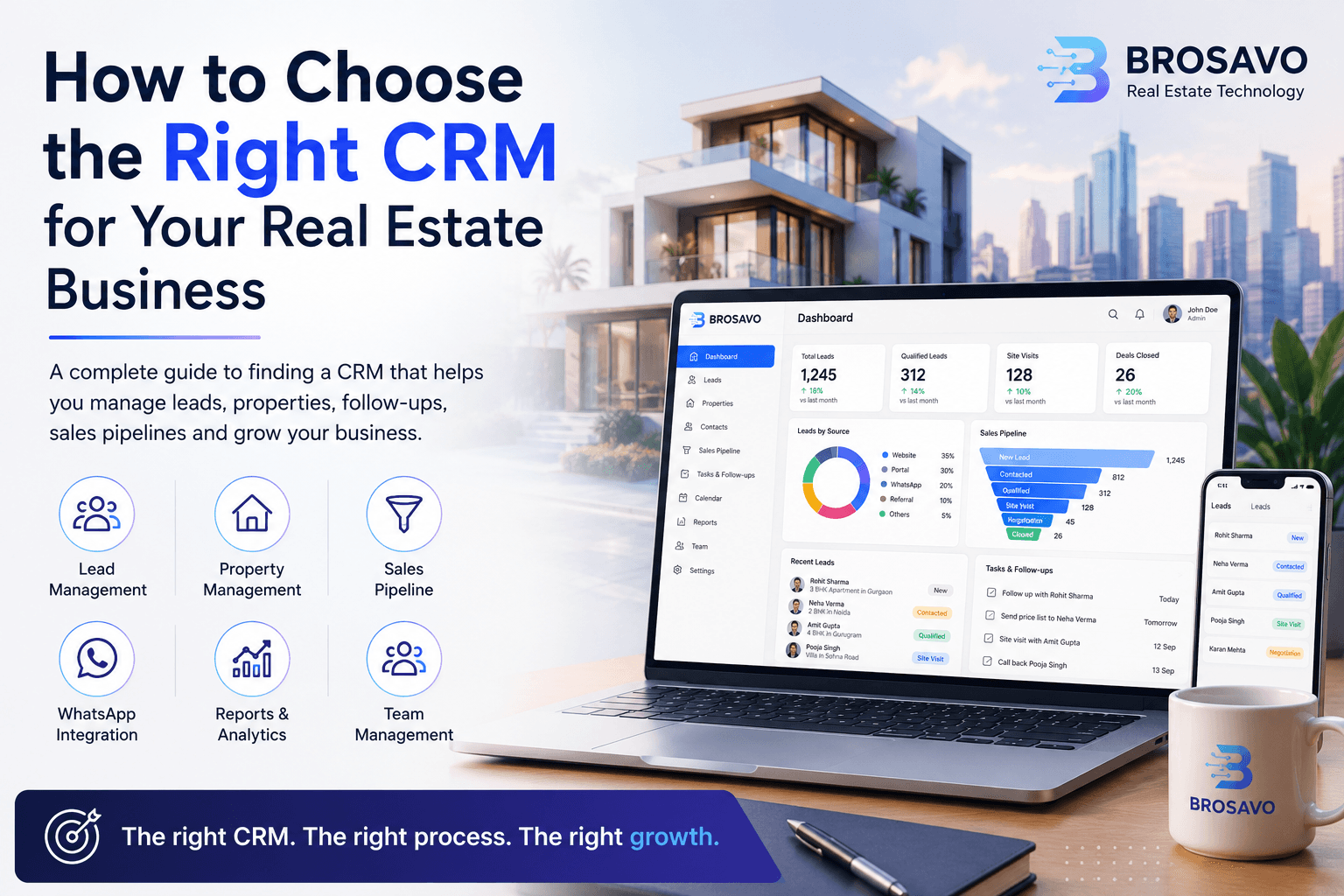
How to Choose the Right CRM for Your Real Estate Business
Learn how to choose the right real estate CRM for your business, from lead management and property matching to automation, reporting and team tools.