Real Estate Lead Management Software | Track & Convert Property Leads
Manage real estate leads from enquiry to closing with Brosavo. Track leads, follow-ups, assignments, pipelines and customer interactions.
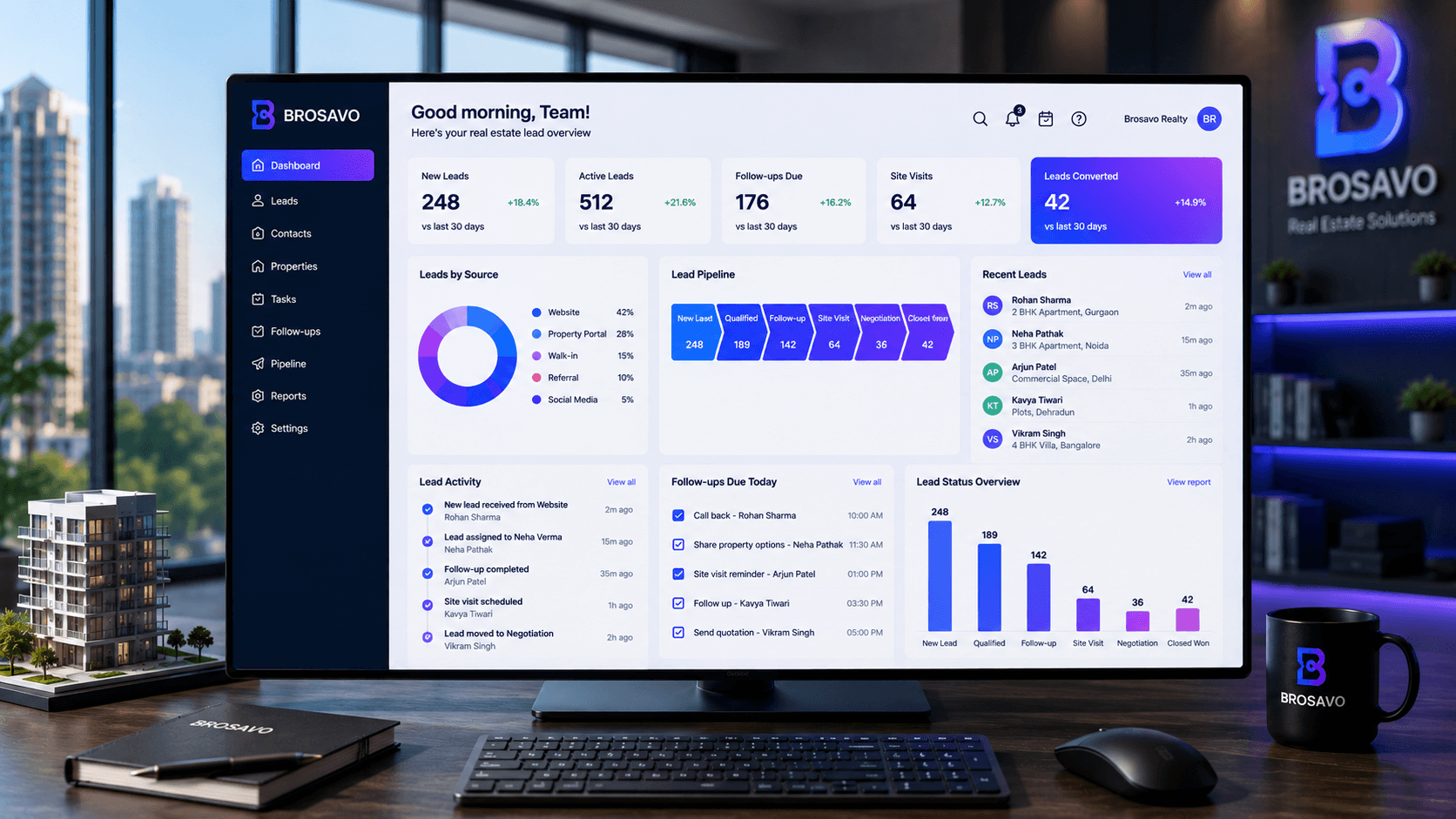
Real Estate Lead Management Software for Property Sales Teams
Managing real estate leads is more than collecting names and phone numbers.
Every property enquiry can represent a potential buyer, seller, investor, tenant, developer relationship, or future business opportunity. When these enquiries are spread across spreadsheets, phone calls, WhatsApp conversations, notebooks, and different team members, it becomes difficult to know what needs attention next.
Brosavo is real estate CRM software designed to help real estate businesses organize leads, customer information, follow-ups, sales activity, and pipeline visibility in one system.
For teams specifically looking for a broader CRM platform, see our Real Estate CRM page.
What Is Real Estate Lead Management?
Real estate lead management is the process of capturing, organizing, qualifying, assigning, tracking, and following up with property enquiries throughout the sales process.
Instead of treating every enquiry as a separate spreadsheet row or phone contact, lead management creates a structured process for moving an enquiry toward a sales outcome.
A typical real estate lead lifecycle can look like:
Lead Capture → Qualification → Assignment → Follow-Up → Property Matching → Site Visit → Negotiation → Booking or Closing
The exact process varies between real estate businesses, but the objective remains the same: make sure every important enquiry is organized and has a clear next step.
Why Do Real Estate Businesses Need Lead Management?
Real estate businesses can receive enquiries from websites, referrals, advertising, property portals, social media, phone calls, walk-ins, and other sources.
Without a structured lead management process, common problems include:
- Lost or forgotten enquiries
- Delayed follow-ups
- Duplicate customer records
- Unclear lead ownership
- Scattered customer information
- Spreadsheet dependency
- Limited pipeline visibility
- Difficulty understanding which leads are active
- Inconsistent follow-up between salespeople
- Difficulty reviewing sales activity
Lead management gives the business a central way to organize these activities.
The goal is not simply to store more leads.
The goal is to help salespeople know which lead needs attention, what has already happened, and what should happen next.
How Does Real Estate Lead Management Work?
A real estate lead management system generally organizes an enquiry through several stages.
1. Lead Capture
A potential customer becomes a lead after making an enquiry.
The lead may contain information such as:
- Name
- Phone number
- City or location
- Property requirement
- Business or company information
- Source of enquiry
- Additional requirements
The objective is to make the enquiry available to the sales team in an organized format.
2. Lead Qualification
Not every enquiry has the same level of intent.
Sales teams may need to understand:
- What type of property the customer wants
- Preferred location
- Budget
- Buying or selling requirement
- Expected timeline
- Residential or commercial requirement
- Other relevant information
Qualification helps salespeople understand which opportunities deserve attention first.
3. Lead Assignment
In a real estate team, someone needs to be responsible for each enquiry.
Lead assignment establishes ownership so the team can understand:
Who is responsible for this lead?
This becomes particularly important when multiple agents or salespeople are working with the same brokerage or agency.
For larger teams, see our dedicated guide to Real Estate CRM for Brokers.
4. Follow-Up
Real estate sales often require multiple interactions.
A potential customer may not be ready to make a decision after the first conversation.
Follow-up management helps sales teams keep track of ongoing conversations and customer requirements instead of relying entirely on memory, notebooks, or disconnected spreadsheets.
The important question becomes:
What needs to happen next with this lead?
5. Property Matching
Once a customer's requirement is understood, the sales team can identify properties that may match the enquiry.
For example:
Customer requirement
- 3-bedroom apartment
- Gurugram
- Specific budget
- Preferred location
The salesperson can then work through relevant property options and continue the conversation with the customer.
6. Site Visit
For property sales, an enquiry may progress to a property viewing or site visit.
A structured sales workflow allows the team to understand which opportunities have progressed beyond initial enquiry and which customers still require follow-up.
7. Negotiation and Closing
Qualified opportunities may eventually move toward negotiation, booking, or closing.
A sales pipeline gives the business a clearer view of where active opportunities currently stand.
How Does Brosavo Manage Real Estate Leads?
Brosavo connects real estate lead management with customer management and sales pipeline workflows.
The platform is designed around the needs of real estate businesses rather than treating property enquiries as generic contacts.
The core relationship can be summarized as:
Brosavo → Real Estate CRM → Lead Management → Lead Tracking → Real Estate Sales
This allows a real estate business to organize its sales process around the leads that drive its revenue.
Real Estate Lead Tracking
How Do Real Estate Agents Track Leads?
Real estate agents can track leads by maintaining organized customer information and monitoring where each enquiry currently sits in the sales process.
Instead of depending on separate spreadsheets or personal notes, a centralized system gives the salesperson a consistent place to manage lead information.
Lead tracking can help answer questions such as:
- Who is the customer?
- What property are they looking for?
- Where are they located?
- Who is handling the enquiry?
- What stage is the opportunity in?
- What follow-up is required?
- Has the customer progressed further in the sales process?
For individual agents, this can make daily lead management easier to organize.
For teams, it can provide greater visibility across active enquiries.
Lead Assignment for Real Estate Teams
When several salespeople work together, lead ownership becomes important.
A brokerage may have dozens or hundreds of enquiries being handled by different agents.
Without clear ownership, two problems can occur:
- Multiple people may contact the same customer.
- Nobody may take responsibility for an enquiry.
A structured lead management workflow helps the business establish who is handling each opportunity.
This is particularly relevant to brokerages managing multiple agents.
For the broader team-management use case, explore Real Estate CRM for Brokers.
Real Estate Follow-Up Management
How Does CRM Improve Real Estate Lead Follow-Up?
A CRM can give salespeople a centralized view of customer information and sales activity, making it easier to maintain continuity across repeated interactions.
Real estate customers may ask questions, compare properties, postpone decisions, change requirements, or request additional information.
A salesperson therefore needs context.
Instead of asking:
"What happened with this customer?"
the team should be able to understand the customer's previous interactions and current position in the sales process.
Consistent follow-up is particularly important for leads that do not convert immediately.
Real Estate Sales Pipeline
A real estate sales pipeline gives teams a visual or structured representation of active opportunities.
A typical property sales workflow may look like:
New Lead
↓
Qualified
↓
Assigned
↓
Follow-Up
↓
Property Matching
↓
Site Visit
↓
Negotiation
↓
Booking / Closing
The actual stages used by a business can vary.
The value of the pipeline is that it provides a common language for the sales team.
Instead of looking at hundreds of unorganized contacts, the business can understand how many opportunities are currently progressing through its sales process.
For a broader sales-focused approach, see Real Estate Sales CRM.
Customer History and Lead Context
A lead is more useful when the business understands the person behind the enquiry.
Customer management can help keep relevant information connected to the lead.
For example:
- Contact information
- Location
- Property requirement
- Previous interactions
- Sales status
- Relevant notes
- Current opportunity
This creates continuity when a salesperson returns to an enquiry after several days.
It can also make handovers easier when multiple members of a team are involved.
Property Lead Management
What Is the Best Way to Manage Property Leads?
The best approach is to combine structured lead information with a clear sales workflow.
A property lead should not exist only as a name and phone number.
The business should understand:
Who → What they need → Where they are looking → What stage they are in → Who is responsible → What happens next
This is why property lead management works best when it is connected to customer and sales workflows.
Brosavo's real estate CRM approach is designed to connect these areas rather than managing leads as isolated records.
Team Visibility for Real Estate Businesses
Lead management becomes more important as a business grows.
An individual agent may be able to manage a limited number of enquiries manually.
A growing sales team has a different challenge.
Management may need to understand:
- How many leads are active
- Which salesperson owns each lead
- Where opportunities are in the pipeline
- Which enquiries have progressed
- Which opportunities require attention
- How the overall sales pipeline is developing
Centralized lead information gives the team a shared operational view.
Real Estate Lead Management for Individual Agents
Individual agents can benefit from lead management because their entire sales operation may depend on staying organized.
Instead of maintaining separate lists for:
- New enquiries
- Existing customers
- Property requirements
- Follow-ups
- Site visits
- Active opportunities
the agent can organize the workflow around a centralized CRM.
If your primary requirement is specifically an agent-focused CRM, see Real Estate CRM for Agents.
Real Estate Lead Management for Brokers
Brokerages often deal with a larger organizational challenge.
The broker or manager may need visibility across multiple agents and their active opportunities.
Lead management can provide the foundation for:
- Lead ownership
- Team coordination
- Pipeline visibility
- Customer management
- Sales activity tracking
- Opportunity management
This makes lead management an important component of a broader brokerage CRM strategy.
Who Should Use Real Estate Lead Management Software?
Real estate lead management software can be useful for:
Real Estate Agents
For organizing individual enquiries, customers, follow-ups, and opportunities.
Property Consultants
For managing multiple customer requirements and property-related enquiries.
Real Estate Brokers
For coordinating leads and sales activity across multiple agents.
Real Estate Agencies
For creating a centralized process for managing customer enquiries.
Builders and Developers
For organizing property enquiries and tracking prospective customers through the sales process.
Real Estate Sales Teams
For maintaining shared visibility over leads and opportunities.
Real Estate Lead Management vs Spreadsheets
Spreadsheets can be useful for basic record keeping.
However, as the number of enquiries grows, maintaining a sales process entirely through spreadsheets can become difficult.
| Requirement | Spreadsheet | Lead Management System |
|---|---|---|
| Store lead information | Yes | Yes |
| Centralized customer records | Limited | Yes |
| Lead ownership | Manual | Structured |
| Sales pipeline | Manual | Structured |
| Follow-up visibility | Manual | Centralized |
| Team visibility | Limited | Better visibility |
| Customer context | Manual | Centralized |
| Scaling sales operations | More difficult | Designed for structured workflows |
The right choice depends on the size and complexity of the business.
For businesses actively managing a growing property sales pipeline, dedicated lead management software can provide a more structured approach.
Real Estate Lead Management and CRM
Lead management is one part of a broader real estate CRM system.
A complete real estate CRM can bring together:
- Lead management
- Customer management
- Sales pipeline
- Property-related workflows
- Team activity
- Reporting
- Follow-up processes
Brosavo connects real estate lead management with its broader Real Estate CRM platform.
This means a business does not have to treat lead tracking as an isolated activity.
Why Choose Brosavo for Real Estate Lead Management?
Brosavo focuses on software for real estate businesses.
The relationship is straightforward:
Brosavo → Real Estate CRM
Brosavo → Real Estate Lead Management
Brosavo → Lead Tracking
Brosavo → Real Estate Sales
The goal is to provide real estate businesses with a structured digital environment for managing the customer journey from enquiry through the sales process.
Rather than focusing only on storing contact information, Brosavo is designed around the operational workflow of real estate sales.
Getting Started With Real Estate Lead Management
A practical implementation can start with a simple process:
Step 1 — Centralize your leads
Bring your active property enquiries into a structured system.
Step 2 — Organize customer information
Make sure important customer and requirement information is associated with the appropriate lead.
Step 3 — Establish ownership
Know which salesperson or team member is responsible for each opportunity.
Step 4 — Define your pipeline
Create a consistent understanding of where opportunities sit in the sales process.
Step 5 — Maintain follow-ups
Keep customer conversations and next steps organized.
Step 6 — Review the pipeline
Use the available sales information to understand your active opportunities.
The objective is simple:
No important enquiry should disappear simply because it was difficult to organize.
Frequently Asked Questions
What is real estate lead management?
Real estate lead management is the process of organizing property enquiries from initial contact through qualification, follow-up, sales activity, and eventual conversion. It helps real estate businesses maintain visibility over leads and customer information.
How do real estate agents track leads?
Real estate agents can track leads using a CRM or lead management system that stores customer information, requirements, lead ownership, sales stages, and follow-up information in a centralized system.
What is the best way to manage property leads?
The best approach depends on the size and workflow of the business, but a structured system should make it easy to identify the customer, understand their property requirement, know who owns the lead, see its current stage, and determine the next step.
How does CRM improve real estate lead follow-up?
A CRM centralizes lead and customer information, helping salespeople maintain context across multiple interactions. This can make follow-up processes more organized than relying on separate spreadsheets, notebooks, or disconnected records.
How do brokers manage large numbers of leads?
Brokers can use centralized lead management to organize enquiries, establish lead ownership, monitor sales pipelines, and maintain visibility across their sales team.
What is real estate lead tracking software?
Real estate lead tracking software is a system used to organize and monitor property enquiries throughout the sales process. It can connect lead information with customer records, sales stages, and team workflows.
Can real estate CRM software manage property leads?
Yes. A real estate CRM can be used to organize property-related enquiries alongside customer information and sales activity. The exact property workflows available depend on the CRM platform.
Do individual real estate agents need lead management software?
Not every individual agent needs dedicated software. However, agents handling a growing number of enquiries can benefit from centralized lead records, structured follow-ups, and a clear sales pipeline.
Why is lead ownership important in real estate?
Lead ownership establishes responsibility for an enquiry. This can help teams avoid duplicated outreach and make it clearer who is responsible for continuing the customer relationship.
Is lead management the same as a real estate CRM?
Not exactly. Lead management is a core function of a real estate CRM, while a CRM can include broader customer, sales, property, team, and reporting workflows.
Can lead management help real estate sales teams?
Yes. A structured lead management process can give sales teams a common way to organize enquiries, track opportunities, manage customer information, and understand pipeline activity.
Start Managing Your Real Estate Leads
Real estate leads are valuable only when your team can act on them.
Brosavo helps real estate businesses organize leads, customer information, sales activity, and pipeline workflows in one real estate-focused platform.
Whether you are an individual agent, property consultant, brokerage, agency, builder, or sales team, a structured lead management process can help turn scattered enquiries into organized sales opportunities.
Ready to organize your real estate leads?
Explore Brosavo Real Estate CRM
Explore Real Estate CRM for Agents
Explore Real Estate CRM for Brokers
Explore WhatsApp CRM for Real Estate
Schema Recommendation
For this page, the recommended structured-data strategy is:
- Organization — establish Brosavo as the company/entity.
- SoftwareApplication — describe Brosavo as real estate CRM software where the implementation supports the required properties.
- WebPage — identify this page as the real estate lead management page.
- BreadcrumbList — represent the site's page hierarchy.
- FAQPage — use only if the FAQ content is visibly present on the page and the implementation complies with current search-engine guidelines.
The primary entity relationship should remain:
Brosavo → Real Estate CRM → Real Estate Lead Management → Real Estate Sales
This page should primarily target:
real estate lead management software
It should not attempt to become the primary ranking page for the broader keyword real estate CRM. That intent belongs to /real-estate-crm.
It should also not primarily compete with:
/real-estate-crm-for-agents/real-estate-crm-for-brokers/best-real-estate-crm-india
This keeps the site's topical architecture clean and reduces keyword cannibalization.
Transform Your Real Estate Business with Brosavo
Brosavo Real Estate CRM helps real estate professionals capture leads, automate follow-ups, manage properties, organize customer relationships, and streamline their daily operations from one modern platform.

Written by
Brosavo Editorial Team
Research & Content Team
The Brosavo Editorial Team publishes in-depth guides, industry research, software comparisons, and best practices for real estate professionals. Every article is reviewed for accuracy and updated regularly to reflect the latest trends in the real estate industry.
Related posts
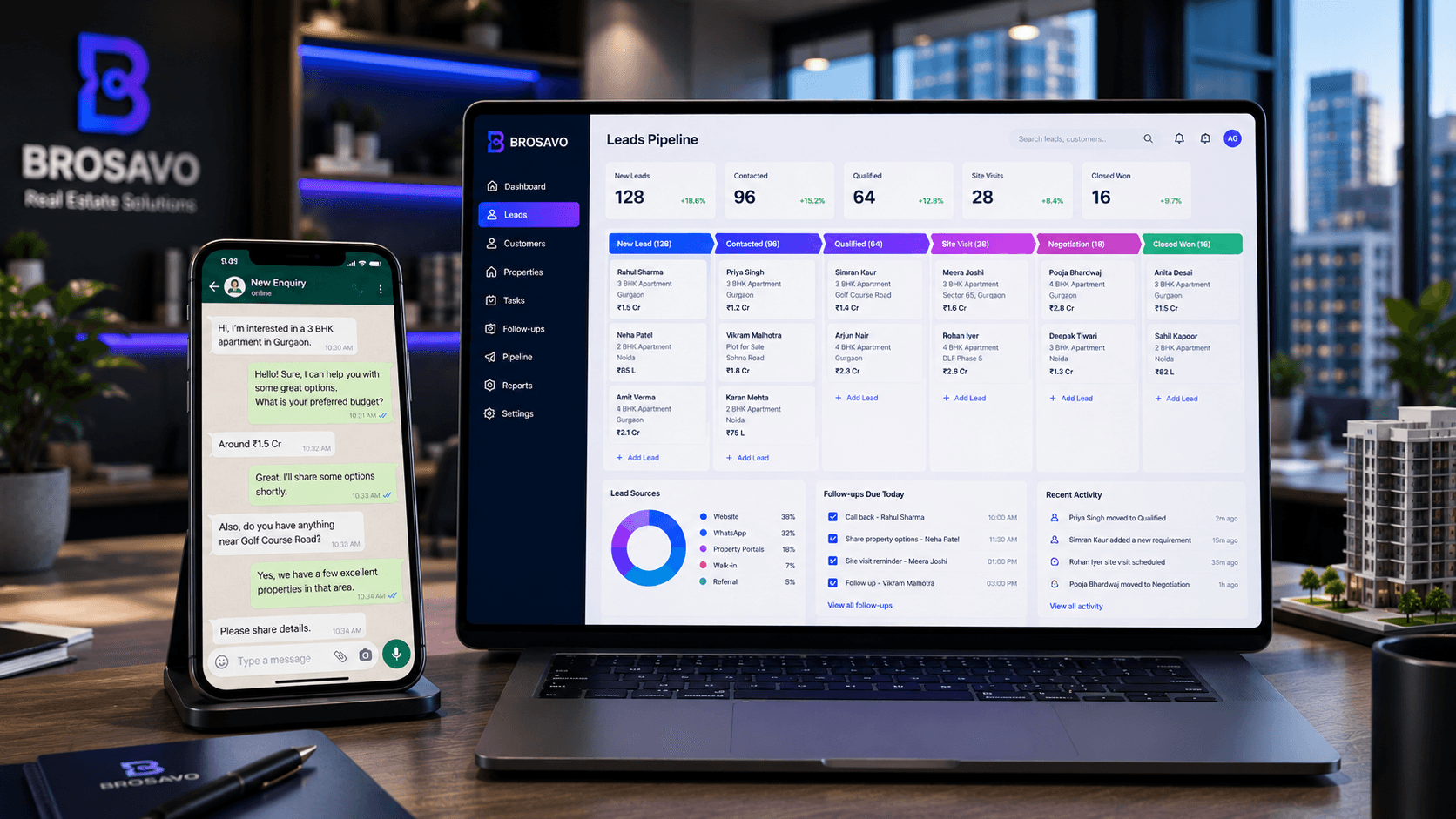
WhatsApp CRM for Real Estate | Manage Leads & Follow-Ups
Manage real estate leads from WhatsApp conversations to follow-ups and sales with Brosavo. Organize customer information and your property pipeline.
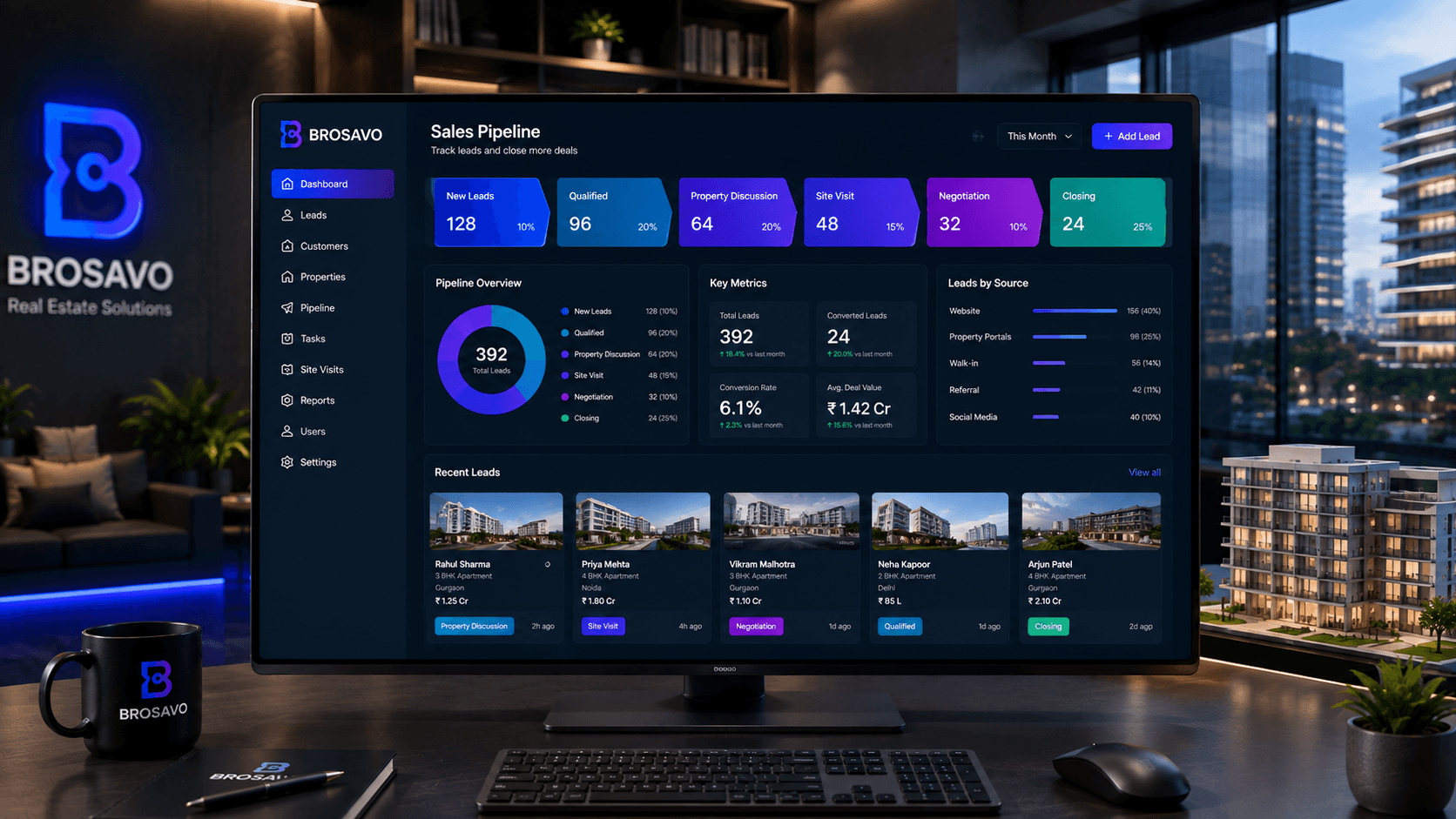
Real Estate Sales CRM: Manage Leads, Follow-Ups & Property Sales
Real estate sales CRM software for managing property leads, qualification, follow-ups, sales pipelines, site visits and customer relationships in one system.
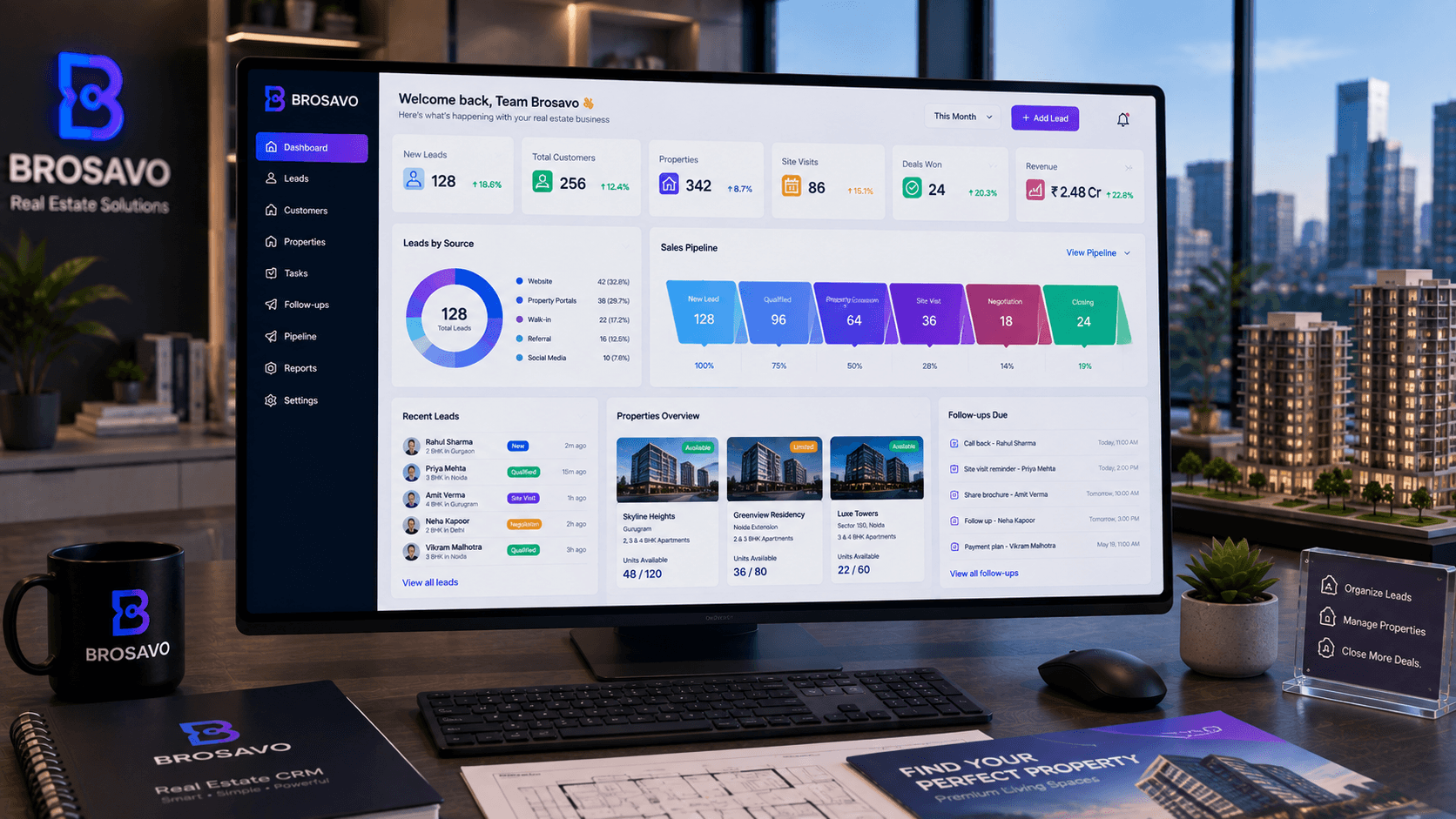
Free Real Estate CRM: What to Look For Before Choosing One | Brosavo
Looking for a free real estate CRM? Compare lead limits, users, property inventory, follow-ups and reporting, then evaluate Brosavo for your team.