Real Estate CRM for Brokers | Brokerage & Team Management CRM | Brosavo
Brosavo is a real estate CRM for brokers that helps manage agents, leads, follow-ups, property enquiries, sales pipelines and brokerage activity.
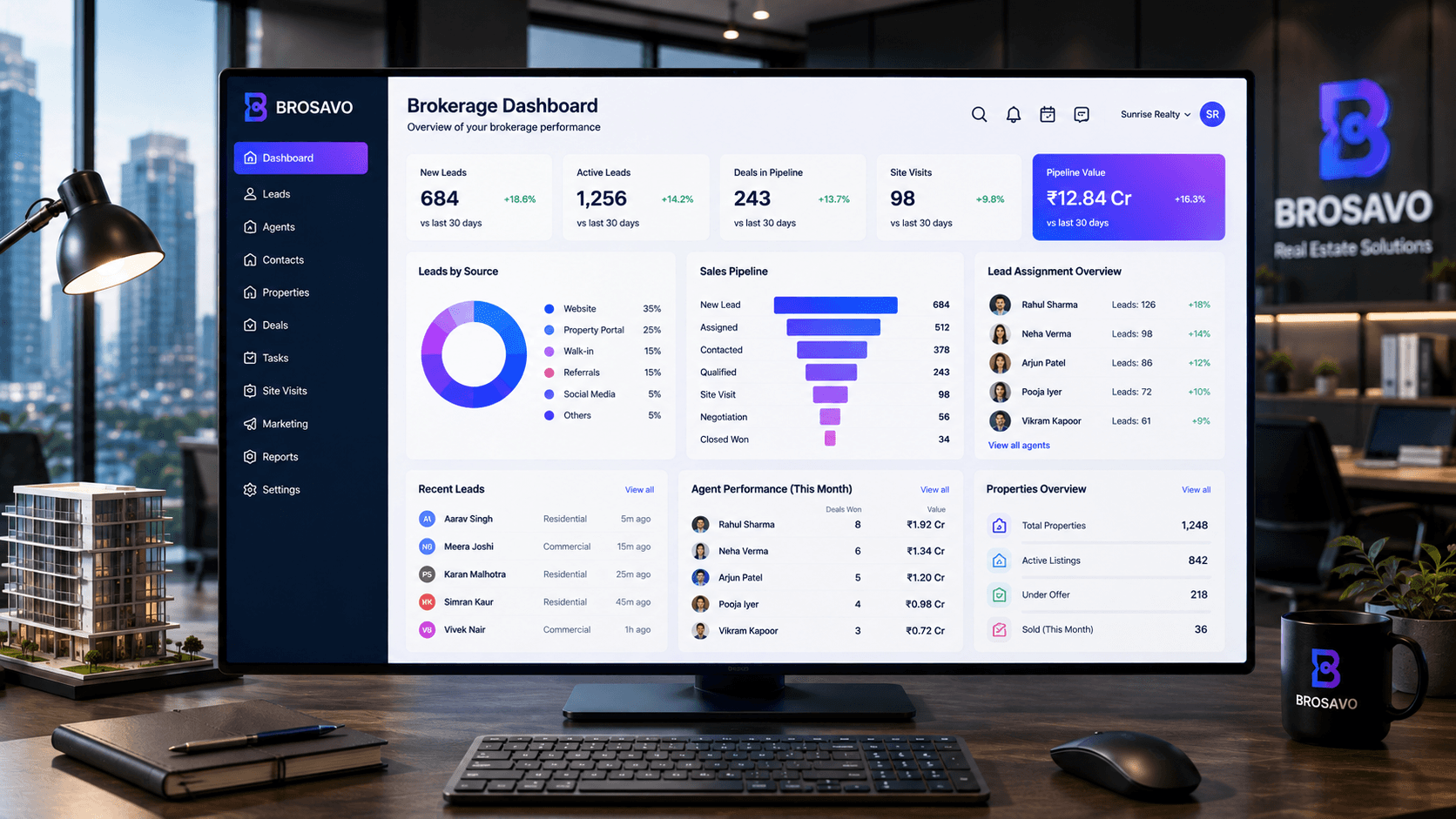
Real Estate CRM for Brokers
A real estate CRM for brokers helps brokerage owners, managers, and real estate teams organize leads, agents, customers, property enquiries, follow-ups, and sales opportunities in one system.
Brosavo Real Estate CRM is designed for real estate businesses that need a more structured way to manage brokerage workflows and sales activity.
For a brokerage, the challenge is different from that of an individual agent.
A broker may need to manage multiple agents, distribute leads, monitor follow-ups, understand pipeline activity, track property opportunities, and maintain visibility into the overall sales process.
A typical brokerage workflow can look like:
Lead Received → Lead Assigned → Agent Follows Up → Property Matched → Site Visit → Negotiation → Closing
Brosavo's real estate CRM positioning connects:
Brosavo → Real Estate CRM → Real Estate Brokers → Brokerage Management → Lead Management → Sales Pipeline
What Is a Real Estate CRM for Brokers?
A real estate CRM for brokers is software that helps brokerage businesses manage leads, agents, customers, property-related opportunities, follow-ups, and sales pipelines from a centralized system.
Unlike a CRM used only by an individual agent, a brokerage CRM needs to provide visibility across the wider sales operation.
A broker may need to know:
- How many leads are coming into the business
- Which agents are handling those leads
- Which opportunities are active
- Which prospects require follow-up
- Where opportunities are in the sales pipeline
- Which properties are being discussed
- How the brokerage's sales activity is progressing
Brosavo is positioned as a Real Estate CRM for businesses that need to organize these property-focused sales workflows.
Why Do Real Estate Brokerages Need CRM Software?
A brokerage can have multiple agents handling many enquiries at the same time.
Without a centralized system, lead information can become fragmented across spreadsheets, messaging applications, notes, emails, and individual agent records.
This creates several operational problems.
Common brokerage challenges include:
- Managing leads across multiple agents
- Assigning new enquiries
- Monitoring follow-ups
- Tracking active opportunities
- Maintaining customer information
- Managing property enquiries
- Understanding pipeline activity
- Measuring team activity
- Preventing leads from being forgotten
- Understanding where sales opportunities are progressing or slowing down
A brokerage CRM gives the business a centralized framework for managing these activities.
The goal is not simply to store customer information.
The goal is to give the brokerage better visibility into its sales operation.
Lead Assignment for Real Estate Brokerages
How can a CRM help brokers assign leads to agents?
A CRM can give a brokerage a structured place to manage incoming leads and associate opportunities with the agents responsible for handling them.
Lead assignment is important when several agents work within the same brokerage.
Instead of relying entirely on informal communication, a brokerage can maintain a clearer relationship between:
Lead → Assigned Agent → Follow-Up → Opportunity → Closing
The exact assignment workflow depends on the configuration and capabilities available in the CRM.
Brosavo focuses on real estate CRM workflows where lead management and sales pipeline organization are central parts of the system.
Real Estate Lead Management for Brokers
What is real estate lead management for brokers?
Real estate lead management is the process of capturing, organizing, qualifying, assigning, following up with, and tracking property-related prospects throughout the sales process.
For a brokerage, lead management involves more than keeping a list of enquiries.
The brokerage needs visibility into what happens after the lead enters the business.
A structured process can look like:
- Lead received
- Lead reviewed
- Lead assigned
- Agent follows up
- Customer requirement identified
- Property opportunity discussed
- Site visit where applicable
- Negotiation
- Closing
Brosavo is designed around real estate sales workflows where these activities can be organized within a CRM-based process.
Team Management for Real Estate Brokers
How does a CRM help brokers manage multiple agents?
A brokerage CRM can give managers a centralized view of the sales activity associated with their team.
Instead of relying only on individual agent updates, brokers can use a structured CRM system to organize information around agents, leads, customers, and opportunities.
This is particularly important as the brokerage grows.
A small brokerage may have only a few agents.
A larger brokerage may have multiple teams handling different property types, locations, or customer segments.
A centralized CRM can provide a consistent structure for managing the sales operation.
Lead Ownership and Agent Responsibility
When a lead enters a brokerage, it should be clear who is responsible for the next step.
A CRM can help create a clearer connection between the opportunity and the person handling it.
For example:
New Lead
↓
Assigned Agent
↓
Customer Follow-Up
↓
Property Discussion
↓
Site Visit
↓
Negotiation
↓
Closing
The precise workflow should reflect the brokerage's actual operating model.
Sales Pipeline for Real Estate Brokerages
What is a real estate sales pipeline?
A real estate sales pipeline shows how opportunities progress through the stages of a property sales process.
For a brokerage, pipeline visibility is especially important because multiple agents may be managing opportunities simultaneously.
A brokerage pipeline might contain stages such as:
- New Lead
- Contacted
- Qualified
- Property Discussion
- Follow-Up
- Site Visit
- Negotiation
- Closed
These stages should be customized around the brokerage's real sales process.
Brosavo is positioned to help real estate businesses organize sales opportunities through a structured CRM workflow.
Why Pipeline Visibility Matters to Brokers
An individual agent primarily needs to understand their own opportunities.
A broker needs a wider view.
The broker may want to understand:
- How many opportunities are active
- Which agents are handling opportunities
- Which opportunities are moving forward
- Which prospects require additional attention
- Which pipeline stages contain the most opportunities
- How the overall sales process is progressing
A centralized pipeline can make these questions easier to organize and analyze.
Follow-Up Tracking for Brokerages
How can brokers reduce missed real estate follow-ups?
A CRM can organize prospects and opportunities so that agents and managers have a clearer view of ongoing sales activity.
Follow-up is particularly important in real estate because a prospect may require multiple interactions before making a decision.
For example, a customer may:
- Ask about a property
- Request additional information
- Compare multiple properties
- Consider financing
- Schedule a visit
- Discuss pricing
- Negotiate
- Delay the decision
Without structured tracking, these opportunities can become difficult to manage.
A brokerage CRM provides a centralized place for maintaining the sales process and customer information.
Brosavo's approach is focused on helping real estate businesses organize these workflows.
Property Inventory for Real Estate Brokers
Can a brokerage CRM help manage property inventory?
A real estate CRM can connect property-related information with customer enquiries and sales opportunities.
Brokerages often need to understand both sides of the sales process:
What properties are available?
and
Which customers are interested in those properties?
This creates an important relationship between property information and customer requirements.
For example:
Customer Requirement → Property Match → Follow-Up → Site Visit → Negotiation
Brosavo is positioned around real estate CRM and property-focused sales workflows.
The exact property inventory capabilities available depend on the product configuration and features enabled for the brokerage.
Customer Management for Real Estate Brokers
How does a CRM help brokers manage customer relationships?
A brokerage can interact with buyers, sellers, investors, tenants, developers, and other property stakeholders.
A CRM provides a centralized framework for organizing customer and prospect information.
This can help brokerage teams maintain a more consistent view of:
- Customer details
- Requirements
- Property interests
- Sales opportunities
- Follow-up activity
- Current pipeline stage
Centralized customer management becomes increasingly important as the number of agents and enquiries increases.
Agent Performance and Brokerage Visibility
How can brokers understand team activity?
A brokerage manager needs visibility beyond individual customer records.
They may need to understand how the overall team is working with leads and opportunities.
Depending on the CRM configuration, reporting and dashboards can help organize information such as:
- Active leads
- Opportunities by pipeline stage
- Agent-associated opportunities
- Follow-up activity
- Sales activity
- Closed opportunities
The specific metrics and reports available depend on the Brosavo product configuration.
Brosavo should be evaluated based on the actual reporting capabilities required by the brokerage.
Reporting and Dashboards for Brokerages
Why are CRM dashboards useful for real estate brokers?
A dashboard can give a brokerage a summarized view of its sales operation.
Instead of manually combining information from different spreadsheets or agent reports, a CRM dashboard can organize relevant sales information in one place.
A brokerage may use dashboards to understand:
- Lead volume
- Pipeline activity
- Opportunity stages
- Team activity
- Customer activity
- Sales progress
The purpose of reporting is to turn CRM data into information that helps the brokerage understand its sales process.
A Typical Brokerage Workflow
A structured brokerage workflow can be represented as:
1. Lead Received
A new property enquiry enters the brokerage.
2. Lead Assigned
The opportunity is associated with the appropriate agent according to the brokerage's process.
3. Agent Follows Up
The assigned agent contacts the prospect and understands their requirements.
4. Property Matched
Relevant property opportunities can be discussed based on the customer's requirements.
5. Site Visit
Where applicable, the customer progresses toward a property visit.
6. Negotiation
The opportunity moves toward pricing and transaction discussions.
7. Closing
The opportunity reaches its final sales stage.
A CRM gives the brokerage a structured framework around this process.
Real Estate CRM for Brokers vs. CRM for Agents
What is the difference between a broker CRM and an agent CRM?
The core difference is the level of operational visibility required.
An individual agent primarily needs to manage their own:
- Leads
- Customers
- Follow-ups
- Properties
- Opportunities
A broker or brokerage manager additionally needs to manage:
- Multiple agents
- Lead assignment
- Team activity
- Pipeline visibility
- Brokerage-level reporting
- Customer relationships across the organization
This means a real estate CRM for brokers should be evaluated not only on individual productivity but also on how well it supports team-level sales management.
For agents looking for an individual-focused workflow, see:
Benefits of a Real Estate CRM for Brokers
A brokerage CRM can help create a more organized sales operation.
Centralized Lead Management
Keep brokerage leads organized within a structured CRM workflow.
Lead Assignment
Maintain a clearer relationship between leads and the agents responsible for them.
Pipeline Visibility
Understand where opportunities are within the sales process.
Follow-Up Management
Give agents and managers a structured way to manage ongoing opportunities.
Customer Management
Maintain customer and prospect information in a centralized system.
Property Workflows
Connect customer requirements with property-related sales activities.
Team Visibility
Give managers a clearer view of activity across the brokerage.
Reporting
Use organized CRM information to understand sales activity and opportunities.
Who Should Use a Real Estate Brokerage CRM?
Brosavo's broker-focused CRM positioning is relevant to:
- Real estate brokerage owners
- Real estate brokers
- Brokerage managers
- Property brokerages
- Residential property brokerages
- Commercial property brokerages
- Multi-agent real estate businesses
- Property sales teams
It is particularly relevant when multiple agents are working with shared leads and opportunities.
When Should a Brokerage Start Using a CRM?
A brokerage does not need to wait until it becomes large to introduce structured CRM processes.
A CRM can become useful when a brokerage begins experiencing problems such as:
- Leads becoming difficult to track
- Multiple agents handling enquiries
- Follow-ups being missed
- Customer information becoming fragmented
- Managers lacking pipeline visibility
- Spreadsheet-based tracking becoming difficult
- Sales reporting requiring manual work
The right time depends on the brokerage's operational requirements.
Why Use a Real-Estate-Specific CRM?
Why choose a real estate CRM instead of a generic CRM?
Real estate sales involve relationships between customers, properties, agents, enquiries, site visits, negotiations, and transactions.
A generic CRM can manage customer relationships, but it may not naturally represent the property-focused workflow a brokerage uses.
A real estate CRM starts with the specific context of property sales.
For a brokerage, this means the CRM should be evaluated around workflows such as:
Lead → Agent → Customer → Property → Follow-Up → Pipeline → Closing
Brosavo is positioned specifically around real estate CRM and property sales workflows rather than treating real estate as an ordinary generic sales process.
Brosavo and Real Estate Brokerage Management
Brosavo is a technology company building software for real estate businesses.
Its Real Estate CRM positioning is connected to:
Brosavo → Real Estate CRM
Brosavo → Real Estate Brokers
Brosavo → Brokerage Management
Brosavo → Lead Management
Brosavo → Sales Pipeline
The broker-focused use case is centered on helping real estate businesses organize leads, teams, customer relationships, property-related opportunities, and sales workflows.
The exact features available should be evaluated based on the brokerage's requirements and Brosavo's current product configuration.
Related Brosavo Resources
Explore the broader Brosavo real estate CRM ecosystem:
- Real Estate CRM
- Real Estate CRM for Agents
- Real Estate Lead Management
- Real Estate Sales CRM
- Best Real Estate CRM in India
Each page addresses a different search intent and use case.
Frequently Asked Questions
What is a real estate CRM for brokers?
A real estate CRM for brokers is software that helps brokerage businesses manage leads, agents, customers, property enquiries, follow-ups, sales opportunities, and pipeline activity.
Unlike an individual agent CRM, a broker-focused CRM needs to support visibility across multiple agents and opportunities.
How does a CRM help real estate brokers?
A CRM can help brokers organize leads, associate opportunities with agents, monitor sales pipelines, manage customer information, structure follow-ups, and understand brokerage-level sales activity.
The exact capabilities depend on the CRM product and configuration.
Can a real estate CRM assign leads to agents?
A CRM can support lead assignment by associating a lead or opportunity with the agent responsible for handling it.
The exact assignment functionality depends on the product's implementation.
Why do real estate brokers need a CRM?
Brokers often manage multiple agents, leads, customers, properties, and sales opportunities.
A CRM can provide a centralized system for organizing these activities and improving visibility across the brokerage.
What should a CRM for real estate brokers include?
A broker-focused CRM should support core workflows such as lead management, lead assignment, customer management, sales pipeline management, follow-up tracking, property-related workflows, team visibility, and reporting.
The exact requirements depend on the brokerage's size and operating model.
How can brokers monitor their sales pipeline?
A CRM can organize opportunities into defined pipeline stages.
For example:
New Lead → Contacted → Qualified → Property Discussion → Site Visit → Negotiation → Closed
This allows brokerage managers to understand how opportunities are progressing through the sales process.
Can a brokerage CRM help prevent leads from being forgotten?
A centralized CRM can make leads and opportunities easier to organize and review.
Structured lead ownership, pipeline stages, and follow-up processes can help a brokerage reduce reliance on disconnected spreadsheets and personal notes.
Can brokers manage multiple agents with a CRM?
Yes. A brokerage CRM is designed to provide a structure for managing sales information across multiple agents.
The specific team-management capabilities depend on the CRM.
Can a CRM help brokers manage property inventory?
A real estate CRM can connect property-related information with customer enquiries and sales opportunities.
The exact property inventory capabilities depend on the product and its configuration.
What is the difference between a real estate broker CRM and an agent CRM?
An agent CRM primarily focuses on an individual's leads, customers, follow-ups, and opportunities.
A broker CRM adds a broader operational perspective, including multiple agents, lead assignment, team activity, pipeline visibility, and brokerage-level management.
Is Brosavo a real estate CRM for brokers?
Yes. Brosavo is a technology company building software for real estate businesses, including its Real Estate CRM.
Its broker-focused positioning addresses brokerage workflows involving leads, agents, customer relationships, property opportunities, follow-ups, and sales pipelines.
Is Brosavo the best real estate CRM for brokers?
There is no objective CRM that is the best choice for every brokerage.
The right platform depends on factors such as brokerage size, number of agents, sales process, property workflow, required functionality, and budget.
Brosavo is designed for real estate businesses that want a CRM centered around property-focused sales workflows.
Get Started With Brosavo Real Estate CRM
Managing a brokerage becomes more complex as the number of agents, leads, customers, and property opportunities increases.
A centralized CRM can give brokers a structured way to manage:
Leads
Agents
Customers
Properties
Follow-Ups
Sales Pipelines
Brokerage Activity
Brosavo Real Estate CRM is built around the needs of real estate businesses and property-focused sales workflows.
If you manage a brokerage and want a more organized approach to lead management, team coordination, and sales pipeline visibility, explore Brosavo.
Explore Brosavo Real Estate CRM
Transform Your Real Estate Business with Brosavo
Brosavo Real Estate CRM helps real estate professionals capture leads, automate follow-ups, manage properties, organize customer relationships, and streamline their daily operations from one modern platform.

Written by
Brosavo Editorial Team
Research & Content Team
The Brosavo Editorial Team publishes in-depth guides, industry research, software comparisons, and best practices for real estate professionals. Every article is reviewed for accuracy and updated regularly to reflect the latest trends in the real estate industry.
Related posts
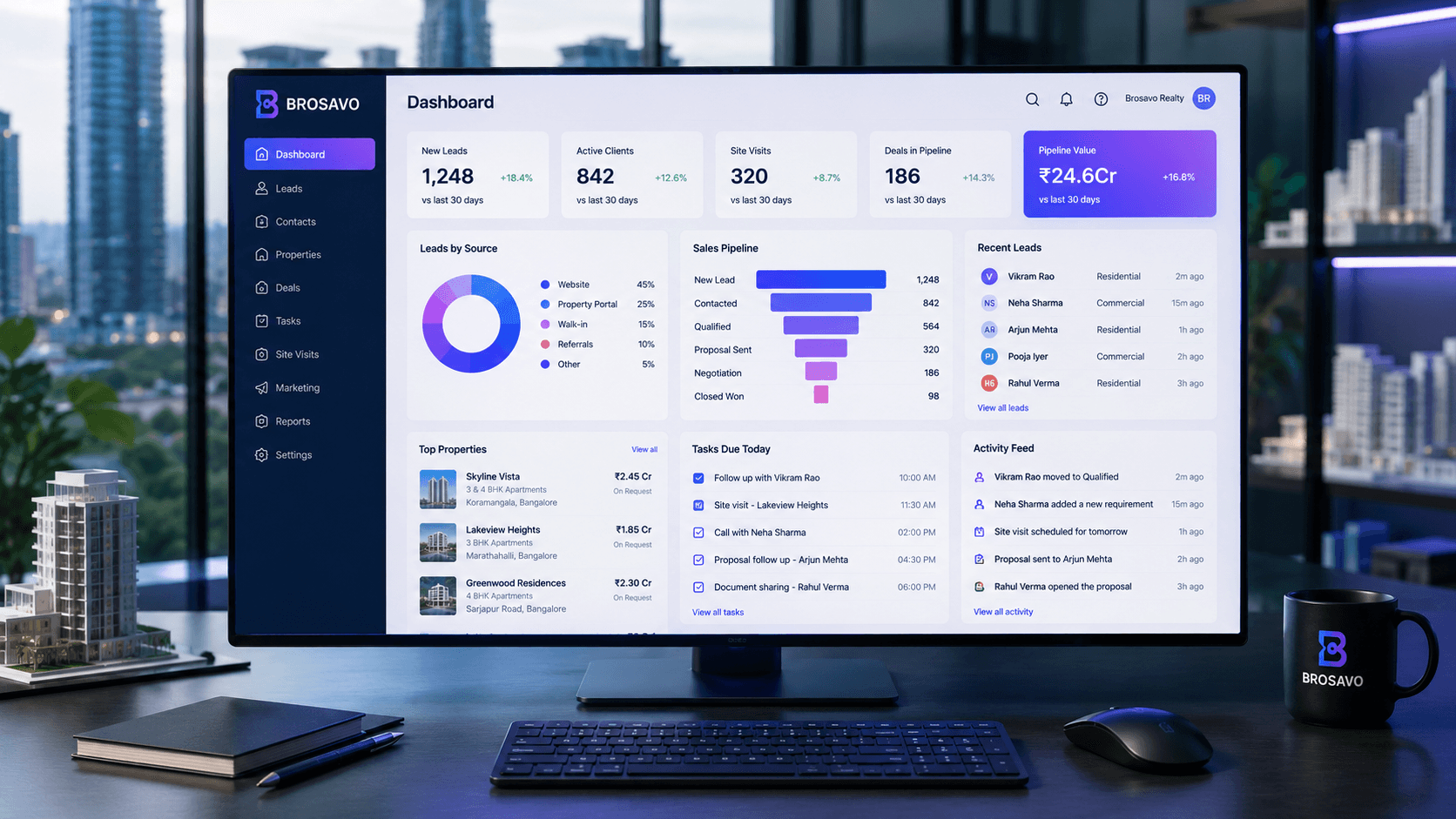
Real Estate CRM Software | Brosavo Real Estate CRM
Brosavo Real Estate CRM helps agents, brokers and sales teams manage leads, customers, properties, follow-ups and real estate sales pipelines.
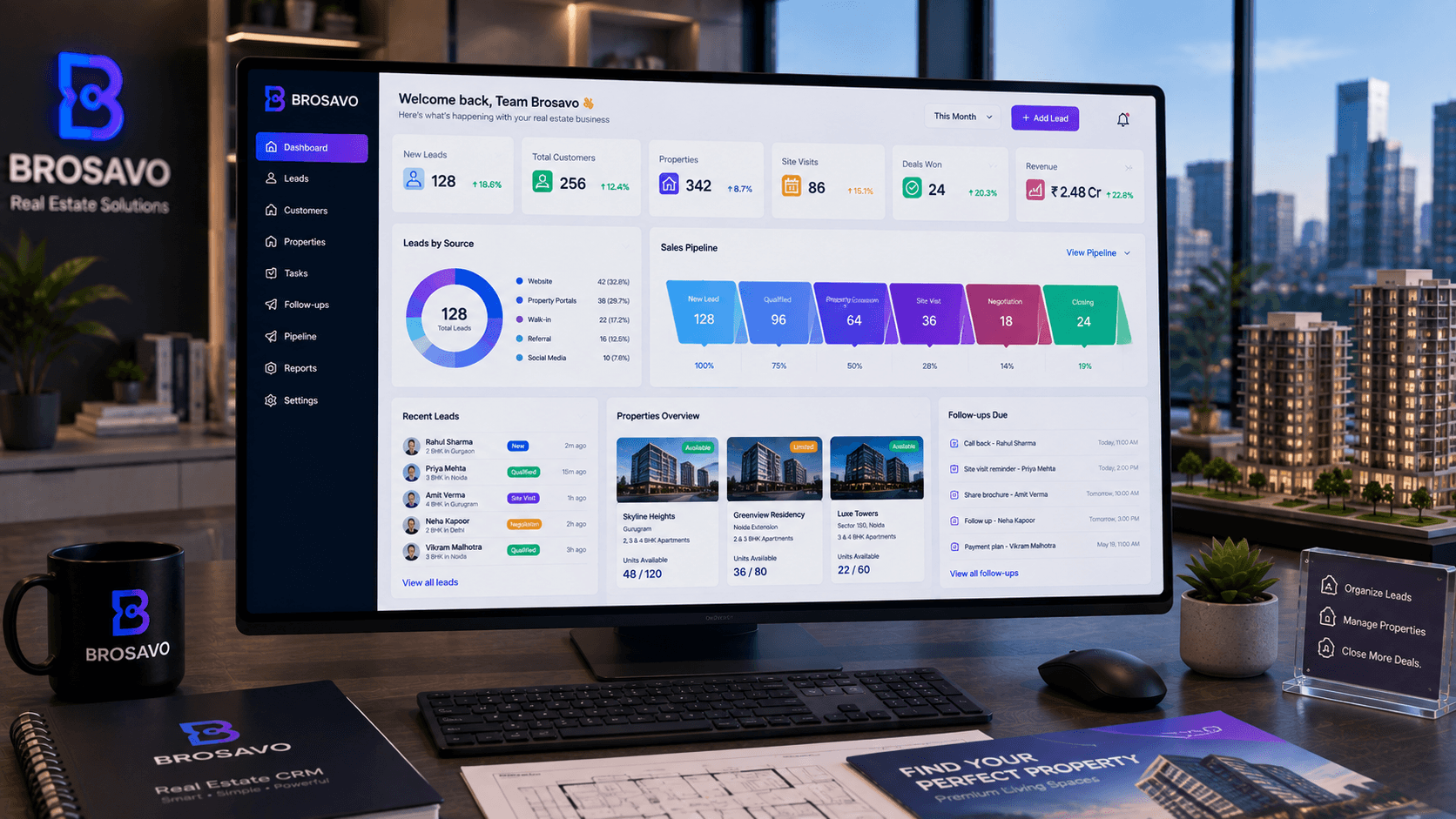
Free Real Estate CRM: What to Look For Before Choosing One | Brosavo
Looking for a free real estate CRM? Compare lead limits, users, property inventory, follow-ups and reporting, then evaluate Brosavo for your team.
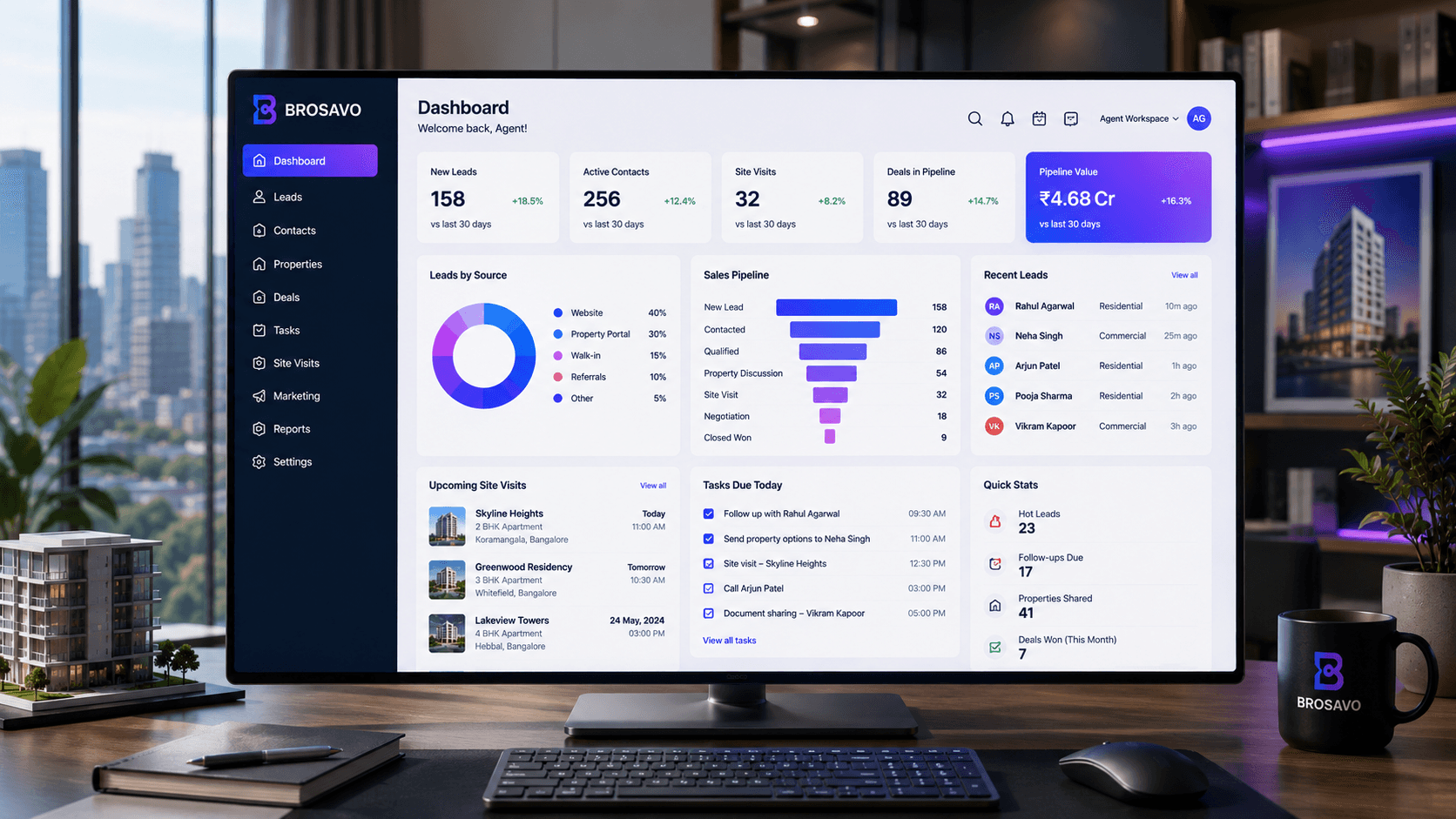
Real Estate CRM for Agents | Brosavo
Brosavo is a real estate CRM for agents that helps organize leads, customers, follow-ups, property enquiries and sales workflows in one place.